
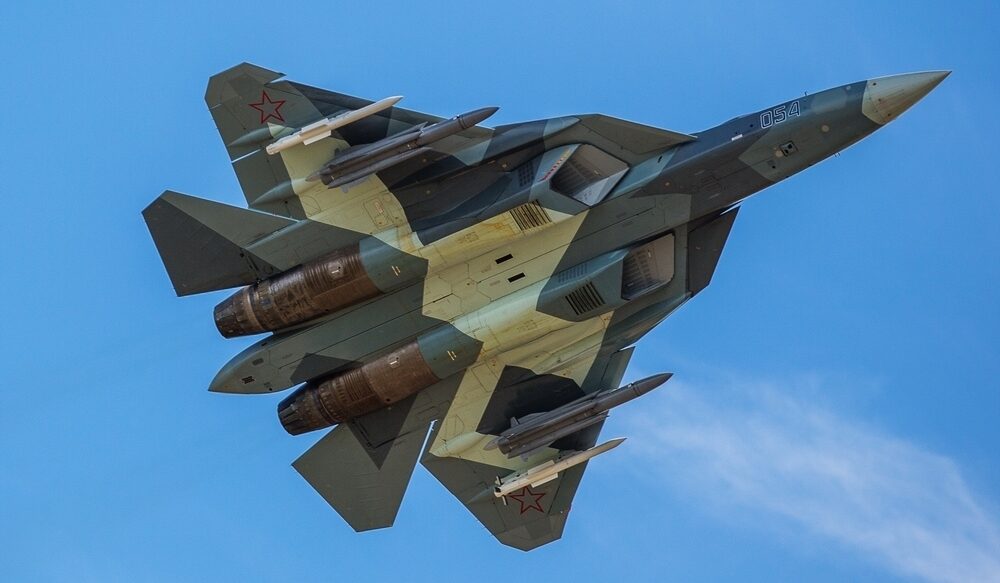
Russian Airforce SU-57 carrying 2x BVRAAM R-37M. Russia Offers R-37M
Russia has reportedly offered India the hypersonic R-37M, its most lethal long-range air-to-air missile. Russia wants to integrate it with the Indian Air Force’s main fleet of Su-30MKI and MiG-29 aircraft. If accepted, the deal could reshape the airpower balance in South Asia. It would sharply improve the IAF’s beyond-visual-range interception capability. Indian fighters could then threaten high-value enemy assets hundreds of kilometres beyond Indian airspace.
The offer comes at a politically and militarily sensitive time, with reports that Pakistan shot down six Indian Air Force jets in a 2025 skirmish with Chinese-supplied PL-15 air-to-air missiles fired from enormous distances. Open-source intelligence and unofficial defense reports suggest that Pakistan Air Force J-10C fighters likely launched PL-15 missiles from ranges exceeding 182 kilometres, far beyond India’s existing BVR inventory. The Russian R-37M, with a strike range of 300-400 kilometres, would enable India to destroy enemy fighters, AWACS, and aerial refuelling aircraft before detection when equipped on the Su-30MKIs.

272-Unit Approved
As of June 2025, the Indian Air Force has some 259 to 262 Su-30MKI aircraft, making up the bulk of India’s air combat inventory. The aircraft are part of an approved acquisition plan for 272 aircraft, with a mix of direct deliveries from Russia and licensed production by Hindustan Aeronautics Limited (HAL) in India. In December 2024, New Delhi reached an agreement to purchase 12 additional Su-30MKI airframes for ₹13,500 crore ($1.5 billion).
These would be assembled in India under HAL’s ‘Make in India’ scheme with more than 62.6 per cent indigenous content. The R-37M, also known as RVV-BD (Raketa Vozduh-Vozduh Bolshoy Dalnosti), is one of the most advanced and lethal long-range air-to-air missiles currently in service. The R-37M is an improved version of the older Soviet-era R-33. That means it now plays well with Russia’s newest interceptors and multirole fighters such as the MiG-31BM, Su-35S and even the stealthy Su-57.
Indian Air Force
More important, engineers designed the missile to hunt down and kill high-value airborne assets. This includes AWACS aircraft, strategic bombers, aerial-refuelling tankers and also fighter aircraft flying in support or at a safe distance. The R-37M is 4.06 metres long, 0.38 metres in diameter, and weighs about 510 kilograms at launch. The R-37M carries a 60-kilogram fragmentation warhead, capable of catastrophic kill effects from a single strike.
The main selling point is its unrivalled range of up to 400 kilometres, making it the longest-ranged AAM in service with any air force in the world. It is powered by a two-stage solid rocket motor which accelerates it to hypersonic speeds of Mach 6+ This extreme speed leaves the opponent with little time to react. It’s a hybrid guidance system with inertial navigation and midcourse updates from a data link.” In the terminal phase an active radar seeker takes over, and the missile is able to hit fast and manoeuvrable targets accurately.
Vympel NPO
Russian missile maker Vympel NPO developed the R-37M, and it was put into full-scale service with the Russian Aerospace Forces. It is mainly used on MiG-31BM interceptors in a strategic anti-AWACS role, designed to cripple NATO’s airborne surveillance and command systems. It is believed Russian forces have used the R-37M in the current Ukraine war. NATO analysts and Western intelligence agencies continue to monitor its performance against Ukrainian aircraft and surveillance platforms.
Operational reports have shown the missile to be reliable even in heavy electronic-warfare conditions. The performance has caught the attention of several air forces, including India’s. India can significantly enhance the range of air-to-air strikes if it gets the R-37M. Indian jets would then be free to attack enemy aircraft before they entered contested or protected areas. This edge can have a profound impact on the air combat scenario in the western and northern borders of India.
R-37M and Su-30MKI
India’s Su-30MKI platforms armed with R-37M missiles could significantly alter the dynamics of any future aerial conflict with Pakistan or China. In a Pakistani theatre, Su-30MKIs armed with R-37M could threaten and destroy PAF airborne early warning assets such as the Saab 2000 Erieye from outside their engagement range. Such an attack would undermine Pakistan’s ability to maintain situational awareness and command coordination in areas of air combat, degrade fighter effectiveness, and create critical gaps in operational command and control.
Su-30s with R-37Ms could engage PAF IL-78 tankers, preventing F-16s and JF-17s from refuelling during combat. India’s fighters have time and space advantages in cutting refuelling chains for prolonged operations against Pakistan’s frontline assets. These Su-30MKIs can target Chinese high-value assets from long standoff ranges in mountainous regions such as Tibet and Aksai Chin. The Chinese KJ-500 AWACS and Y-20 tankers would be in serious trouble without even detecting the Indian jets approaching.
The Integration Challenges
Chinese escort fighters such as the J-10C or J-16s would be vulnerable far beyond their missile engagement ranges. India’s deep-penetration strikes with Rafale, Tejas and Mirage 2000 jets punch through after knocking out their shield. These strike corridors reduce the probability of early detection and interception, thus increasing the chances of mission success and preserving valuable airframes in contested areas. To make India successful, it is necessary to upgrade Su-30MKI radars and procure datalinks to guide the R-37M in real time for long-distance shots.
Without these upgrades, fast-changing air combat situations will not use the missile’s range. However, if India can solve the integration challenge, the Su-30MKI shifts from being a regional fighter to a strategic one. Then it could take on enemy tankers, AWACS and bombers far beyond the reach of Chinese and Pakistani interceptors. Such reach would shift the regional balance of air power, providing India with a first-strike or denial advantage in any crisis.

Conclusion
The Russian R-37M missile represents a dramatic change in the balance of airpower in Asia from a geopolitical perspective. This may compel China and Pakistan to re-evaluate their airborne command and control. They will probably reposition AWACS aircraft as well so they do not fall into the missile’s dangerous engagement envelope. The two countries could also modify their refuelling plans to reduce exposure during combat operations.
This shift may result in new long-range missiles to counter India’s expanding reach. India’s use of the R-37M is a significant shift in the regional airpower paradigm. It shows that range and precision in today’s skies are more than just numbers or size. In modern air combat, the real advantage lies in who shoots first and who shoots farthest.
References
- Asia Times — “India turns to Russian missiles to counter China-backed Pakistan”
- Reuters — “How Pakistan shot down India’s cutting-edge fighter using Chinese gear”
- South China Morning Post — “Could Russian missiles help India counter its arch-rival’s Chinese weapons?”
- U.S. Army ODIN — “R-37M Russian Air-to-Air Missile”
About the Author