

RTX Stock Gains on Missile Demand Backlog
RTX stock is back in the news because investors can now see two supports at once: a substantial backlog and a faster base for making missiles. RTX had a total backlog of $268 billion at the end of 2025, with $107 billion of that coming from defense. Management said sales would be between $92 billion and $93 billion in 2026. That makes the shares’ story about the industry clearer than just a war of trade.
Why RTX Stock Matters Now
RTX stock became more trustworthy after the company reported better fourth-quarter 2025 numbers than many investors had thought it would. Revenue grew to $24.24 billion, adjusted EPS rose to $1.55, and free cash flow rose to $3.2 billion. Raytheon had $7.657 billion in quarterly sales, and adjusted operating profit rose 22% as missile volumes went up for the Patriot, GEM-T, Evolved SeaSparrow, and Tomahawk work.
This news is important because people are no longer only judging RTX stock on what it might do in the future. The company also said that it had $88.6 billion in sales for the whole year of 2025, $7.9 billion in free cash flow, and $138 billion in new awards. This means that it had a book-to-bill ratio of 1.56. To put it another way, RTX didn’t just talk about demand. It made a reservation.
The Backlog Is the Real Story
Still, the best reason to buy RTX stock is the quality of its backlog. Management has a lot of visibility because of a $268 billion backlog, and the defense part alone is worth $107 billion. That matters more to defense investors than a single contract headline because it spreads demand across missiles, radars, engines, and maintenance. It also lowers the chance that one late award will ruin the overall earnings case.
Additionally, the backlog indicates that the business mix is more resilient to shocks compared to a pure-play missile house. In the fourth quarter, Pratt & Whitney did better because there was more demand for F135 engines and repair work. Collins, on the other hand, still made money despite tariff pressure. That mix means that RTX stock can benefit from both the recovery of commercial aerospace and the replenishment of defense.
Missile Demand Rises, Capacity Decides
The next thing to look at for RTX stock is how well it does. RTX said in its 2025 investor presentation that Raytheon increased the production of weapons by 20% across important programs like GEM-T, AMRAAM, and Coyote. Factories connected to the internet now account for over half of all manufacturing hours, according to the company. Those details are important because investors need deliveries, not just signals of demand.
RTX has also gone beyond just talking about missile capacity. Raytheon signed five framework agreements with the Pentagon in February 2026 to increase production of the Tomahawk, AMRAAM, SM-3 Block IB, SM-3 Block IIA, and SM-6. The agreements will raise annual Tomahawk production to over 1,000, AMRAAM to at least 1,900, and SM-6 to over 500.
In March 2026, the company finished a $115 million expansion of its missile integration facility in Alabama. RTX said that the expansion would increase the ability to integrate and deliver by more than 50%. That is relevant for RTX stock because industrial capacity often determines whether backlog becomes cash or just sits on the books. For related context on regional demand and strike dynamics, see Iran War Tests Chinese Air Defense Claims and How the GBU-57 MOP Bunker Buster Works.
Importance of Iran Conflict
The conflict in Iran has clearly made replenishment logic clearer, especially for long-range strike weapons and missile defense. Reuters said on March 27 that the Washington Post said the US had fired more than 850 Tomahawk cruise missiles in four weeks of war with Iran. However, Reuters said it had not checked that number on its own. Even with that warning, the main point is still true: high-intensity use puts pressure on restocking.
But you shouldn’t think of RTX stock as a one-way war headline trade. Reuters also said on April 8 that markets went up after the U.S. and Iran announced a two-week ceasefire. This made oil prices drop sharply and calmed immediate fears in global equities. That is a positive reminder that demand for defense can stay strong even when the market mood changes in the short term. So, investors should keep industrial demand separate from the daily mood of the world.
The Valuation Question
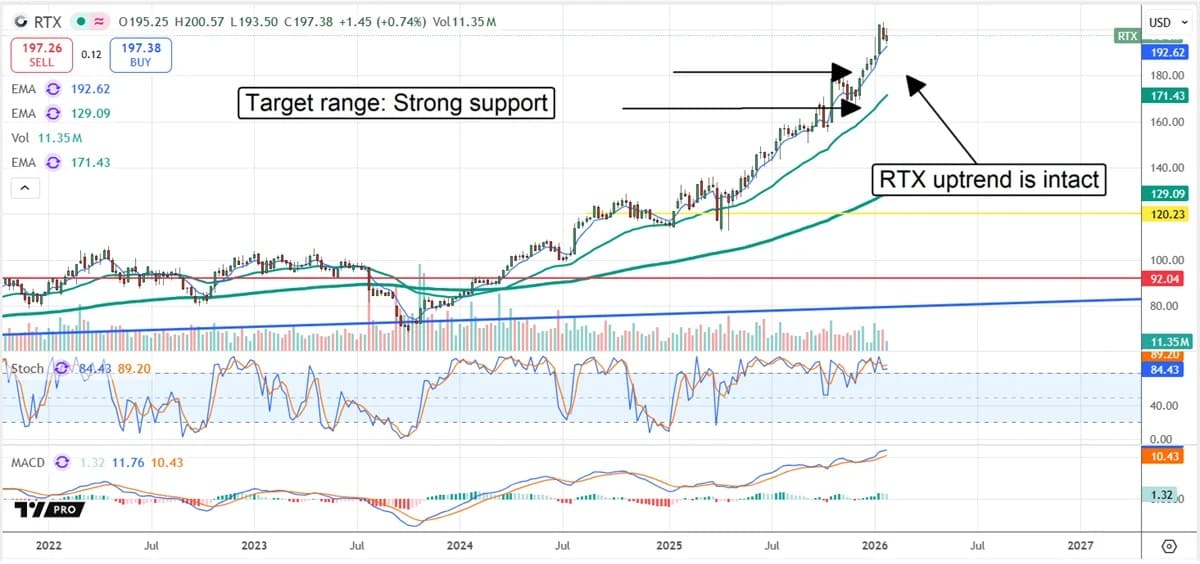
That’s where the case for RTX stock gets more balanced. As of April 8, 2026, RTX was worth $197.92 per share, which gave the company a market cap of about $224 billion and a price-to-earnings ratio of about 34. That is not a low price. Investors are already paying for stronger backlogs, better cash flow, and faster missile production, so the company’s future success will depend on more than just excitement.
Tariffs are still a risk. Reuters said that RTX lost about $600 million in tariffs in 2025. The company said it plans to invest another $500 million in munitions facilities in 2026. That extra spending might help long-term capacity, but it also means that RTX stock needs to keep turning backlog into margin growth if the market is going to reward it more. For readers who want primary source material, see RTX’s 2025 results and 2026 outlook and Reuters’ report on RTX’s fourth-quarter results.
Defense Investors Outlook
My basic view is simple. RTX stock still has a good chance of making money because the company is big, has many orders, is increasing its missile throughput, and is exposed to both the defense and aerospace recoveries. However, the next significant increase is likely to hinge on more than just headlines about conflicts.
It will also depend on on-time delivery, margin discipline, and steady orders for more supplies. For defense readers, the key question to ask right now is whether RTX can keep turning backlog into cash at the same rate that it turns battlefield demand into contracts.
References
- https://defensenewstoday.info/iran-war-tests-chinese-air-defense-claims/
- https://defensenewstoday.info/how-the-gbu-57-mop-bunker-buster-works/
- https://investors.rtx.com/static-files/6d2e2fd9-aa0e-40e2-aa9f-a4051a058306
- https://www.reuters.com/business/aerospace-defense/rtx-posts-higher-quarterly-sales-strong-engine-demand-aircraft-repairs-2026-01-27/
About the Author