
Putin’s India Visit 2025 — Defense Stocks In Focus
Summit and the Markets
Putin’s India Visits Defense Stocks theme is not just a media soundbite; it reflects a real convergence of geopolitics and market positioning. On 4–5 December 2025, Vladimir Putin and Narendra Modi will meet in New Delhi. They will hold the 23rd India–Russia Annual Summit, which usually delivers concrete defense and energy outcomes.
For New Delhi, the summit must balance strategic autonomy. India wants to keep discounted Russian oil flowing. It also aims to sustain its legacy arms relationship with Moscow. At the same time, it seeks deeper ties with the United States and other Western partners.
Moscow’s visit offers a chance to secure long-term defense and trade arrangements. Sanctions are biting, and Russia is tilting further towards Asia. Therefore, any sign of India and Russia moving beyond a simple buyer–seller model will matter greatly. It would immediately shape the narrative surrounding Putin’s visit to India for defense stocks.
Agenda: S-400, S-500 and Su-57
Markets will parse every line of the joint statements for clues on big-ticket systems. Indian and Russian officials have already flagged additional S-400 air-defense squadrons as a core topic, alongside long-delayed upgrades to existing systems.
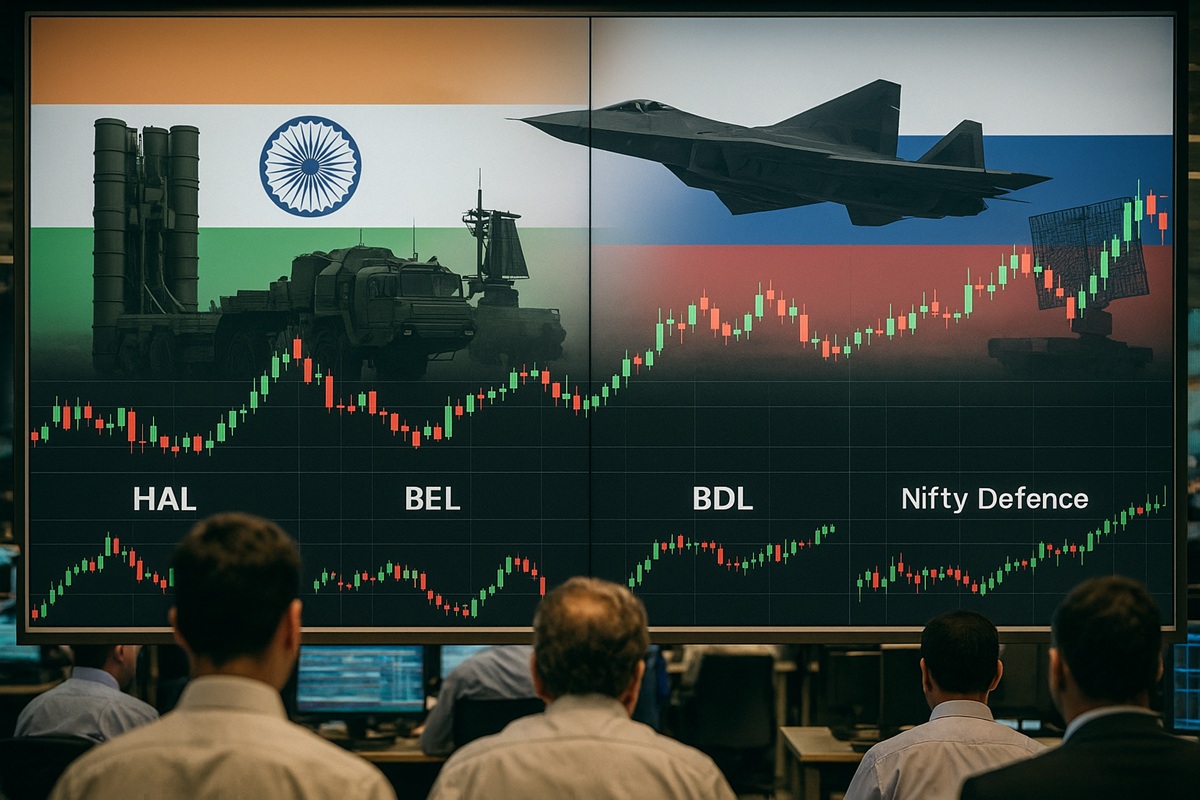
Moreover, Russian proposals now reportedly include up to 50 percent technology transfer for S-400 missiles and associated systems. That structure would allow Bharat Dynamics Limited (BDL) to assemble key missile components in India and accelerate production of the 48N6 series already cleared by New Delhi.
Parallel discussions around the S-500 next-generation air defense system and Su-57 fifth-generation fighter underline a broader strategic intent: India wants more reach, better missile defense, and credible long-range strike options; Russia wants to anchor its high-end export portfolio with a familiar partner.
The S-400 already proved its value during Operation Sindoor in May 2025. Indian air defense systems reportedly enabled long-range precision strikes and reinforced deterrence signals towards Pakistan. That battlefield performance gives New Delhi political cover for further S-400 investment with Moscow. It also strengthens the case for treating Putin’s India visit defense stocks as a multi-year theme.
Why do BEL, HAL and BDL sit at the center?
Hindustan Aeronautics Limited (HAL)
HAL remains the backbone of India’s combat aviation complex. Any plans for acquiring the Su-57, producing it under license, or upgrading the Su-30MKI fleets will likely involve sharing work, maintenance, and integrating avionics at
Consequently, investors will watch for language on:
- The summit could lead to the establishment of licensed production lines, or significant upgrades in India will be key areas of focus for investors.
- Indian weapons, sensors, and software will be integrated into Russian airframes.
- The summit also includes commitments to co-develop future engines or avionics.
Even modest progress in this area can reinforce the long-term earnings visibility that already supports the HAL component of the defense stock narrative related to Putin’s visit to India.

Bharat Electronics Limited (BEL)
BEL operates within the C4ISR and electronic-warfare stack, which enhances the effectiveness of any air or missile defense system. Negotiations on the S-400 and S-500 almost certainly imply follow-on work in:
- The development of long-range surveillance radars and target-illumination systems is likely to be the next step.
- They are establishing secure data links and battle-management networks.
- Command posts are being established to integrate both Russian and indigenous sensors.
Therefore, BEL becomes a natural proxy for India’s ambition to convert imported “hardware” into an integrated, domestically controlled air-defense architecture.
Bharat Dynamics Limited (BDL)
For BDL, the summit could be pivotal. Current proposals would push the transfer of S-400 missile technology to about 50 percent. They include local assembly of critical missile rounds, directly expanding BDL’s order book and know-how. In addition, any co-production deals for future surface-to-air or air-to-air missiles would strengthen BDL’s role as India’s primary tactical-missile house. That is why many analysts frame BDL as the purest play in Putin’s India visit defense stocks basket.
Market scenarios
In the near term, investments in HAL, BEL, and BDL will be influenced by perceived “headline risk” and the specifics of any deals.
- Bullish scenario: India announces additional S-400 squadrons with formalized technology transfer, a clear pathway for S-500 evaluation, and a structured Su-57 negotiation track. The market would likely reward HAL, BEL, and BDL, while also benefiting private supply chain companies.
- Base case: The summit confirms intent, frameworks, and joint statements but defers binding contracts to 2026. In this case, defensive public sector undertakings (PSUs) may still outperform the broader index; however, some of the pre-summit rally could fade.
- Risk case: If the US strongly signals sanctions or CAATSA-style measures, it could overshadow the summit’s positive image, leading to lower valuations for emerging-market defense stocks
Crucially, Russia remains India’s largest single defense supplier, even though its share of imports has dropped from over 70 percent a decade ago to around one-third today as New Delhi diversifies. This situation creates both opportunities and vulnerabilities for investors who are focusing on defense stocks during Putin’s visit to India.

Investors should track
Serious defense investors and strategists will not trade this story based on headlines alone. Instead, they will watch for:
- Contract structure, not just volume
Technology-transfer percentages, localization clauses, and export controls will matter more than nominal deal size. A 50 percent local content requirement changes earnings trajectories very differently from a simple off-the-shelf purchase. - Signal on strategic autonomy
India’s willingness to deepen Russian defense ties while simultaneously pursuing US-origin systems like javelins and Excalibur artillery shells shows a deliberate multi-vector strategy. The market will assess how effectively New Delhi can maintain that balance. - Knock-on effects across the ecosystem
Subsystem suppliers, software houses, and private missile-component firms will read the same communiqués and plan capacity accordingly. This is where India’s long-term defense-industrial base either accelerates or stalls.
For additional strategic context, readers can revisit Defense News Today’s analysis of Russia’s Zircon hypersonic missile programme. A separate article breaks down Ukraine’s Gripen fighter roadmap and its implications for future airpower coalitions.
Conclusion
In summary, the theme of Putin’s visit to India for defense stocks intersects with both balance sheet realities and grand strategy. The summit will not decide India’s entire defense trajectory, but it can meaningfully steer where capital, technology, and political attention flow over the next decade.
If New Delhi gets better technology transfers for the S-400, clear ways to assess the S-500, and reliable options for making or upgrading the Su-57, HAL, BEL, and BDL could become the top choices. If, instead, geopolitical pushback and risk premia dominate, the story may evolve into a slower, more selective re-rating of India’s defense complex.
Either way, this visit will show whether India and Russia can translate legacy dependence into a more modern, mutually beneficial defense-industrial partnership—one that investors can value, rather than simply assume.
About the Author