

Poland GNOM loitering munition
Why GNOM matters now
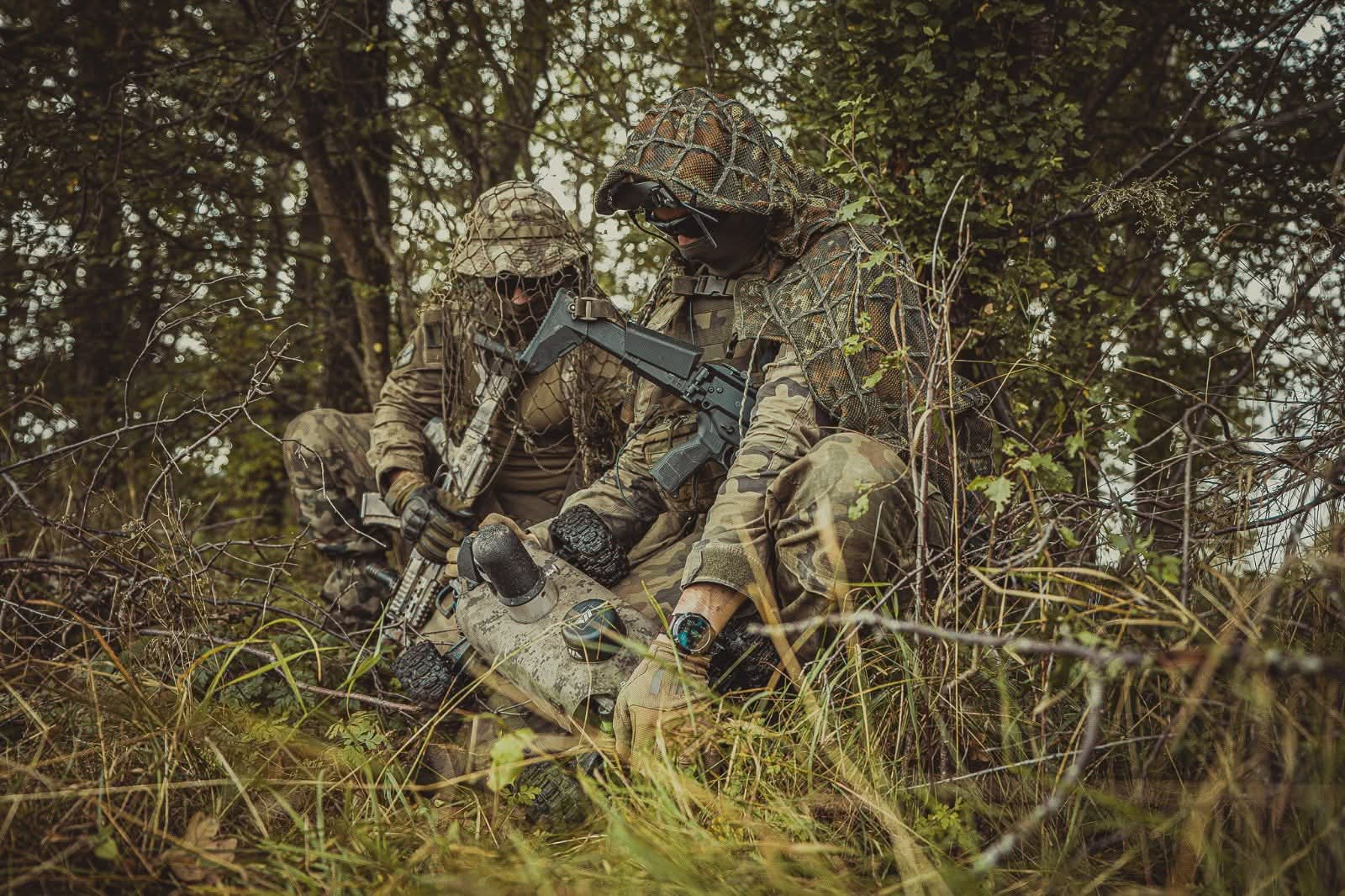
Poland’s GNOM loitering munition is designed to blunt armoured assaults before they hit the line of contact. Rather than flying overhead, the platform hugs the ground, uses a tiny profile, and strikes with purpose-built anti-armour warheads.
Therefore, units can shape the fight sooner and at lower cost than with man-portable ATGMs or expensive airpower. For a European theatre facing massed armour, the Poland GNOM loitering munition addresses a real operational gap.
From trials to tactics
Tested during Iron Gate 25 with Poland’s 18th Mechanized Division, GNOM completed a week of mountain training for operators and then executed scripted missions at Orzysz. As a result, crews validated rapid handover from training to operations in difficult terrain.

According to MACRO-SYSTEM leadership, GNOM handled reconnaissance, kinetic strikes, and command-post raids under demanding conditions. Consequently, the Poland GNOM loitering munition moved beyond lab demos into formation-level drills.
Ground-hugging, not air-launched
Unlike aerial loitering munitions, GNOM rides on wheels. This choice brings several advantages:
- Stealth and survivability: a low, ground-skimming profile reduces visual and radar exposure.
- Precision routing: operators can thread the Poland GNOM loitering munition through dead ground, roadside cover, and rubble.
- Ambush utility: teams can pre-position the platform along likely armour avenues of approach and trigger at the decisive moment.
Moreover, ground movement simplifies logistics; small teams can deploy GNOM without specialised launchers or airspace coordination.
Effects against armour
GNOM fields a warhead optimised for disabling tanks and APCs before they breach defensive lines. During the exercise, the platform simulated the destruction of representative targets (including a Rosomak and a light utility vehicle) and conducted diversionary attacks beneath stationary assets.
Therefore, the Poland GNOM loitering munition demonstrated both frontal disruption and deep ambush roles. While specific penetration figures remain undisclosed, the intended effects align with anti-armour and mission-kill outcomes.
Fibre-optic assurance in EW
Electronic warfare defines modern battlefields. To counter jamming, GNOM offers dual-mode control:
- RF remote link for routine operations.
- Fibre-optic tether with up to 5 km range for contested environments.
Because the cable maintains a hard link, operators preserve command even under heavy interference. The vehicle’s very low operating height further degrades enemy jamming effectiveness. Consequently, the Poland GNOM loitering munition remains controllable where many aerial drones lose links.
Mission set: beyond a single trick
During Iron Gate 25, GNOM executed four core mission types that map well to modern combined-arms doctrine:
- Precision strikes on armoured targets to achieve mobility kills or catastrophic effects.
- Command-post raids using fibre-optic control for near-silent approach.
- Diversionary operations beneath vehicles and static nodes to sow confusion.
- Reconnaissance and observation in support of manoeuvre, including route confirmation and flank security.
Because the platform can recon first and strike later, it compresses kill chains. In practice, this means the Poland GNOM loitering munition can hand off target data to mortars, artillery, or ATGM teams—or finish the job itself if conditions allow.
A force multiplier for brigades
Traditional counter-armour options impose trade-offs:ATGMs force teams into forward, exposed positions; attacking aviation is scarce and expensive; artillery needs precise targeting and favourable rules of engagement. By contrast, GNOM offers persistent, low-signature presence near likely axes of advance.
Consequently, brigades gain continuous interdiction at the tactical edge. Moreover, multiple platforms can swarm or stagger attacks, amplifying delay and disruption. In this way, the Poland GNOM loitering munition acts as a force multiplier for infantry and mechanised forces.
Integration with larger UGVs
MACRO-SYSTEM also fielded GOBLIN, a larger UGV for reconnaissance, logistics, and support. It towed loads up to 16 tonnes, conducted route recce, supported medical evacuation in MASCAL drills, and teamed with Rosomak APCs.
Because GOBLIN extends endurance (around 20 hours per battery charge) and payload capacity, it complements the Poland GNOM loitering munition. Together, they illustrate a layered unmanned approach: small strike assets up front, multi-role support behind.
Cost, scale, and export interest
Operational relevance often hinges on cost curves and manufacturability. GNOM’s compact form and simplified deployment suggest a favourable cost-per-effect compared with air-launched loitering munitions. Additionally, MACRO-SYSTEM reports growing foreign interest, including Scandinavian demonstrations, activity in France and the Baltics, and strong Asian enquiries after MSPO Kielce.
Importantly, proposed local production could enable partners to scale inventories rapidly while preserving supply resilience. Therefore, the Poland GNOM loitering munition could proliferate as a budget-sensible answer to massed armour.
Doctrine: shaping before contact
Future land battles will mix armoured thrusts, dense EW, and attrition-minded manoeuvres. In that environment, small, smart, and stealthy ground-launched munitions let defenders shape the approach march—cutting columns into packets, forcing route changes, and buying time for counter-attacks.
Because GNOM operates forward with a low signature, it can start that shaping early and keep pressure on until heavier assets arrive. Consequently, the Poland GNOM loitering munition fits emerging doctrine that prizes distributed effects and deception over single-axis firepower.
Limits and next questions
No system is invulnerable. Terrain can obstruct routes, hard obstacles can impede progress, and active protection systems (APS) on tanks pose a dynamic challenge for designers. However, tactics can adapt: multi-vector attacks, decoys, timed diversions, and coordination with top-attack munitions all increase the odds.
Therefore, the practical question is not “perfect interception” but integration—how commanders weave the Poland GNOM loitering munition into reconnaissance, artillery fires, EW, and deception plans. Continued trials should surface data on reliability rates, sustainment loads, and optimal team structure.
References
About the Author