

Pentagon Rolls Out ChatGPT on GenAI.mil
Pentagon’s AI Desktop Moment
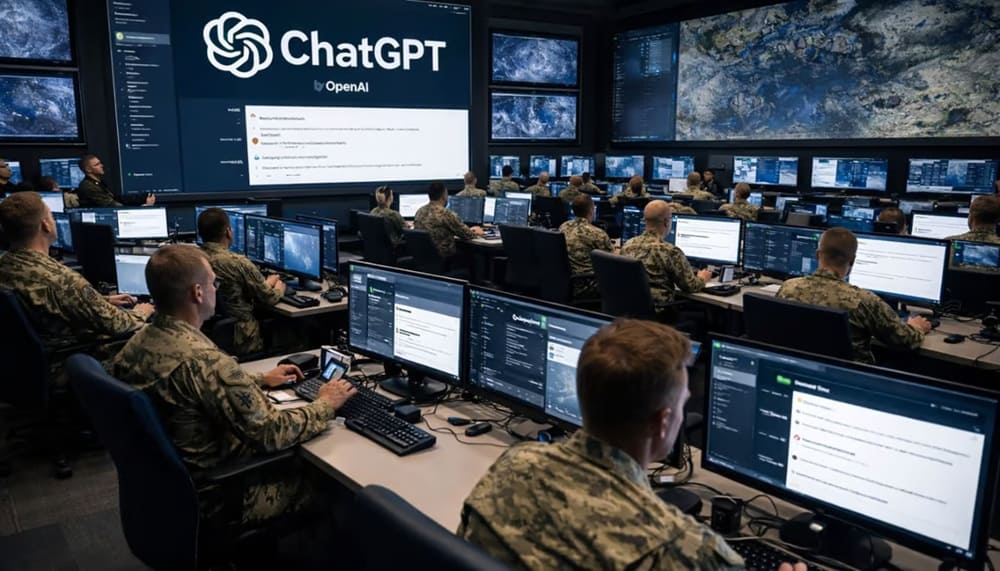
The Pentagon has moved fast on GenAI.mil, and it just added another heavyweight. On Monday, 9 February 2026, the Department of Defense confirmed it will roll ChatGPT on GenAI.mil out alongside Google’s Gemini and xAI’s Grok. That matters because scale changes behavior. The platform targets 3 million uniformed personnel, civilian employees, and contractors.
Why GenAI.mil Exists
The Defense Department did not build GenAI.mil to impress people with demos. Instead, it built the site to normalize daily, low-friction AI use across staff work and operational support. In December 2025, the Pentagon launched the platform with a government version of Google Gemini designed for sensitive but unclassified work. Since then, adoption has spiked. Breaking Defense reports the site claims 1.1 million unique users, with no major downtime since launch.
Built for Multiple AI Models
From the start, GenAI.mil aimed to host multiple frontier models rather than bet on one vendor. First came Gemini in early December 2025. Then, three days before Christmas (22 December 2025), the Pentagon announced it would add xAI’s Grok through an IL5 path, explicitly tying it to workflows that handle Controlled Unclassified Information (CUI). Now, the Pentagon has added ChatGPT. Therefore, the platform looks less like a single tool and more like an enterprise “AI shelf” where teams can pick the best model for the job.
Why “Secure but Unclassified” Matters
The Pentagon establishes a clear distinction between sensitive but unclassified use and fully classified work. GenAI.mil currently operates on the lower side of that boundary. In practice, that still covers a lot of real work: policy memos, acquisition documents, compliance checklists, internal reporting, and planning material that must stay protected but does not carry Secret or Top Secret markings. However, moving these models into Secret and Top Secret environments remains a much higher hurdle. The Pentagon has signaled interest, but it has not claimed that capability yet.
OpenAI’s DoD-Ready ChatGPT
OpenAI frames this as a custom version of ChatGPT running inside authorized government cloud infrastructure, with platform-level safety controls. It also makes a central promise that defense users care about: data stays isolated in the government environment and does not train OpenAI’s public or commercial models. OpenAI also lists practical mission-support use cases rather than flashy “war AI” claims. For example, it highlights the tasks of summarizing guidance, drafting procurement and contracting materials, and generating internal reports and checklists.
Adoption at Scale: Culture Shift
GenAI.mil has not spread quietly. Reports describe Pentagon messaging that pushes personnel to actually use the platform, including prominent posters that echo Uncle Sam-style recruitment visuals. That kind of internal campaigning signals something bigger than IT modernization. It signals a cultural push to treat generative AI as a standard office capability—like email, search, or shared drives—rather than a niche experiment.
$200M Contracts Behind the Rollout
This rollout sits on top of a broader procurement wave. In June 2025, the Pentagon’s Chief Digital & AI Office awarded OpenAI a contract with a ceiling of up to $200 million tied to prototyping frontier AI for defense needs. Moreover, reporting indicates the Pentagon moved to similar ceiling-value agreements with other frontier labs, which helps explain why GenAI.mil keeps adding providers rather than locking into one.

Will GenAI.mil Add Claude Next?
Pentagon officials have avoided firm commitments on a fourth model. However, they have left the possibility open. If GenAI.mil expands again, Anthropic’s Claude looks like the most straightforward addition, because it remains the major frontier model not currently listed on the platform.
Yet Claude also comes with fresh scrutiny. In late 2025, Anthropic revealed and talked about a spying operation that used AI to help with cyber attacks, which started a big discussion in the industry about safety measures and the risks of misuse. Therefore, the Pentagon’s next move will likely balance capability diversity against cyber risk optics.
Conclusion
GenAI.mil has transitioned from being a pilot project to becoming the Pentagon’s primary AI gateway. By adding ChatGPT alongside Gemini and Grok, the DoD is signaling that choice, scale, and secure handling of sensitive-but-unclassified work matter more than vendor loyalty.
More importantly, the platform’s early uptake suggests people will actually use it when leadership removes friction and sets clear guardrails. The real test now is discipline: keeping CUI protected, training users to write clean prompts, and auditing outputs like any other staff product. If the Pentagon gets that right, AI becomes routine—quietly boosting speed, clarity, and decision support.
References
- https://breakingdefense.com/2026/02/chatgpt-will-be-available-to-3-million-military-users-on-genai-mil/
- https://openai.com/index/bringing-chatgpt-to-genaimil/
- https://breakingdefense.com/2025/12/pentagon-rolls-out-genai-platform-to-all-personnel-using-googles-gemini/
- https://www.reuters.com/world/us/openai-wins-200-million-us-defense-contract-2025-06-16/
About the Author