
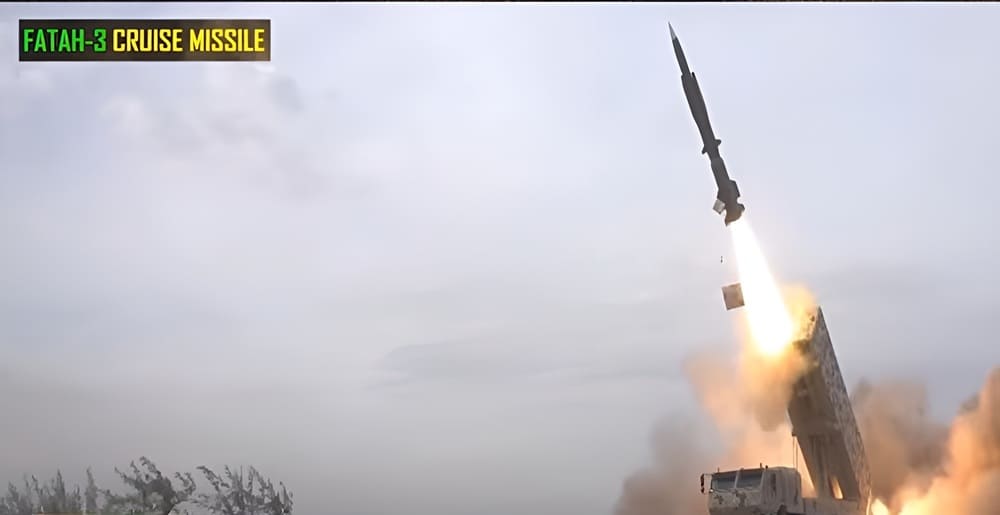
Fateh-3 Supersonic Cruise Missile
Pakistan’s claimed Fateh-3 supersonic cruise missile represents a move to a faster class of conventional precision strike. It is probably intended for high-speed penetration, quick reaction, and anti-access rather than as an artillery rocket or a slower terrain-following cruise missile.
However, Pakistan has not issued a full official technical datasheet. As such, these figures are to be considered as reported specifications, not confirmed figures of performance. However, the profile claimed pits the Fateh-3 against the BrahMos missile, which CSIS describes as a ramjet-powered supersonic cruise missile with a range of 300-500 km depending on the variant and launch platform.
Importance of Ramjet Propulsion
What is said to be the main feature of the Fateh-3 supersonic cruise missile is its ramjet propulsion. Usually a missile of this type first needs a solid rocket booster to reach supersonic speed. Then the ramjet sustainer lights and burns fuel with the incoming compressed air. Thus, the missile can fly at high velocity for a longer flight profile.
The main advantage of this design is its simplicity. The missile does not have to carry an oxidizer during the cruise phase. This allows for more efficient high-speed operation than a pure rocket-powered weapon. But ramjets also require accurate inlet design, thermal control and stable combustion at high dynamic pressure
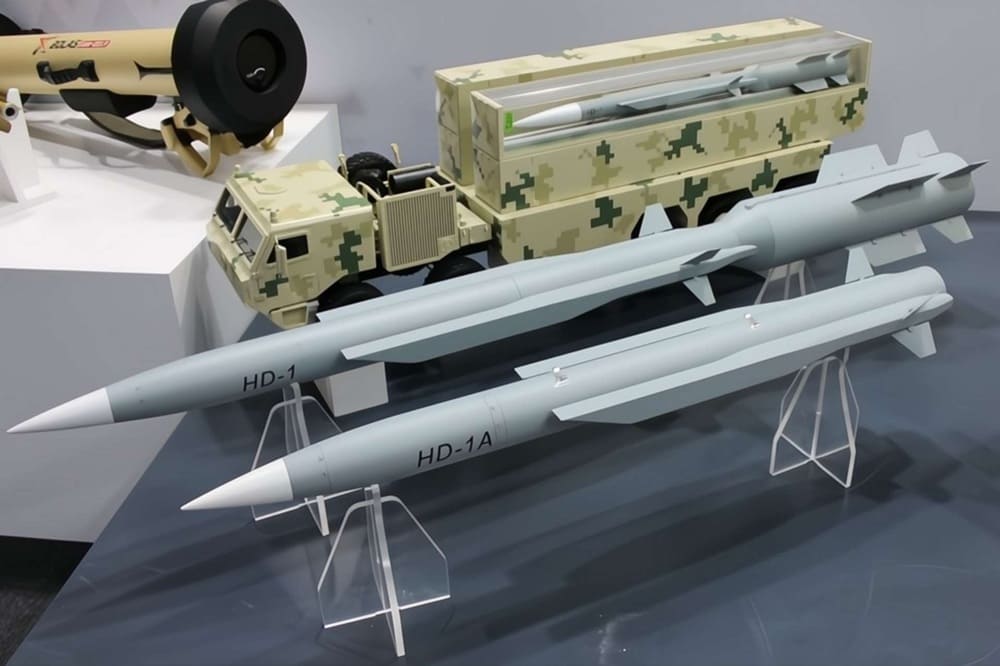
China’s HD-1 is a useful technical comparison. The HD-1 had a maximum range of 290 km, a speed of 0.75-1.2 km/sec, and a sea-skimming altitude of 4.8-9.7 m, CSIS said. The HD-1 used inertial navigation, satellite guidance, and radar plus infrared terminal guidance, Army Recognition said. The details closely resemble the Fateh-3 profile currently being discussed in defence circles.
Fateh Missile Family
| Missile | Type | Range | Reported Specs | Status | Remarks |
|---|---|---|---|---|---|
| FATAH-I | Guided MLRS / surface-to-surface rocket | ≥140 km | CEP <50 m; 8 rockets per launcher; conventional precision strike role | Confirmed | Official GIDS listing confirms range, accuracy, and launcher capacity. (GIDS) |
| Fatah-series 120 km test | Surface-to-surface missile / likely short-range Fatah-series round | 120 km | Enhanced navigation and better tested accuracy | Confirmed test, not a separate family member | Do not list it separately as “Fatah-I Expanded. Consider it a test/training launch in the Fatah series. (Radio Pakistan) |
| FATAH-II | Guided Rocket System / GMLRS-style surface-to-surface missile | 400 km domestic figure | Advanced navigation, unique trajectory, maneuverable features and precision deep strike role | Confirmed / inducted | ISPR-linked reporting and AP give an operational range of 400 km. GIDS also lists a development/export style Fatah-II with shorter range and INS/GNSS guidance, so don’t confuse export with domestic specs. (Associated Press of Pakistan) |
| FATAH-III | Reported supersonic cruise missile / HD-1-style system | Reported around 290–400 km | Reported ramjet/supersonic profile; BrahMos-style role claimed | Reported / not fully verified by official written specs | Please keep this row, but ensure it is labeled properly. Public reporting states that it was revealed as a supersonic cruise missile. I could not locate a clean official ISPR/GIDS spec sheet. (Defence Security Asia) |
| FATAH-IV / Fatah-4 | Ground-launched cruise missile | 750 km | Modern avionics Modern navigation aids Terrain following flight Precision strike | Confirmed / newly inducted | This is a different cruise-missile branch under Army Rocket Force Command, not a guided MLRS like Fatah-I/II. (Dawn) |
Range and Payload Profile
What makes the Fateh-3 supersonic cruise missile most disturbing is its reported speed of Mach 3-4. Mach 3 means that the missile is moving at about a kilometer a second. That speed reduces reaction time for radar detection, classification, tracking, and interception.
The range of 290–400 km reported would put the Fateh-3 into the theater-strike category. It would not replace longer-range cruise missiles such as the Fatah-4, which AP said had a range of 750 km and a terrain-hugging flight profile. Not so. Fateh-3 would be used for a different purpose: quick, high-pressure strikes against time-sensitive or heavily defended targets.
Equally relevant is its alleged payload of 240–400 kg. Heavier payload equals more lethality against warships, hardened sites, logistics nodes, and air base infrastructure. Additionally, it’s got a high terminal velocity, so it has a kinetic effect before the explosion. The combination makes supersonic weapons dangerous even with conventional warheads.
Sea-Skimming and Anti-Ship Value
Fateh-3’s sea-skimming terminal profile makes it relevant against ships. At very low altitudes, the missile can hide below the radar horizon for much of its approach. Therefore, shipborne sensors may not be able to detect it in time, particularly in the littoral clutter.
But anti-ship warfare is not solely about missile speed. Pakistan would need a reliable network of targets. We need maritime patrol aircraft, drones, coastal radars, satellites, and electronic intelligence assets to locate, classify, and keep target positions up-to-date. Without this kill chain, a fast missile can not take advantage of its range.
So Fateh-3 should be considered in the context of a larger system. The missile requires command and control links, pre-launch target data, and terminal seeker performance. The real value will lie in how Pakistan integrates these components under the command of the Army Rocket Force.
Seeker, Guidance and Accuracy
A modern missile of this class would probably use multi-layer guidance. Once launched, inertial navigation would keep it on track. Satellite navigation may be useful for mid-course corrections. Finally, in the attack phase, the terminal seeker would focus on the target.
For a land attack, the missile can use radar, infrared, or terrain-referenced logic. The most probable means of maritime attack remains active radar. Meanwhile, chaff can jam and decoy and confuse radar seekers. Therefore, a dual-mode seeker would provide improved survivability and target discrimination.
And this is where technical maturity comes in. Speed is not the same as accuracy. A missile has to keep its lock on the target while flying fast, low, and under heavy electronic pressure. It also has to contend with sensor noise, heat, and vibration in the terminal phase.
Fateh-3 (HD-1) vs BrahMos (P-800 Oniks)
Inevitably, the Fateh-3 supersonic cruise missile will be compared with BrahMos. BrahMos is a mature, combat-ready family of land, sea, and air launch platforms. It also benefits from the long development experience of India and Russia.
The missile has a flight range of up to 290 km and maintains supersonic speed throughout the flight, says BrahMos Aerospace. CSIS lists the BrahMos in ship- and ground-launched versions, with a solid booster, a liquid-fuel ramjet sustainer, and a payload of 300 kg.
If Fateh-3 can achieve Mach 3-4 with a payload of up to 400 kg, it could pose a threat to BrahMos in terms of payload and terminal pressure. However, BrahMos already has operational depth, export credibility, and multi-platform integration. The real measures of success for Fateh-3 will be successful testing, seeker reliability, production scale, and force integration.
BrahMos vs HD-1 Specs
| Specification | BrahMos (P-800 Oniks) | Fateh-3 (HD-1) |
|---|---|---|
| Origin | India-Russia | Pakistan-China |
| Type | Supersonic anti-ship / land-attack cruise missile | Supersonic anti-ship / land-attack cruise missile |
| Status | Operational | Trial / export-oriented system; public data limited |
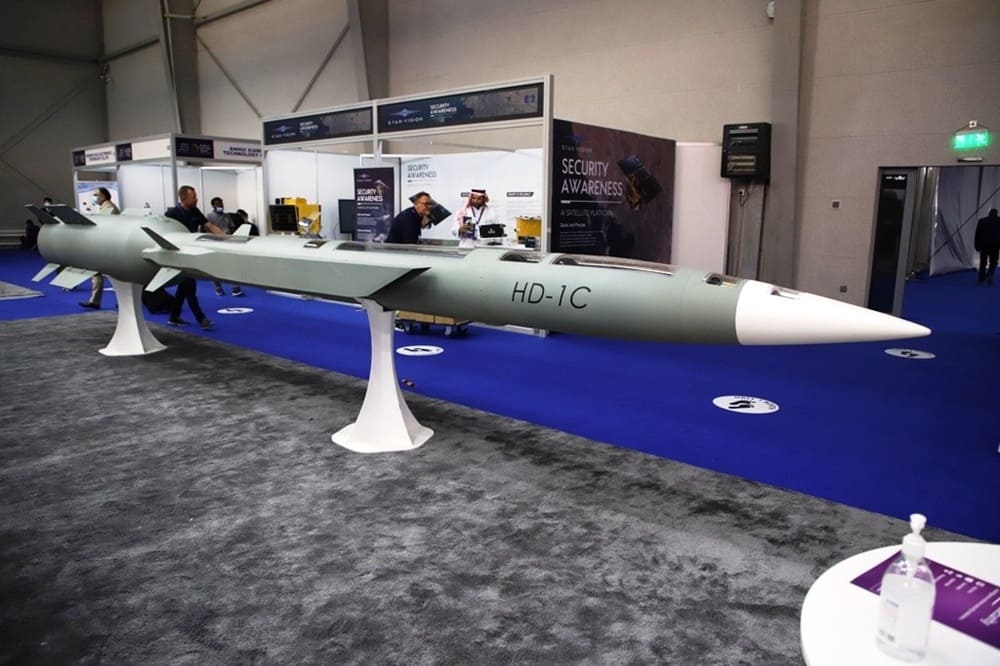
| Length | 8.0–8.2 m | 5.7 m missile; HD-1C uses extra 2.9 m booster |
| Diameter | 0.67 m | 0.375 m missile body; HD-1C booster 0.65 m |
| Launch weight | 2,200–3,000 kg | 1,200 kg missile; around 2,500 kg for HD-1C with booster |
| Payload / warhead | 200–300 kg | About 240 kg; some reports claim up to 400 kg |
| Propulsion | Solid booster + liquid-fuel ramjet sustainer | Solid booster + solid-propellant ramjet |
| Speed | Mach 2.0–2.8 reported by CSIS | Mach 3.5 claimed; CSIS lists 0.75–1.2 km/s |
| Range | 300–500 km; 290 km export version | 30–290 km |
| Flight profile | Supersonic cruise; anti-ship and land attack | High-altitude cruise with sea-skimming terminal attack |
| Sea-skimming altitude | Low-altitude attack profile | 4.8–9.7 m / roughly 5–10 m |
| Guidance | INS/GPS for land targets; active/passive radar terminal guidance | INS + GPS; IIR seeker for HD-1A; active radar seeker for HD-1C |
| Launch platforms | Ground, ship, submarine, aircraft | Ground, ship and aircraft-adaptable variants |
| Main advantage | Mature, operational, multi-platform ecosystem | Lighter missile body, claimed lower cost and high speed |
| Main limitation | Heavier and costlier system | Less proven publicly; limited operational record |
The BrahMos is a more mature and combat-ready system that has been proven to be deployed on multiple launch platforms. HD-1 appears lighter and possibly less expensive with strong claimed speed figures, but operational maturity is less clear. BrahMos has the stronger service record, while the HD-1 appears tailored as a lower-cost export challenger. (missilethreat.csis.org)
Army Rocket Force
Pakistan’s reported unveiling of the Fateh-3 also fits into a broader doctrinal trend. Reuters reported that Pakistan was preparing to create a new Army Rocket Force in 2025 to oversee missile combat capabilities should a conventional war erupt. Such a command structure indicates Islamabad’s desire for more rapid missile deployment, clearer command lines, and more conventional deterrence.
The Fateh-3 makes the problems facing defense planners even more difficult. In a compressed decision cycle, it can threaten coastal assets, forward bases, radar sites, and naval formations. It also gives Pakistan an option other than guided rockets and long-range cruise missiles.
Conclusion
The Fateh-3 supersonic cruise missile does not upset the missile balance in South Asia unilaterally. India continues to fly the BrahMos on various platforms and build its strike ecosystem. But if Pakistan delivers on its reported performance, Fateh-3 could fill a critical capability gap.
The real value of the missile is in the speed, survivability, and operational pressure it can exert. Mach 3-4 sea skimmers leave less time to warn and put a strain on the air defense network. But its usefulness in the battle depends on sensors, seekers, doctrine of launch, and capacity for production. The platform doesn’t win the game; the network does. That’s the missile war today.
References
- https://missilethreat.csis.org/china-test-fires-hd-1-supersonic-cruise-missile/
- https://missilethreat.csis.org/missile/brahmos/
- https://www.defensenewstoday.info/
- https://www.defensenewstoday.info/china-to-pakistan-vs-usa-to-israel-arms-transfers/
About the Author