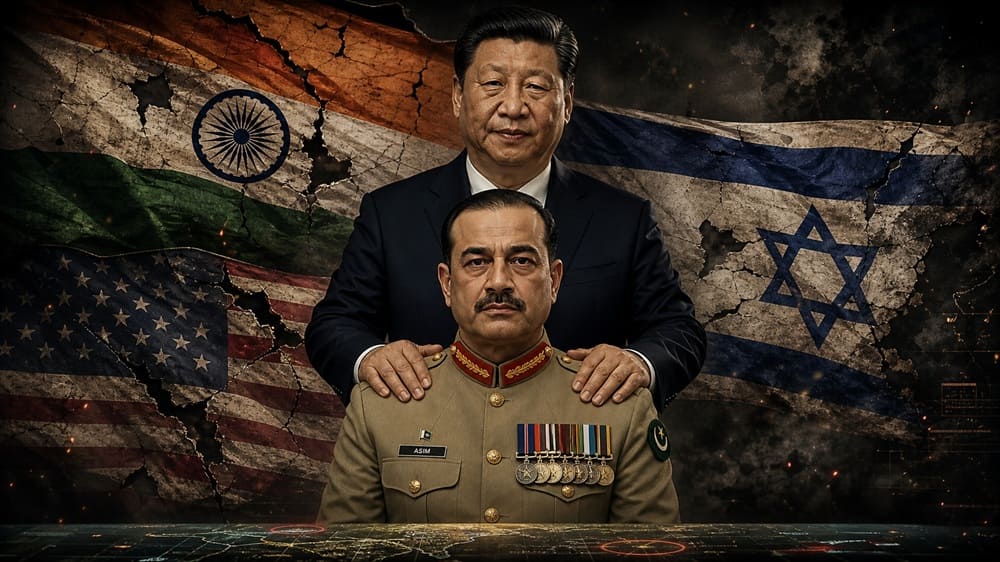
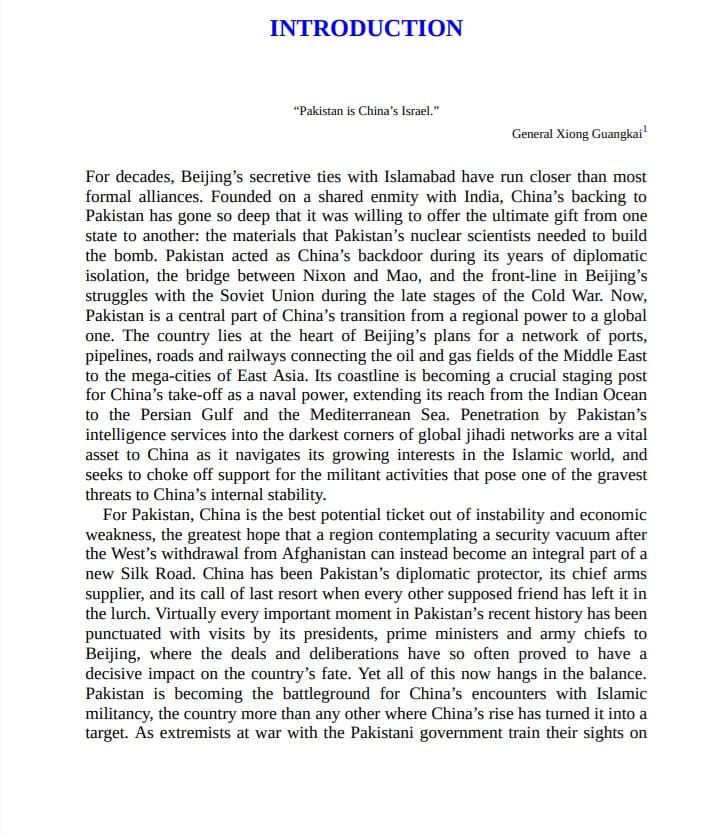
Pakistan is China's Israel
The Pakistan-China partnership has become one of the most important strategic relationships in Asia. It is not a treaty-based alliance like NATO. But it is a deep strategic partnership, based on defense, diplomacy, infrastructure, and regional balancing. In this sense, it increasingly resembles the U.S.-Israel relationship, in which a major power supports a smaller, but strategically important, partner.
The comparison is beneficial, but you need to be cautious. Pakistan is not Israel; China is not the United States. Their political systems, economies, military doctrines, and foreign policy cultures are in stark variance. But both partnerships follow a similar strategic logic: a great power supports a frontline partner to protect larger regional interests.
Importance of U.S.-Israel Model
A clear example of long-term strategic patronage is the U.S.-Israel alliance. Washington provides Israel with advanced weaponry, missile defense cooperation, diplomatic protection, and access to high-end military technology. The 2016 agreement for U.S. security assistance to Israel promised $38 billion over ten years. This money would go to foreign military financing and help with missile defense.
This support provides Israel a major qualitative edge in the Middle East. Israel, therefore, does not rely solely on its domestic defense industry. It also comes with the benefit of American cash, intelligence links, and political backing. This combination enables Israel to deter larger regional threats while retaining a technological edge.
China’s Strategic Support
The Pakistan-China relationship is based on a different model. Beijing does not give Pakistan American-style open-ended military grants. Instead, China provides Pakistan long-term industrial support, diplomatic support, weapons cooperation, infrastructure finance, and strategic access. Pakistan’s foreign ministry describes CPEC as the “cornerstone” of the Pakistan-China “All-Weather Strategic Cooperative Partnership.”
CPEC began in 2013 and links China’s Belt and Road initiative with Pakistan’s infrastructure and connectivity needs. For China, Pakistan provides geography. It is located on the western flank of India and provides Beijing access to the Arabian Sea. Pakistan also helps China to complicate India’s strategic planning. Pakistan relies on China for reliability, especially when the West’s support is uncertain or politically conditioned.
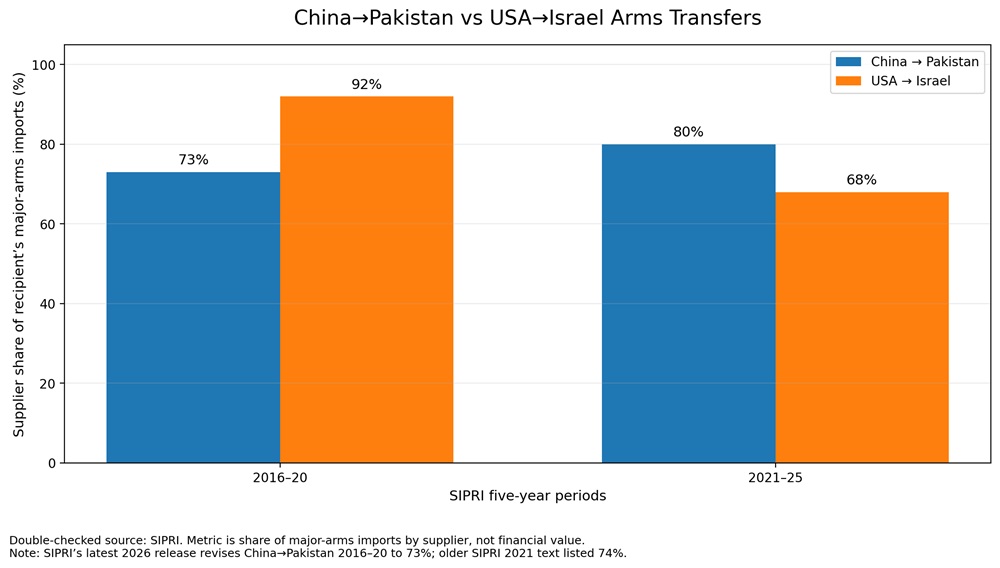
China–Pakistan vs US–Israel Arms Transfers
For China’s arms transfers to Pakistan, SIPRI’s older 2021 reporting showed that China accounted for 74% of Pakistan’s major arms imports during 2016–20. However, SIPRI later updated its database and released a newer 2026-dataset. This latest version revises the figure slightly down to 73%. It is a small difference, but for accuracy the latest SIPRI figure should be used. SIPRI also confirms that Pakistan became increasingly reliant on Chinese major weapons, as China’s share rose to 80% in 2021–25.
The SIPRI Yearbook 2021 reported that the United States supplied 92% of Israel’s major arms imports in the period 2016–20. That shows how dominant the U.S. was as Israel’s main arms supplier during that period. But in 2021-25, the U.S. share was down to 68%, and Germany provided 31%. This does not mean that U.S.-Israel defense ties have deteriorated overall. That means that Israel received a larger portion of major arms from Germany during that period, especially naval platforms.
Defense: The Key Parallel
The clearest bridge between the two models is defense cooperation. Israel depends heavily on American platforms, including F-35 fighters, precision weapons, and missile defense interceptors. Meanwhile, Pakistan has placed a great deal of its modernization efforts on Chinese systems. The JF-17 Thunder continues to be the most visible example. Pakistan Aeronautical Complex says the JF-17 was a joint venture between PAC Kamra and China’s Chengdu Aircraft Industry Corporation.
It is an all-weather, day/night multi-role fighter capable of performing air-to-air and air-to-surface missions. This is important because the JF-17 is not merely a fighter aircraft. It’s a tactic. Pakistan wants systems that it can operate, upgrade, manufacture, and export with fewer political constraints. Therefore, working with China helps Pakistan reduce its dependence on supply chains from the West.
Submarines and Sea Deterrence
Now the naval dimension has added weight to the Pakistan-China alliance. In April 2026, Pakistan will launch its first Hangor-class submarine in China. The program involves eight submarines, with China building four and Pakistan building the other four under a technology transfer agreement. This deal shows how China is not just selling hardware. It is helping Pakistan to develop its domestic industrial capacity.
That’s the deeper logic of the U.S.-Israel relationship, where weapons, funding, doctrine, and industry overlap over decades. The Hangor-class submarine is a step up in Pakistan’s maritime deterrence against India. It also provides sea denial in the Arabian Sea. It also helps secure Pakistan’s maritime routes and its strategic coastlines.
China: ‘Pakistan is our Israel.’
Once when a US delegate challenged a Chinese diplomat on Beijing’s unwavering support for Pakistan, the Chinese is said to have responded with a loaded sarcastic riposte: “Pakistan is our Israel.” However, judging from China’s unwavering support for some of its allies, including North Korea, Burma, Zimbabwe, and Sudan, its protective arm around these countries is no different from the US and Western political embrace of Israel—right or wrong.
India, Israel and Regional Balancing
Every alliance has its rival within itself. Iran and its regional partners shape much of Israel’s threat perception. India is the principal strategic challenge for Pakistan. China has also unresolved tensions with India, particularly after repeated border crises. This makes a natural convergence. Pakistan wants to fight India. China wants to prevent India from becoming an unchallenged Asian power.
As such, the Pakistan-China axis applies pressure on New Delhi from two sides. But that does not mean that Pakistan and China share all of the same objectives. Beijing wants stability because that is beneficial for trade, infrastructure, and influence in the region. Pakistan’s priorities are deterrence, territorial defense and conventional balance. But there is enough common ground to make the relationship enduring.
Limits of the Comparison
The US-Israel relationship is more institutionalized. It has deep defense-industrial ties, strong political backing in Washington, and decades of formal military aid. The alliance between Pakistan and China is more low-key, more state-driven, and less overtly emotional. There is another distinction. Israel is already a high-end exporter of defense technology. Pakistan’s still building that base.
But China gives Pakistan the scale and industrial backing to move from just importing to co-producing. Pakistan also needs to manage dependence carefully. Chinese weapons build Pakistan, but they also bind it. Key issues remain security for CPEC, debt sustainability, and protection of Chinese workers. In 2025, a joint statement from China and Pakistan reiterated the need to protect Chinese personnel and projects in Pakistan.
Why it’s pivotal
The Pakistan-China alliance is no longer just a diplomatic slogan. Now it includes aircraft, submarines, missiles, infrastructure, ports, industrial projects, and multilateral diplomacy. So it’s one of the most important strategic relationships in Asia. The lesson for defense analysts is clear. With assistance from China, Pakistan is building strategic resilience. China is using Pakistan to gain influence, counter India and secure access to the Arabian Sea. So the relationship will probably continue to grow.
Similar Logic, Different Model
The strategic rationale for the Pakistan-China alliance does look like the U.S.-Israel relationship. In both cases a major power is supporting a smaller but militarily important partner. These two partnerships shape regional deterrence, influence the calculus of rivals, and blend weapons and diplomacy. But the model is not the same.
Aid, lobbying, political consensus, and elite technology transfer form the basis of the U.S.-Israel alliance. Pakistan and China are partners by geography, by co-production, by infrastructure, and by shared concern about India. That is a difference. But the strategic result is the same. Pakistan acquires depth, China gains leverage, and India experiences a more complicated regional balance.
References
- https://2017-2021.state.gov/ten-year-memorandum-of-understanding-between-the-united-states-and-israel/
- https://sanipanhwar.com/uploads/books/2024-08-28_13-13-44_7b5d180f329ca8d283936dc2e10a9009.pdf
- https://mofa.gov.pk/china
- https://www.pac.org.pk/jf-17
- https://www.reuters.com/world/china/pakistan-navy-add-advanced-chinese-submarines-2026-04-30/
About the Author