

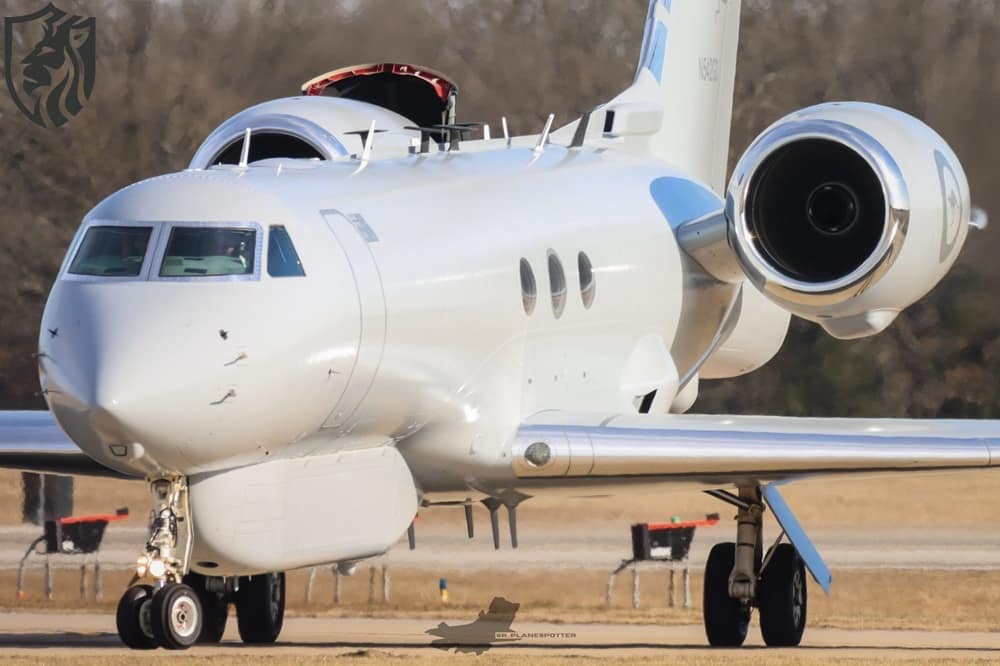
MC-55A Peregrine
Australia has taken a major step toward a truly networked air force with the arrival of its first MC-55A Peregrine at RAAF Base Edinburgh, South Australia. The aircraft reached the base on 22 January 2026, after a long multi-stop delivery flight from the United States.
While the airframe began life as a Gulfstream G550 business jet, Australia’s configuration targets a demanding mission set: airborne intelligence, surveillance, reconnaissance, and electronic warfare. In practical terms, the new platform gives the Royal Australian Air Force (RAAF) a scarce, high-end capability that can watch, collect, and connect across wide areas.
First MC-55A Delivery Details
Aviation photos confirmed the jet’s arrival at RAAF Base Edinburgh, the fleet’s future hub and a key surveillance base. Reports say the delivery flight departed Greenville, Texas, and crossed the Pacific in several stages. It reportedly stopped at Davis-Monthan AFB, Hickam AFB, Wake Island, and Andersen AFB in Guam. The aircraft then continued to Australia and landed at Edinburgh.
This aircraft is the first of four scheduled to join the Edinburgh-based fleet. No. 10 Squadron will operate the new platform once the handover is complete. Project AIR 555 follows US approval in 2017 for up to five modified aircraft. In 2019, Australia committed about $1.6 billion to buy four jets and their mission systems. However, the program faced delays and missed earlier delivery plans. Initial timelines aimed for around 2022, not 2026. That gap shows how complex mission-system integration can be on a compact business-jet airframe.
Why the G550 Fits Modern SIGINT and EW
The G550 family offers a blend that militaries increasingly value: high altitude, long range, and enough electrical and cooling margins for sophisticated payloads. The MC-55A Peregrine reportedly offers roughly 15 hours of endurance and can operate around 51,000 feet, which expands line-of-sight collection and supports long standoff orbits.
This aspect matters because modern airborne sensing often depends less on a single “big radar” and more on persistent access to the electromagnetic spectrum. Therefore, a long-legged business-jet platform can deliver effects that once required larger, more expensive airframes.
Antennas and Fairings: What They Suggest
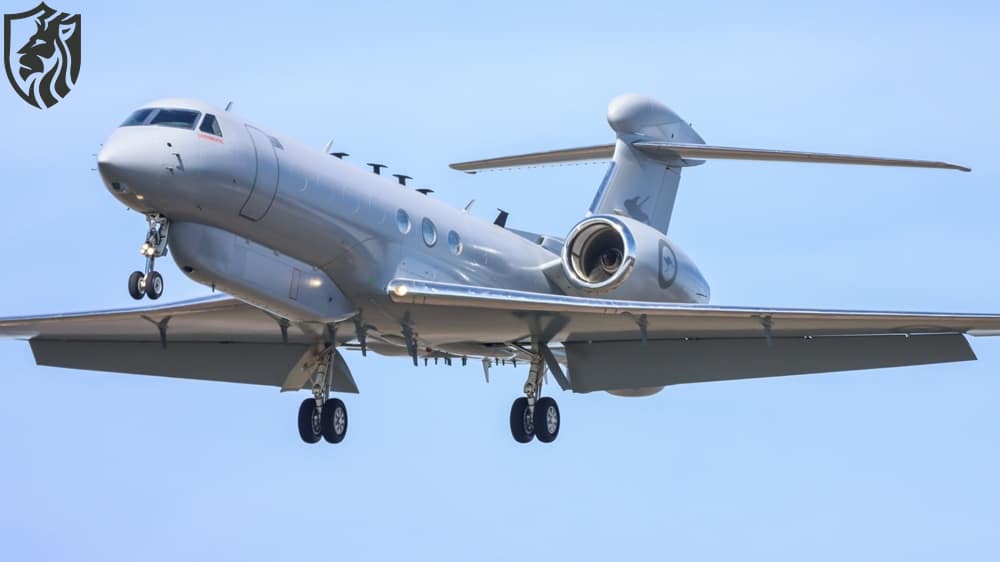
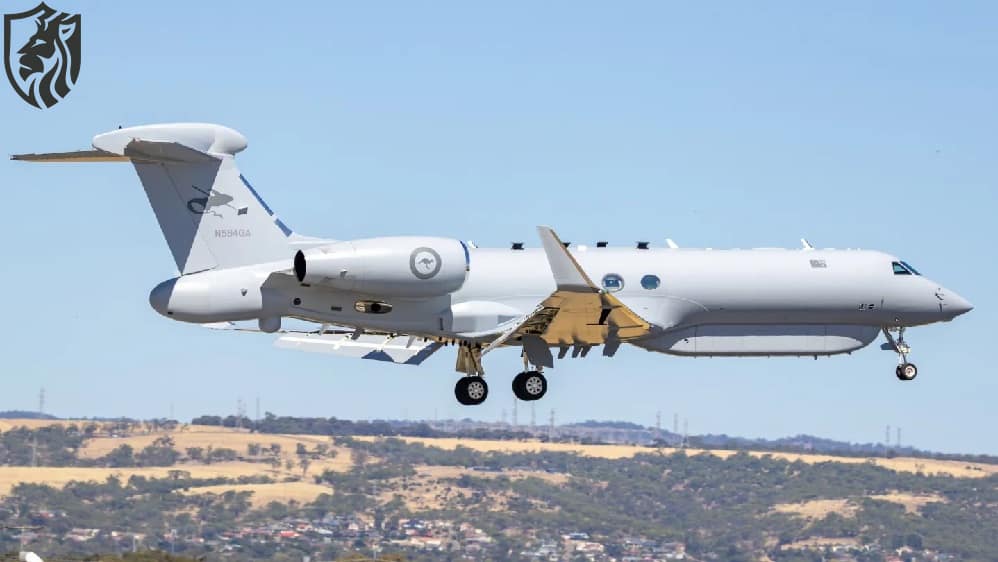
Photographs show extensive modifications: numerous antennas, a large ventral “canoe,” and a reshaped tail area. Those features usually indicate a mix of signals intelligence (SIGINT), communications intelligence, collection, and relay functions. However, public sources still keep sensor specifics tightly controlled. Analysts can only infer roles from the aircraft’s visible apertures and from how similar platforms operate.
Even so, official messaging frames the aircraft as a multi-source intelligence collector designed to support defense operations, which strongly suggests data fusion and rapid dissemination, not just passive listening. Notably, the aircraft lacks certain “cheek” fairings seen on some other G550 conversions. That does not reduce its relevance. Instead, it suggests the RAAF and industry team selected a different sensor arrangement to match Australian concepts of operations.
1) Emitter-Focused ISR
Traditional ISR looks for platforms and activity. Spectrum-centric ISR also hunts for radars, data links, jammers, and command nodes. That is vital in the Indo-Pacific, where standoff distance and information advantage often decide the tempo.
2) Force-Package EW Support
The RAAF already operates the EA-18G Growler for electronic attack and the F-35A for advanced sensing and self-protection. The Peregrine can complement both by collecting, classifying, and distributing threat data faster across the force.
3) Networking and Relay Node
The aircraft is intended to help link nodes across air, maritime, and land forces—working alongside assets such as the E-7A Wedgetail and naval surface combatants. This role resembles the logic behind the US E-11A BACN concept: keep the network alive, extend reach, and bridge waveforms when the battlespace gets messy.
Crewed–Uncrewed Teaming Role
Australia is also pushing into Collaborative Combat Aircraft (CCA) concepts, including the MQ-28A Ghost Bat program. As CCAs mature, they can carry payloads into riskier airspace and still feed data back to safer standoff nodes.
That dynamic creates an obvious future pairing: a high-value crewed platform managing collection and networking, while uncrewed systems extend sensing, deception, or electronic effects. The RAAF has already explored control concepts using other airborne nodes, and the Peregrine’s mission profile makes it a plausible candidate for similar roles as tactics evolve.
Basing and Indo-Pacific Coverage
RAAF Base Edinburgh already anchors Australia’s surveillance enterprise. Co-locating the Peregrine with maritime and high-altitude systems increases operational efficiency and speeds cross-cueing between platforms. Beyond Edinburgh, Australia has also highlighted enabling locations that expand reach. Government and reporting point to support infrastructure that strengthens access to the north and into the Indian Ocean approaches, including the Cocos (Keeling) Islands.
That geography matters because it pushes collection coverage into areas where distance often protects an adversary’s activities. In a region shaped by accelerating military modernization, the value of persistent airborne collection grows quickly. Therefore, the MC-55A Peregrine is likely to become a low-density, high-demand asset tasked against priority theaters and time-sensitive targets.
Key Takeaway for Defence Watchers
The most important change is not a single sensor. It is the shift in how the RAAF can sense, decide, and share at range. The MC-55A Peregrine strengthens Australia’s ability to map the spectrum, track patterns, and move intelligence across a joint force in near real time. It is unclear how this system, a prominent member of the QUAD, will respond to China’s rise.
Moreover, the program reflects a broader trend: smaller, efficient jets can now carry mission systems once reserved for bigger aircraft. As a result, Australia gains a sophisticated tool that supports deterrence, crisis warning, and—if required—combat operations in a contested information environment.
References
- https://www.minister.defence.gov.au/media-releases/2026-01-24/mc-55a-peregrine-first-type-capability-strengthening-australias-defence
- https://www.twz.com/air/australia-just-took-delivery-of-one-of-its-most-powerful-weapons
- https://www.australiandefence.com.au/news/news/arrival-of-first-mc-55a
- https://thedefensepost.com/2026/01/23/raaf-peregrine-arrival/
About the Author