Kongsberg–Helsing IST Constellation for Europe
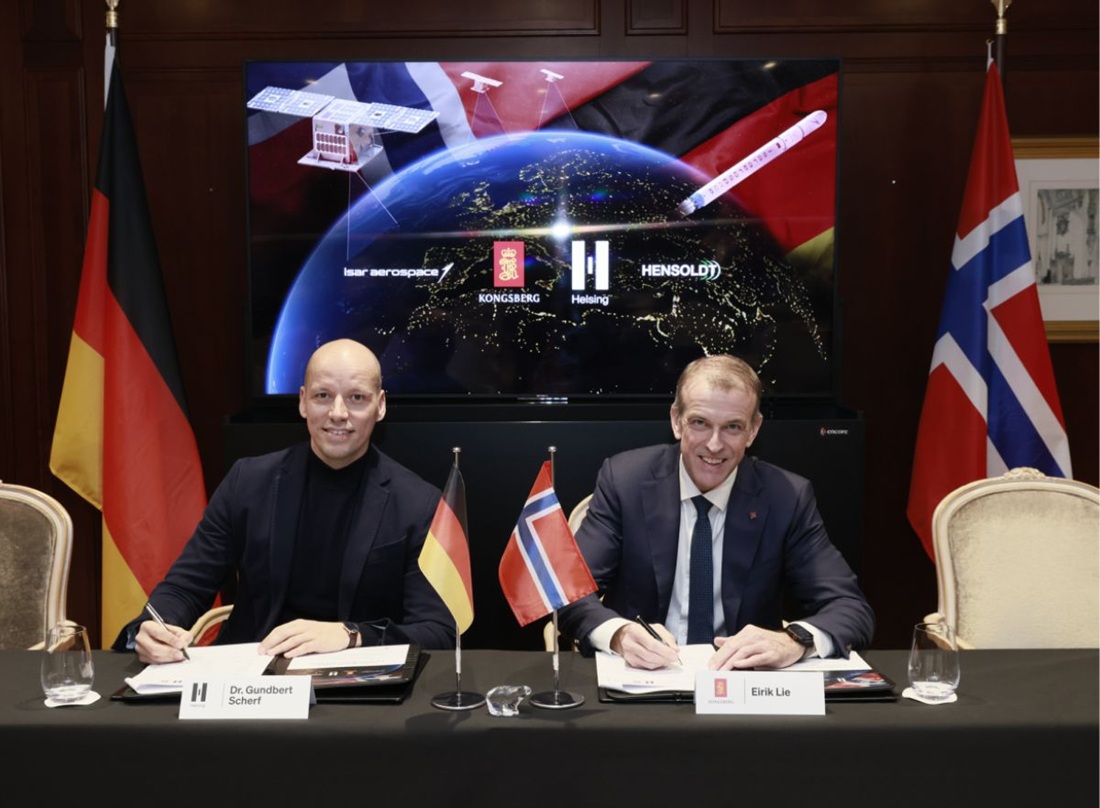
Europe is moving to reduce its reliance on US space intelligence. In December 2025, Kongsberg (Norway) and Helsing (Germany) signed a teaming agreement for a Kongsberg–Helsing satellite-intel constellation to support European intelligence, surveillance, and targeting by 2029. The plan combines satellites, AI-driven exploitation, and an integrated communications layer for defense users.
By 2029: What the Partnership Delivers
The companies explain that they are creating a defense-focused, independent IST system that relies on a group of satellites and the necessary ground connections. Hensoldt will provide sensor technology, while Isar Aerospace is the preferred launch partner. In addition, Kongsberg Satellite Services (KSAT) will contribute its ground network for tasking and communications.
SAR, EO/IR & RF Sensor Mix
The agreement focuses on fusing synthetic aperture radar (SAR), electro-optical/infrared (EO/IR), and radio-frequency (RF) data, with Helsing’s AI software accelerating analysis. Hensoldt will supply SAR, EO/IR, and electronic warfare sensors to support the architecture.

Why Sovereign Space ISR Matters Now
Europe’s dependence on American space-based intelligence now looks like a risk. Notably, a US pause in intelligence data sharing with Ukraine earlier in 2025 sharpened that concern, according to reports. Therefore, defense planners want end-to-end control: sensing, downlink, processing, dissemination, and the policies that govern tasking.
The demand is already reshaping procurement. Finland’s ICEYE reportedly sold at least eight radar satellites in 2025 to European customers seeking sovereign space capability. Against that backdrop, the Kongsberg–Helsing satellite-intel constellation aims to offer an integrated alternative, not just raw imagery.
How AI Fusion Changes ISR
Targeting usually requires multiple sensors. However, fusing SAR, EO/IR, and RF can reduce uncertainty and time-to-understanding for commanders. For example, SAR works through clouds and at night, while EO/IR helps with recognition in clear conditions.
Meanwhile, RF data can reveal emitter activity and patterns. Helsing claims to have operationally used its algorithms in Ukraine and conducted data analysis in orbit. If that scales, it could reduce bandwidth pressure and shorten latency.
Industrial plans and Sovereignty Gaps
The partners also plan local satellite production in Germany to build a “self-reliant” European capability. However, key details remain open: the investment required, the number of satellites, target customers, and who would own the fleet. Those answers will define resilience, revisit rates, and affordability for real users.

Key Watchpoints for 2029
First, the comms layer will matter as much as the sensors. Constellations only deliver value when users can task satellites quickly, move data securely, and push insights to units in minutes. Second, launch availability is a pacing item.
The partners call Isar Aerospace their preferred launcher, yet the reporting notes Isar’s Spectrum rocket still needs a fully successful demonstration. Finally, Europe will want clarity on governance: who owns the satellites, which nations buy in, and how tasking priorities work during a crisis. For more news related to aerospace, visit Defense News Today.
References
- https://www.kongsberg.com/kda/news/news-archive/2025/kongsberg-and-helsing-team-up-to-realise-european-space-ambitions/
- https://helsing.ai/newsroom/kongsberg-and-helsing-team-up-to-realise-european-space-ambitions
- https://www.defensenews.com/global/europe/2025/12/10/kongsberg-helsing-team-up-for-european-satellite-intel-constellation/
- https://www.satellitetoday.com/government-military/2025/12/10/kongsberg-and-helsing-invest-in-intelligence-constellation-for-europe/Sources
About the Author