

KIZILELMA UAV — First BVR Air-to-Air Kill
KIZILELMA’s and BVR engagement
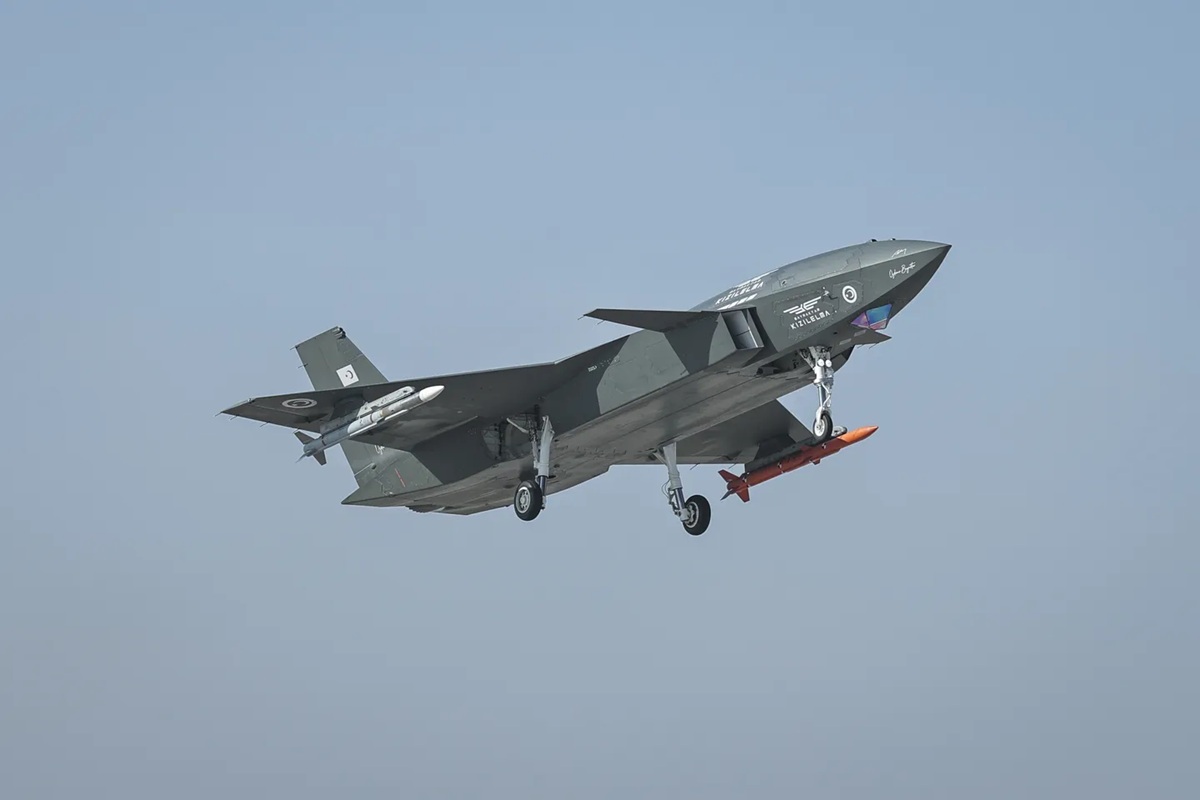
Türkiye’s first uncrewed fighter jet, Bayraktar KIZILELMA, has become the world’s first UAV to fire a beyond-visual-range (BVR) air-to-air missile at a jet-powered target off the coast of Sinop. In this landmark event, KIZILELMA becomes the first UAV with a BVR air-to-air kill, underlining how far Türkiye’s UCAV ecosystem has advanced.
During the trial, KIZILELMA launched the indigenous GOKDOGAN air-to-air missile from a wing station and destroyed a high-speed jet target. The aircraft first detected and tracked the target with ASELSAN’s MURAD AESA radar, then released the missile once the engagement geometry and kinematic envelope were satisfied. This fully national “sensor-shooter” chain means radar, missile, and airframe were all Turkish-designed and produced.
A first for global UCAV programmes
This firing marks the first time in Turkish aviation history that a national aircraft has used a domestically produced air-to-air missile, guided by a national radar, to engage an aerial target. At the same time, KIZILELMA becomes the first UAV with a BVR air-to-air kill and the only uncrewed platform with a publicly verified long-range air-to-air engagement against a jet-powered target.
KIZILELMA now occupies a distinct niche as a fighter-class UAV, while many UCAV projects continue to focus on strike or limited self-defense. It sits alongside other Turkish systems, such as TB2 and AKINCI, but adds a genuine air superiority and interceptor role rather than functioning solely as a bomb truck.
Low-observable design and multi-role punch
KIZILELMA’s low radar cross-section, blended fuselage, and internal payload options allow it to approach hostile airspace while remaining hard to detect. The aircraft integrates the MURAD AESA radar, the TOYGUN electro-optical targeting system, and a growing suite of domestically produced munitions.
In earlier test campaigns, KIZILELMA achieved direct hits with TOLUN and TEBER-82 precision weapons, proving that it can deliver accurate air-to-ground effects as well as conduct interceptions. As a result, KIZILELMA becomes the first UAV with a BVR air-to-air kill while retaining robust strike capability, giving Turkish planners a multi-role, uncrewed fighter that can shift between offensive and defensive missions without exposing pilots.

Crewed–unmanned teaming
The latest test also explored future crewed-unmanned teaming concepts. Five F-16 fighter jets from Merzifon Air Base flew in formation with KIZILELMA over the Sinop range. A Bayraktar AKINCI UAV recorded the missile firing from the air. Together, these platforms showed how a loyal wingman concept might work in Turkish service.
KIZILELMA extended sensor coverage and screened crewed fighters during the engagement. It also took the first BVR shots in contested airspace. In this context, KIZILELMA becomes the first UAV with a BVR air-to-air kill. The achievement is not an isolated stunt or publicity exercise. Instead, it fits into Türkiye’s drive to build a networked, layered unmanned force structure.
Baykar’s export engine
Since 2003, Baykar has financed its UAV projects using its own resources. These include TB2, AKINCI, and now Bayraktar KIZILELMA in the same self-funded portfolio. The company generated about $1.8 billion in export revenue in both 2023 and 2024. Roughly 90% of its income came from foreign customers during those years. This reflects a rare, export-first business model in global defense aviation.
Bayraktar TB2 now serves 36 countries across multiple regions. Bayraktar AKINCI has secured customers in 16 states so far. These sales helped Baykar remain Turkey’s top defense and aerospace exporter for four consecutive years. Against that backdrop, KIZILELMA becoming the first UAV with a BVR air-to-air kill feels unsurprising.
The aircraft is emerging as the flagship of an already proven export-focused unmanned family.
For readers tracking Turkish airpower, Defence News Today presents a detailed Bayraktar KIZILELMA capability profile. That profile sits within a broader analysis of Türkiye’s air and missile modernization.
Implications for regional and global airpower
KIZILELMA’s success will shape loyal-wingman and UCAV programs across Europe, the Middle East, and Asia. Defense planners will study how it blends low observability, indigenous sensors, and beyond-visual-range weapons.
Their findings will force a rethink of the balance between crewed fighters and uncrewed shooters in future forces. For many observers, this test marks the moment Türkiye’s uncrewed fighter concept became a credible operational capability.
References
- Naval News – “Unmanned Fighter Jet Bayraktar KIZILELMA Hits Target in First Air-to-Air Test-Firing” – https://www.navalnews.com/naval-news/2025/11/turkiyes-unmanned-fighter-jet-bayraktar-kizilelma-hits-target-at-first-air-to-air-test-firing/ Naval News
- https://defensenewstoday.info/kizilelma-tests-ukrainian-engine-with-guided-mk-82/
- TRT Afrika – “Turkish jet KIZILELMA becomes world’s 1st to fire air-to-air missile at air target” – https://www.trtafrika.com/article/209f8d48b887 TRT Afrika
- TurDef – “Bayraktar KIZILELMA Makes Historic BVR Air-to-Air Strike” – https://turdef.com/article/bayraktar-kizilelma-makes-historic-bvr-air-to-air-strike TURDEF
- Wikipedia – “Bayraktar Kızılelma” – https://en.wikipedia.org/wiki/Bayraktar_K%C4%B1z%C4%B1lelma Wikipedia
About the Author