

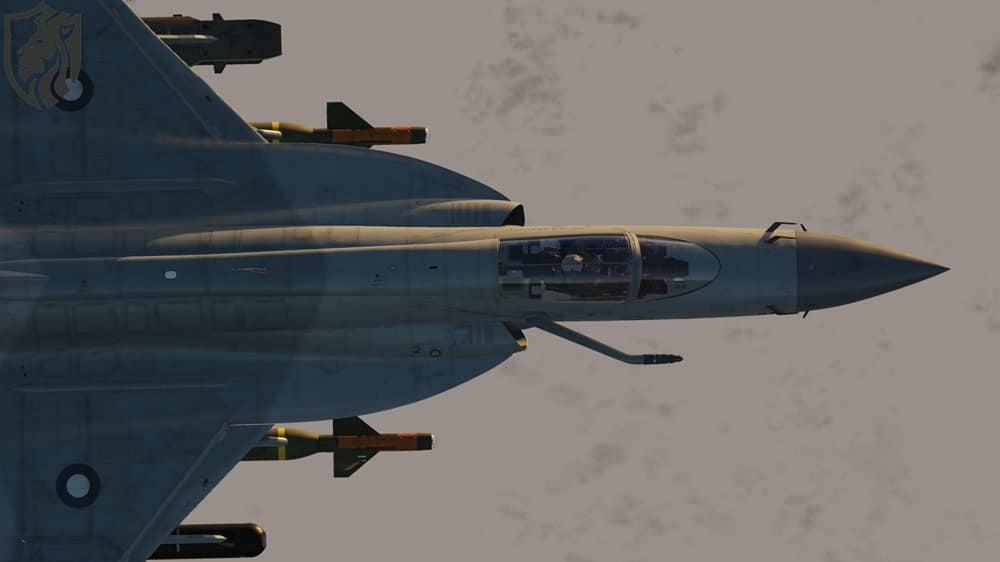
JF-17 Block III: From Operational Workhorse to Export Winner
By January 2026, the JF-17 Thunder Block III had crossed a threshold many “affordable fighter” programs never reach: it was no longer sold as a promise. It is now available as a complete system—featuring a fully developed production line in the country, a reliable JF-17 multi-role avionics suite, and a weapons and network package that has been tested in real situations and approved for sale to other countries The success is so overwhelming that PAF is planning additional production lines to cater to surplus orders.
JF-17 Variants: Active and Planned Line-up
The Block III is best understood as a re-baselining of the JF-17’s mission-system architecture, not a simple “Block II plus” update. Block III concentrates its value in three technical areas, while the airframe remains a lightweight, single-engine, supersonic multi-role design.
- Block III focuses on sensors and the pilot-vehicle interface (PVI).
- Electronic warfare (EW) survivability and emission-control tactics
- Network integration for beyond-visual-range (BVR) and multi-domain kill-chains
Pakistan Aeronautical Complex (PAC) publishes baseline performance figures that frame the platform’s kinematic envelope—service ceiling 55,500 ft, thrust-to-weight ratio 1.07, engine thrust quoted at 19,000 lb, and g-limits +8/-3. These are not the only parameters that matter in modern air combat, but they set the constraints within which the Block III’s avionics and weapons must deliver.
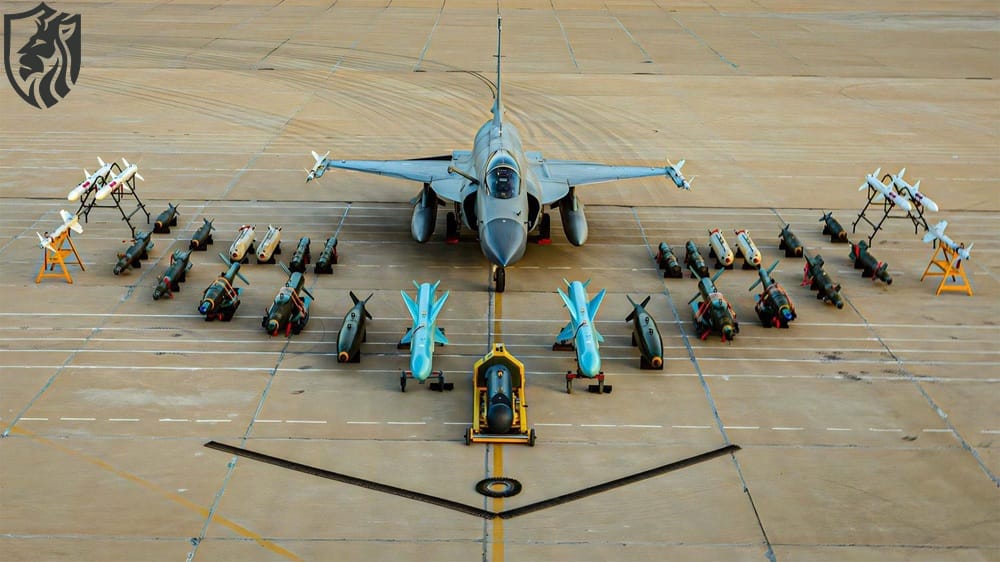
Block III Export Weapons Package
| Mission set | Weapon/store | Class | Typical employment on Block III |
|---|---|---|---|
| Air-to-air (BVR) | PL-15 (incl. PL-15E) | Long-range active-radar BVRAAM | Long-range CAP/escort; early shots with datalink/radar support to expand no-go zones |
| Air-to-air (BVR) | SD-10A | Medium-range active-radar BVRAAM | Baseline BVR load for air defence; paired with WVR missile + tank(s) |
| Air-to-air (WVR) | PL-10E | High-off-boresight IR AAM | Helmet-cued close-in kills; high off-boresight shots in merges |
| Air-to-air (WVR) | PL-5E / PL-9C | Short-range IR AAM | Cost-effective WVR carriage for routine alert/QRA and training sorties |
| Strike (precision – local) | H-2 / H-4 SOW | Stand-off weapon (Pak) | Standoff strike on fixed targets; used when planners want reach without deep ingress |
| Strike (precision – local) | REK “Takbir” + Mk-82/83/84 | GPS/INS glide-guidance kit (Pak) | Medium standoff precision strike; reduces exposure to point defenses |
| Strike (unguided) | Mk-82 / Mk-83 / Mk-84 | General-purpose bombs | Low-cost strike/training; often paired with pods/kits depending on target set |
| Strike enabling | Targeting pod (e.g., ASELPOD) | EO/IR + laser designator pod | PID, day/night targeting, laser designation, post-strike assessment |
| Maritime strike | C-802AK | Anti-ship cruise missile | This missile is designed for anti-surface warfare, littoral sea denial, and coastal strike profiles. |
| Standoff strike (high speed) | CM-400AKG/Taimoor ALCM | Supersonic air-to-surface/anti-ship weapon | High-energy standoff shots against defended or time-sensitive targets/Terrain hugging stealth indigenous cruise missile in the class of Taurus and Storm Shadow |
| SEAD/DEAD (reported) | MAR-1 | Anti-radiation missile (ARM) | Counter-emitter missions vs radar sites depend on cueing and threat libraries |
| Self-protection | EJ-600 Chaff/flare dispensers | Countermeasures | The system provides break-lock and decoy capabilities against surface-to-air missile (SAM) and air-to-air missile (AAM) threats, and it supports low-level egress. |
| Internal gun | GSh-23-2 (23mm) | Cannon | Last-ditch WVR, strafing, and functional test firing |
Block III combat edge: see, link and shoot
BVR combat is now information geometry. The side that solves the shot first usually wins. It does so with minimal exposure. It also keeps track of quality long enough for a high-Pk missile launch. Reuters’ review of the May 2025 India–Pakistan air fight highlights this pattern. It argues that situational awareness decided the outcome. It also credits a tighter sensor-to-shooter kill chain. The Reuters analysis primarily focuses on Pakistan’s J-10C. However, the same logic fits the Block III concept, as both fighters share similar electronics and weaponry.
The aim is to fight as part of a network. Shared surveillance feeds can lower radar use on the fighter. This supports emission control tactics. Data links can spread tracks across multiple platforms. That improves timing for BVR shots. Reuters says Pakistani officials described a kill chain across air, land, and space sensors. They also mentioned a Pakistan-made secure datalink called LINK-17 connecting different systems. In simple terms, Block III upgrades push the JF-17 toward network-centric combat. It relies less on a “fighter-only” radar approach.
Weapons integration: credibility leap
Weapons integration is a clear sign of Block III maturity. It can reshape how an opponent plans and flies. In May 2025, the PAF revealed Block III imagery carrying the PL-15. Janes reported it as the first public display of that pairing. Exact missile performance stays classified or debated. Still, the operational message is simple. Rivals must assume a longer engagement zone. They also face larger no-go areas. Bad range intelligence becomes far more costly.
Reuters later linked range misjudgment to a Rafale loss in the same clash. It said flawed estimates of the PL-15 envelope created false confidence. That is modern combat success in practice. It is not raw speed or turn rate alone. It is a stack of advantages working together. Sensors, data links, missiles, and tactics shape the geometry. They push the opponent into worse options.
Combat success: availability & repeatability
For defense enthusiasts, it is tempting to judge success only based on air-to-air scorecards. In practice, air forces judge success by mission-capable rates, turnaround time, and repeatable strike workflows under political constraint. The JF-17 family has been used in operational contexts ranging from strike to air defense, and by 2026, Pakistan will explicitly market the type as “combat-tested” in its export push.
It is also worth noting that the May 2025 episode produced contested claims about losses and shoot-downs from both sides, including public statements by India and denials by Pakistan. In scholarly terms, the safe inference is not “who won every exchange,” but that the conflict provided a rare modern data point demonstrating the operational relevance of long-range AAMs, EW, and networked situational awareness—exactly the areas Block III is designed to improve.
JF-17 Block III vs Rivals and Competitors
The JF-17 Block III offers a blunt value case for budget-minded air forces: robust capability without luxury pricing. It combines a modern sensor and avionics suite, network-ready tactics, and standoff strike options on a light, maintainable airframe. In real terms, it can cover many of the same missions—air policing, BVR deterrence, precision attack, and limited maritime strike—while costing far less to buy and often less to keep flying.
Some competing jets still need to prove delivery speed, upgrade stability, and improve combat routines. By contrast, the JF-17 family has built operational hours and sharpened its support ecosystem. That lowers procurement risk and improves cost predictability. The “per jet” figures are simple divisions of reported contract totals and are not like-for-like unit prices because packages differ (weapons, spares, training, offsets, upgrades).
| Aircraft Name | OEM/Origin | Typical deal scale & signals | User countries | Prices (publicly reported examples) |
|---|---|---|---|---|
| KAI FA-50 | Korea Aerospace Industries (KAI), South Korea | Often bought in 12–48 lots as an affordable “light fighter + lead-in trainer” package (training, support, weapons integration). The Philippines doubled its fleet with a fresh batch; Poland signed for a much larger fleet. (Defense News) | South Korea, the Philippines, Indonesia, Thailand, Iraq (operators); Poland (ordered); Malaysia (ordered). (Defense News) | $700m for 12 (Philippines, 2025) ≈ $58m/jet (package). (Defense News) $3.0b for 48 (Poland, 2022) ≈ $62.5m/jet (two contracts). (Defense News) $920m for 18 (Malaysia, 2023) ≈ $51m/jet. (EDR Magazine) |
| HAL Tejas Mk1A | Hindustan Aeronautics Ltd (HAL), India | Marketed as a light, modernized fighter, but the deal signal is mainly domestic scale (large home orders that sustain production). (Reuters) | India (operator). (Reuters) | ₹623.70bn / $7.03b for 97 (India contract, 2025) ≈ $72m/jet (includes associated equipment). (Reuters) |
| Saab Gripen E/F | Saab, Sweden | Tends to appear in small initial tranches (4–12) with training/support, then follow-ons; also won a major Latin American replacement program. (Start) | Sweden, the Czech Republic, Hungary, South Africa, and Thailand ordered the Gripen C/D; Brazil ordered the Gripen E; and Colombia has also placed an order. (Start) | SEK 5.3b (~$556m) for 4 (Thailand, 2025) ≈ $139m/jet (incl. support/training). (Start) €3.1b for 17 (Colombia, 2025) ≈ €182m/jet (incl. offsets/support). (Reuters) |
| F-16 Block 70/72 (F-16V) | Lockheed Martin, USA | Frequently sold as FMS “packages” where jets, weapons, spares, and training are bundled; deal sizes range from dozens to larger modernization packages. (Reuters) | Taiwan (ordered 66 new-build); Turkey (40 new-build planned purchase); Bahrain (new-build deal reported); Morocco (25 new-build + upgrades); Slovakia (ordered Block 70); Bulgaria (ordered Block 70). (Reuters) | $8b for 66 (Taiwan, 2019) ≈ $121m/jet (package). (Reuters) $7b for 40 (Turkey, 2024, incl. ammunition) ≈ $175m/jet (package-heavy). (Reuters) $3.787b for 25 (Morocco request, 2019) ≈ $151m/jet (package). (Defense News) |
| Mirage 2000-5 (used market + upgrades) | Dassault Aviation, France | Competes when buyers want fast availability via used airframes, then upgrades—subject to fleet availability and refurbishment cost growth. (Reuters) | Legacy/operator footprint includes Egypt, Greece, India, Peru, Qatar, Taiwan, UAE, and Brazil (export customer list). (Dassault Aviation) | €733m (~$790m) for 12 used Mirage 2000-5 planned by Indonesia (later cancelled) ≈ €61m/jet (used-aircraft package). (Reuters) |
From combat credibility to export momentum
By January 2026, the JF-17 export story had transitioned from sporadic deals to a more structured pipeline narrative, supported by named negotiations and visible inductions. The only hindrance is the Russian Klimov RD-93MA engine. Though China ensured that the Russian engine supply will not be subject to an abrupt halt. Still, due to the Ukraine war, Russian supply lines are stretched thin, so engine supply may face delays in the future. For this, China and Pakistan jointly suggested the WS-13 engine was considered as a direct replacement, and Pakistan has it as of late 2025.
Azerbaijan: induction proves delivery
Azerbaijan has inducted JF-17s, with Janes reporting a five-aircraft flypast (four single-seat plus one twin-seat) during the Victory Day parade in November 2025—strong evidence that deliveries are real, not just paper agreements. Reuters had earlier reported Pakistan signing a contract to sell JF-17 Block III aircraft to Azerbaijan (without disclosing quantities or cost).
Libya: big package deal, high risk
Reuters reported Pakistan finalized a major arms deal with Libya’s eastern-based Libyan National Army that includes 16 JF-17 fighter jets and 12 Super Mushak trainers as part of a package reported around $4.6 billion, despite the complexities of an arms-embargo environment. This matters because it demonstrates a key export enabler: Pakistan is not only selling airframes—it is selling bundled training, support, and wider equipment relationships.
Indonesia, Bangladesh, Saudi: talks at scale
Reuters reported advanced talks with Indonesia that could involve more than 40 JF-17 jets plus drones. Reuters also reported Pakistan–Bangladesh discussions that center on potential JF-17 sales. And Reuters described Pakistan–Saudi talks about converting roughly $2 billion of Saudi loans into a JF-17 deal framework.
Why sales are working
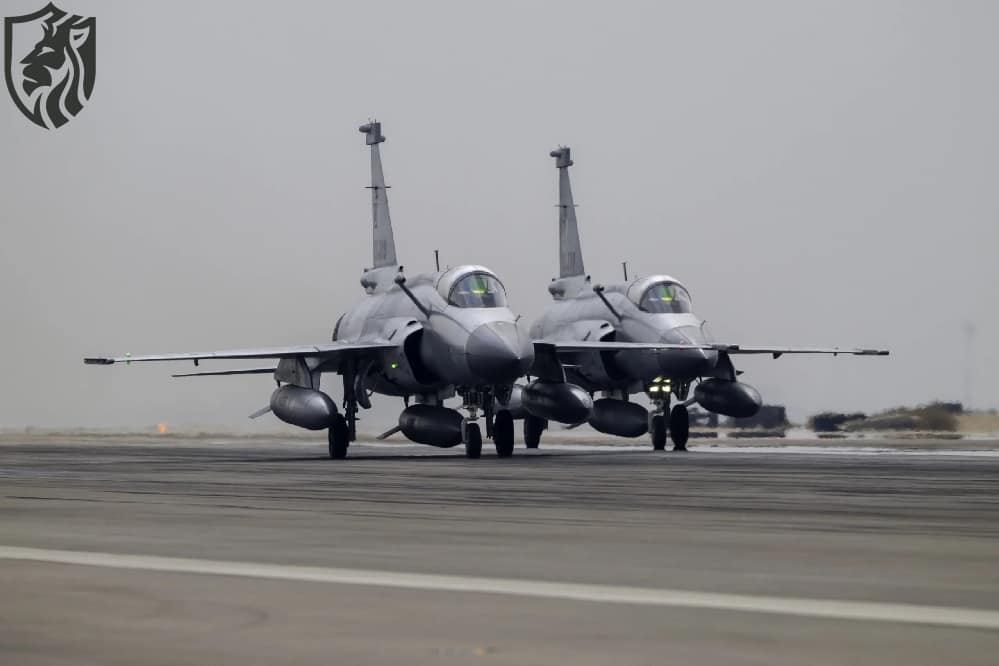
Technically, Block III is attractive because it offers a modern combat system without the full cost and political strings of top-tier Western fighters. Commercially, Pakistan is positioning itself as an integrator able to package aircraft + weapons + training + sustainment and, in some cases, attach creative financing or state-to-state arrangements. Operationally, recent conflict narratives have amplified buyer interest in platforms associated with effective BVR tactics and networked kill chains.
Block III Integrated Systems
| System domain | Block III system (publicly known / typical) | Manufacturer (known / typical) | What it does on Block III |
|---|---|---|---|
| Fire-control radar | KLJ-7A AESA radar | LETRI / AVIC (China) | Primary BVR search/track; supports radar-guided weapons |
| Mission computing (aircraft-level) | Mission computer + OFP | PAC + AVIC (integrated) | Sensor fusion, weapons logic, symbology, tactics pages |
| Mission computing (PAC avionics) | Weapon Mission Management Computer (WMMC) | PAC (APF) | Core avionics control: bus management, mission planning, fire-control calculations, nav aids, alerts, display/pilot interface |
| Avionics backbone | Data buses and high-speed internal networks | PAC + AVIC (integrated) | Moves radar/EO/EW/INS data; enables fusion and weapon cueing |
| Flight controls | 3-axis quad-redundant digital FBW | AVIC (commonly stated) | Improves handling, stability, safety margins, high-workload control |
| Cockpit/HMI | Wide-angle HUD and glass cockpit displays | AVIC (typical) | Improves cueing; reduces head-down time |
| Pilot-vehicle interface | HOTAS + display processors | PAC + AVIC (integrated) | Faster sensor/weapon management via hands-on controls and display logic |
| Helmet cueing | Helmet-mounted display/sight (HMD/S) | AVIC/Chinese suppliers (reported) | High off-boresight cueing for WVR missiles; rapid target designation |
| EW sensing/threat warning | RWR — BM/KJ-8602 / BM/KJ-8602A | PAC (APF) + CEIEC (China) | 360° radar-threat detection/ID; prioritized warnings for pilot/EW response |
| EW effects | ECM/jammer management (EJ-600) | China (reported) | Coordinates jamming/countermeasures with threat cues (details non-public) |
| Missile warning | MAWS (S-740) (reported fit) | China (reported) | Detects inbound missile events; triggers alerts/countermeasure actions |
| Countermeasures | Chaff/flare dispensers + CM controller | Not publicly disclosed | Cues/automates expendables and dispense sequences vs SAM/AAM |
| Identification | IFF interrogator/transponder—JZ/YD-125 | PAC (APF) + Jiuzhou (China) | Friendly identification and deconfliction; ties into track management |
| Data links | Tactical datalink terminal (LINK-17 referenced) | Pakistan-developed (commonly referenced) | Shares tracks/targets; supports cooperative BVR tactics (waveforms/crypto non-public) |
| Communications | Secure radios (voice) | LINK-17 | Encrypted voice for command/package control (crypto specifics non-public) |
| Navigation (primary) | INS/GNSS + air data system | Mixed / not consistently disclosed | Position/velocity/attitude for weapons delivery, autopilot, ranging |
| Navigation (backup) | Global Attitude Heading Reference System (GAHRS) | PAC (APF) | Backup roll/pitch/heading to mission computer if INS degrades (RS-422) |
| Cockpit warnings | Light Warning System (LWS) | PAC (APF) | Emergency warnings with BIT and graded warning levels |
| Redundancy/backup computing | Backup Up Acquisition Computer (BAC) | PAC (APF) | Keeps flight-critical data flowing to MFDs if primary bus/MC fails; sensor excitation |
| Stores management | SMS (Stores Management System) | PAC + AVIC (integrated) | Controls pylons/weapon power-up, consent, release, safe separation |
| Fire control/weapons | Weapon control and guidance interfaces | PAC + AVIC (integrated) | Launch envelopes, sequences, and weapon support functions |
| Targeting pod (external) | EO/IR targeting pod interface (ASELPOD-compatible) | ASELSAN (Turkey) (pod) | PID + laser designation + day/night precision targeting via pod |
| Sensor growth (optional) | IRST (reported option/growth) | Not publicly confirmed for Block III | Passive detect/track to support EMCON and counter-stealth search |
| Aerial refueling | IFR probe/drogue (operator-dependent) | PAC + AVIC (airframe integration) | Extends endurance/loiter; supports CAP and ferry |
| Engine | RD-93 family (RD-93MA often linked as growth) / WS-13 discussed as a replacement. | Klimov (Russia) / (WS-13: China, discussed) | Thrust/acceleration, hot-and-high margins, payload/range trade-offs |
| Hardpoints/carriage | Expanded/optimized stores carriage (reported) | PAC + AVIC | More flexible mix of AAMs, standoff weapons, pods, tanks |
| Data loading | Data Transfer Unit (DTU) | PAC (APF) | Uploads mission data, initializes subsystems, and records/retrieves operational/technical data (RS-422) |
| Recording/debrief | Mission data recorder (ACME POD) | PAC (APF) | Captures flight/avionics data for debrief, tactics refinement, fault tracing |
| Audio management | Audio Control Box (ACB) | PAC (APF) | Routes/manages comm/nav/mission audio to pilot headset/recording |
| Pilot interface/cockpit control | Up Front Control Panel (UFCP) | PAC (APF) | Sets/displays nav/comm parameters; links to mission computer/WMMC (RS-422) |
| Pilot workload/system power-up | Avionics Activation Panel (AAP) | PAC (APF) | Activates/deactivates avionics individually or in groups to simplify pilot ops |
| Maintenance | Built-in test/health monitoring | Not publicly disclosed | Diagnostics to shorten turnaround and isolate faults faster |
| Power | Generators and power management | Not publicly disclosed | Stabilizes supply for radar/EW loads; protects avionics from transients |
| Cooling | ECS/avionics cooling | PAC + AVIC (airframe integration) | Removes heat from avionics bays; critical for AESA/EW reliability and sortie rates |
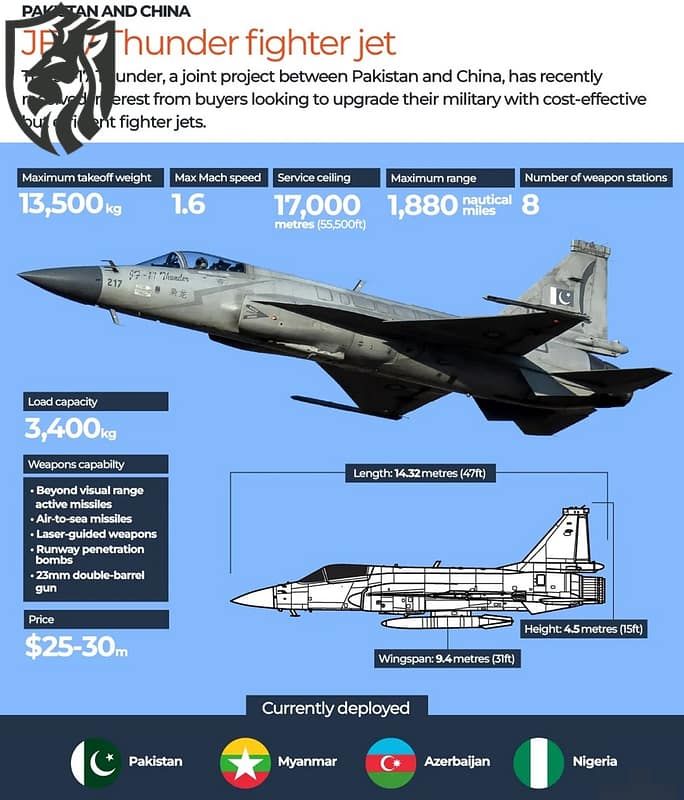
JF-17 Combat Frame
The JF-17 became much more well-known after the February 27, 2019, Swift Retort attacks, when reports and open-source investigations indicated that PAF JF-17s used stand-off glide-bomb kits—locally called “Takbir” range-extension kits—against Indian military targets One widely cited account describes the weapon as an INS/GPS glide kit on a Mk-83-class bomb, used to hit preselected impact points rather than direct hits on headquarters targets. During the May 2025 crisis caused by India’s Operation Sindoor, some reports linked to Pakistan said that JF-17s fired CM-400AKG missiles at parts of India’s S-400 system, including the
However, public, independently verifiable battle-damage evidence has not been widely produced, so these strike claims remain disputed however when Prime Minister Modi reached Adampur Airbase to boost the morale of his troops after Operation Sindoor concluded, Modi stood in front of the S-400 deployed there, but unfortunately only launchers were there, and the 96L6E “Cheese Board” radar was not seen. Later, the Pakistan Air Force (PAF) claimed to have destroyed the radar during a near-suicide, one-sided mission. Either way, the messaging hinged on standoff range and sensor-link confidence.
Confirmed JF-17 operators (as of Jan 2026)
| Country | Status | Variant focus (publicly reported) | Quantity reported | Deal/ops risk | Evidence |
|---|---|---|---|---|---|
| Pakistan | Core operator (lead user) | Block I/II + Block III in service | “More than 150” in PAF inventory (reported) | Low (domestic programme) | Al Jazeera cites the JF-17 forming the bulk of the PAF, with more than 150 jets. (Al Jazeera) |
| Myanmar | Export operator | Block II (incl. twin-seat) | Ordered: at least 16; delivered: 7 (reported) | Medium–High (sanctions, sustainment/spares friction) | Al Jazeera reports at least 16 ordered and 7 delivered under project Ruby. (Al Jazeera) |
| Nigeria | Export operator | Block II | 3 inducted (May 2021) | Medium (budget + sustainment pipeline) | A Nigerian Air Force statement confirms the induction of 3 JF-17s on 20 May 2021. (Nigerian Air FOrce) |
| Azerbaijan | Export operator (newest) | Block III | Initial order: 16; 5 publicly unveiled/overflight (Nov 2025) | Low–Medium (integration, training, follow-on support) | Janes describes four single-seat and one twin-seat at the Victory Day parade (Nov 2025). (Default) Al Jazeera reports an initial order of 16; those five were unveiled in November 2025. (Al Jazeera) |
Active negotiations (as of Jan 2026)
| Country/buyer | Status | Quantity/scope reported | Deal risk | Why does the risk look that way? | Evidence |
|---|---|---|---|---|---|
| Indonesia | Advanced talks | “More than 40” JF-17s discussed | Medium | Big-ticket, multi-year procurement; competing options; contract not signed | Reuters: talks at an advanced stage involving more than 40 JF-17s. (Reuters) |
| Bangladesh | Interest / exploratory | Includes 40 JF-17 (reported) | Medium | Interest acknowledged, but not a signed contract; procurement timelines are long | Al Jazeera: Bangladesh has expressed interest (not a signed deal). (Al Jazeera) |
| Saudi Arabia | Financing-linked talks | Convert ~$2B loans into JF-17 purchases (reported) | Medium–High | Deal hinges on state financing structure and political timing | Reuters: talks to convert about $2B of Saudi loans into a JF-17 purchase. (Reuters) |
| Libya (LNA) | Reported package deal | Includes 16 JF-17 (reported) | High | UN arms embargo/legal & diplomatic exposure, plus internal conflict risk | Reuters: The reported $4.6B package includes 16 JF-17 jets. (Reuters) |
| Sudan | Late-stage package; JF-17 “possible” | The JF-17 is described as a possible add-on (no figures) | High | Active civil war environment; export-control/sanctions complexity; delivery risk | Reuters (via Arab News): The deal includes aircraft/drones/air defence and possibly JF-17 fighters. (Arab News) |
Bottom line
As of 2026, the JF-17 Block III’s “combat success” is more about how reliable the system is—using network-based strategies, long-range missile capabilities, and consistent performance And its “sale success” is increasingly measurable: visible inductions (Azerbaijan), large package deals (Libya), and negotiations that are now counted in dozens of airframes (Indonesia) rather than token batches. For future engagements, PAF wants to expand its experience with JF-17 manufacturing into new ventures, including PFX and Turkish KAAN local production.
References
- https://www.janes.com/osint-insights/defence-news/air/update-pakistan-shows-jf-17-block-iii-fitted-with-pl-15-missiles-for-first-time
- https://www.pac.org.pk/avionic
- https://www.reuters.com/world/asia-pacific/pakistan-indonesia-closing-jets-drones-defence-deal-sources-say-2026-01-12/
- https://www.reuters.com/world/asia-pacific/pakistan-strikes-4-billion-deal-sell-weapons-libyan-force-officials-say-2025-12-22/
- https://www.reuters.com/business/aerospace-defense/pakistans-military-says-it-has-signed-contract-sell-jf-17-fighter-jets-2024-09-26/
About the Author