
Israel’s MiG-29 Tests — What Pilots Really Found
A rare chance to fly the “enemy’s” Fulcrum
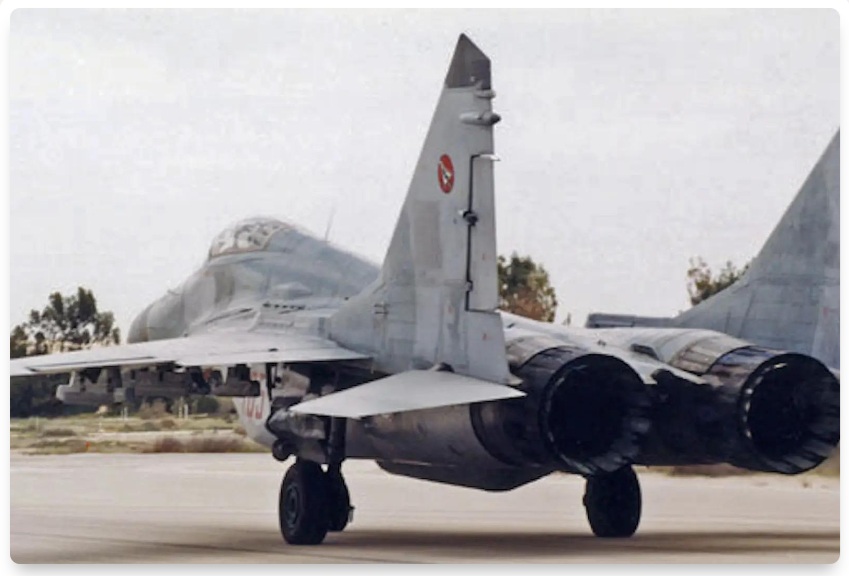
When Israel’s MiG-29 Fulcrum tests began in the late 1990s, Israeli pilots knew they were sitting on gold. Most Western air forces lacked sustained, instrumented access to frontline Soviet fighters. Israel suddenly had three MiG-29A Fulcrums to fly, pull apart and quietly compare against its own F-15s and F-16s.
The aircraft arrived through a discreet deal with Poland, which had inherited MiG-29s from the Warsaw Pact and was pivoting towards NATO. Official statements stayed vague about the source, yet aviation analysts quickly pointed to Warsaw and to three airframes that slipped out for “evaluation.”.
Israel’s MiG-29 Fulcrum tests offered a priceless opportunity: to learn exactly how a potential adversary’s frontline fighter handled, turned, and fought—before meeting it for real over Lebanon or Syria.
How Poland quietly enabled Israel’s MiG-29 Fulcrum tests
Most open sources place the evaluation in the late 1990s, often between 1997 and 1999, with the jets operating from a desert base in southern Israel. Polish MiG-29As arrived under tight security, received local avionics tweaks and then joined a controlled but very real “enemy” squadron.
Both sides kept public comment to a minimum due to the deal’s ambiguous political nature. However, the fact that Israel’s MiG-29 Fulcrum tests happened at all tells you how seriously Warsaw wanted to cement its NATO future—and how determined Jerusalem was to understand Soviet design logic from the inside.

Dogfights in the Negev: Fulcrum vs Baz and Netz
Following the jets’ inspection, the Israeli Air Force swiftly transitioned into unique air combat training. Pilots pitted the MiG-29 against F-15 Baz and F-16 Netz fighters in scripted engagements that mirrored real Middle Eastern scenarios. Reports from those of Israel’s MiG-29 Fulcrum tests suggest that, in a close-in dogfight, the Fulcrum was no pushover. Its instantaneous turn rate, powerful engines and high-alpha handling impressed even seasoned Israeli pilots. Many quietly admitted they would not want to meet a well-flown MiG-29 in a turning fight without a plan.
Moreover, the helmet-mounted sight and R-73 missile changed Soviet tactics in a basic, brutal way. Pilots rushed to the merge, pointed the cue at the enemy, and let the missile solve geometry. Israeli F-16C and F-15C upgrades later copied this approach, proving how compelling the idea really was. The MiG-29, however, demonstrated that this pairing was already deadly long before Western cockpits embraced it. If you want a broader comparison, look at Defence News Today’s Rafale M versus MiG-29K naval air-power analysis. That piece explores similar trade-offs between raw agility, modern avionics, and long-term sustainment burdens.
Cockpit culture clash: Soviet ergonomics vs Western workflows
However, Israel’s MiG-29 Fulcrum tests also highlighted a different story in the cockpit. Israeli pilots found that while the MiG-29’s raw performance impressed, Soviet ergonomics demanded more effort. The switch placement, symbology, and workload felt less intuitive than in the F-15 and F-16.
In Western jets, decades of human-factors work had produced “flows” that fighter pilots could fly in their sleep. In contrast, the MiG-29 reflected a culture that expected pilots to work harder physically but also accepted a higher baseline risk. Israeli crews made jokes about the Fulcrum’s ability to outclimb their fighters, but their maintenance chiefs likely worried about some of the design compromises.
Nevertheless, Israel’s MiG-29 Fulcrum tests confirmed something uncomfortable: in the hands of a competent pilot, the Fulcrum could absolutely threaten Western types of its generation, especially if the fight collapsed into a tight, low-altitude turning battle.

The MiG-29’s clever landing gear party trick
One detail from Israel’s MiG-29 Fulcrum tests stuck in many pilots’ minds: the landing gear logic. In the MiG-29A, if the gear handle stays in the “retracted” position, the system automatically retracts the landing gear after landing when conditions are met. As the main gear folds away, the wheels are automatically braked to a stop during retraction.
This feature sounds small, yet it reflects a very specific design philosophy. Soviet engineers wanted to reduce pilot workload and prevent a tired or distracted pilot from forgetting to stow the gear after a touch-and-go. The automatic brake also reduces stress on components and eliminates the risk of spinning tires entering the bays.
By contrast, contemporary F-15 and F-16 designs relied more heavily on pilot habit and checklist discipline for those tasks. The automation in the Fulcrum made some Israeli aviators smile; one can imagine a veteran F-16 pilot muttering that “the jet is babysitting me now” while secretly appreciating the safeguard.
From a safety and sortie-generation standpoint, Israel’s MiG-29 Fulcrum tests indicated that even small automation features can shave seconds off the pattern, cut mishap risk and keep maintenance crews happier.
What Israel actually gained from the Fulcrum
Strategically, Israel’s MiG-29 Fulcrum tests were never just about flying a cool jet. It was about rewriting tactics, updating threat libraries, and preparing for future wars. Radar signatures, infrared profiles, throttle responses, and climb rates are all fed into classified databases that have shaped engagement rules for years.
Moreover, Israel used the Fulcrum to stress-test its fighters and ground-based radars. How early could existing sensors detect a low-flying MiG-29 on a realistic route? How quickly could an F-15 CAP intercept if the Fulcrum used terrain masking? Those answers influenced everything from patrol altitudes to missile shot doctrine.
Modern readers can discern a similar operational approach in Ukraine’s approach to its Gripen fighter order and air-power shift, highlighting the importance of comprehending both friendly and enemy platforms beyond mere brochure statistics.

Why Israel’s MiG-29 Fulcrum tests still matter today
Today, fifth-generation aircraft dominate headlines, yet the lessons from Israel’s MiG-29 Fulcrum tests remain relevant. Many air forces still face legacy Soviet types across their borders. In any future conflict, the first jets they meet may be Fulcrums, Flankers or their Chinese derivatives rather than stealth fighters.
Therefore, understanding how those aircraft actually fly—where they shine, where they struggle and how their pilots think—still matters. Israel’s experience shows that flying the opponent’s jet, even for a short window, can generate years of doctrinal advantage.
For defence professionals and enthusiasts, Israel’s MiG-29 Fulcrum story carries a simple but powerful message. Air power is never just about buying the newest shiny aircraft. It depends on understanding the whole threat ecosystem that surrounds those jets. Small details matter, from smart landing-gear logic to helmet sights that completely reshape close-in dogfights.
References
- https://www.twz.com/israels-secretive-mig-29-fulcrum-test-program The War Zone
- https://en.wikipedia.org/wiki/Mikoyan_MiG-29 Wikipedia
- https://jasonblair.net/wp-content/uploads/2015/06/MIG29-Flight-Manual-Pt-2.pdf jasonblair.net
- https://defensenewstoday.info/indias-rafale-m-vs-mig-29k-the-debate-over-naval-air-superiority/ DEFENSE NEWS TODAY
About the Author