

Trophy APS for Indian Tanks—Rafael-L&T MoU
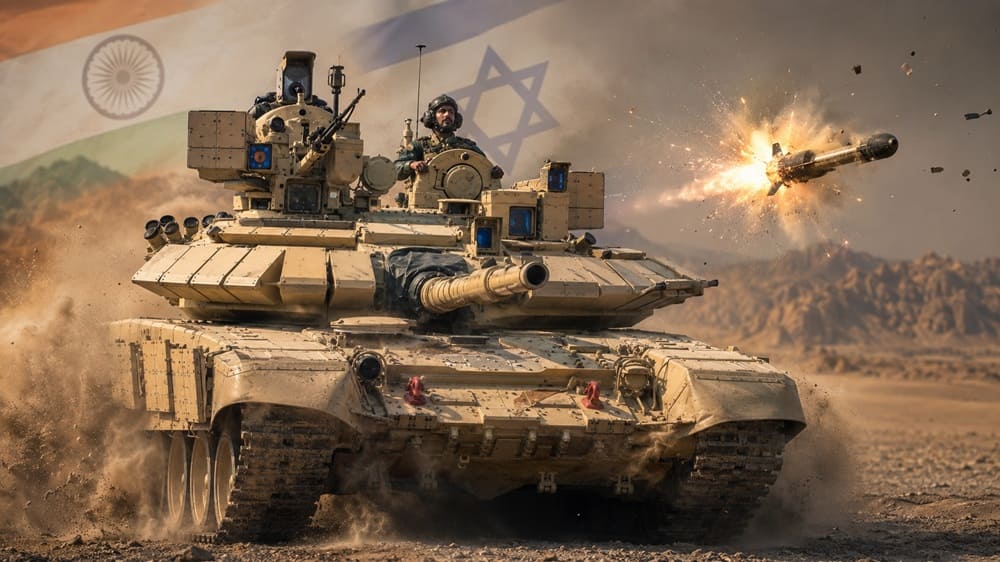
Rafael Advanced Defense Systems and Larsen & Toubro have taken India’s armoured modernization debate to a more serious level. At Aero India 2025, the two companies signed a memorandum of understanding to jointly offer the Trophy Active Protection System for Indian defense platforms. The cooperation will enable Trophy APS to be indigenously produced with local sustainment and a customized fit for Indian combat vehicles, L&T said.
Rafael-L&T Targets Indian Armour
The proposal for the Trophy APS for Indian tanks is important, as India needs to defend a large mixed armoured fleet against anti-tank guided missiles, rocket-propelled grenades, loitering munitions, and small drones. Modern battlefields have already shown that armour cannot rely on steel, composite armour and explosive reactive armour alone.
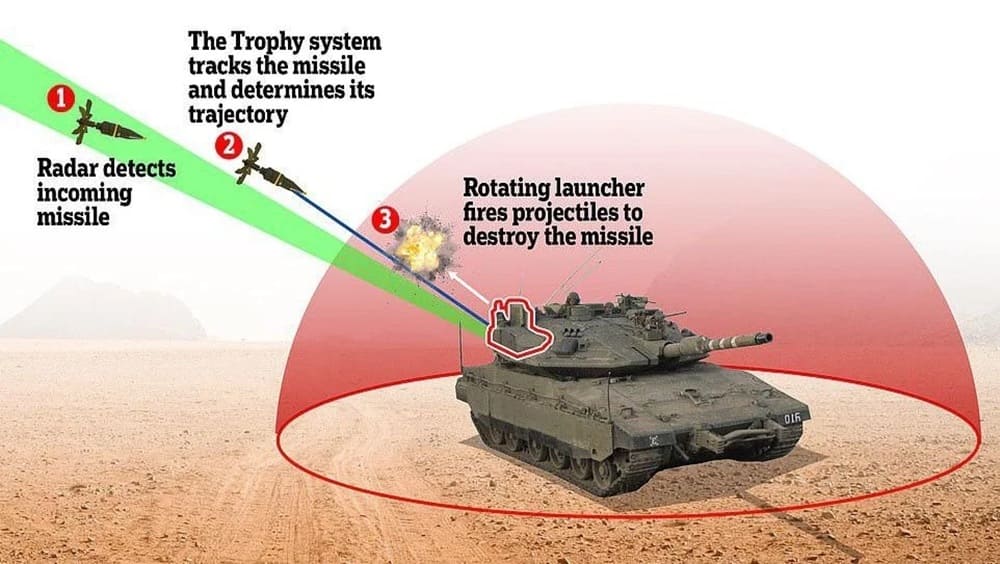
Trophy gives commanders an additional layer of defense. It detects, tracks and destroys incoming threats before they impact. Additionally, Larsen & Toubro’s local manufacturing role aligns with India’s wider Aatmanirbhar Bharat and Make in India policy. This is important because sustainment, spares, software support and platform integration determine whether an APS is a battlefield asset or a costly add-on.
Why India Needs Trophy APS
India has one of the biggest tank fleets in the world. According to Military Balance 2024 figures, open-source reporting says the Indian Army has about 1,200 T-90S tanks, 2,418 T-72M1s, and 122 Arjun tanks in service. Thus, a major survivability upgrade must be aimed at in-service platforms and not future vehicles.
The Trophy APS idea for Indian tanks can be initially implemented on high-value platforms like T-90S Bhishma and Arjun Mk-1A. But the same logic could be extended later to infantry fighting vehicles, self-propelled artillery and the Zorawar light tank family. This wider application would build a more compelling industrial case for local production.
T-90S Bhishma Remains Priority
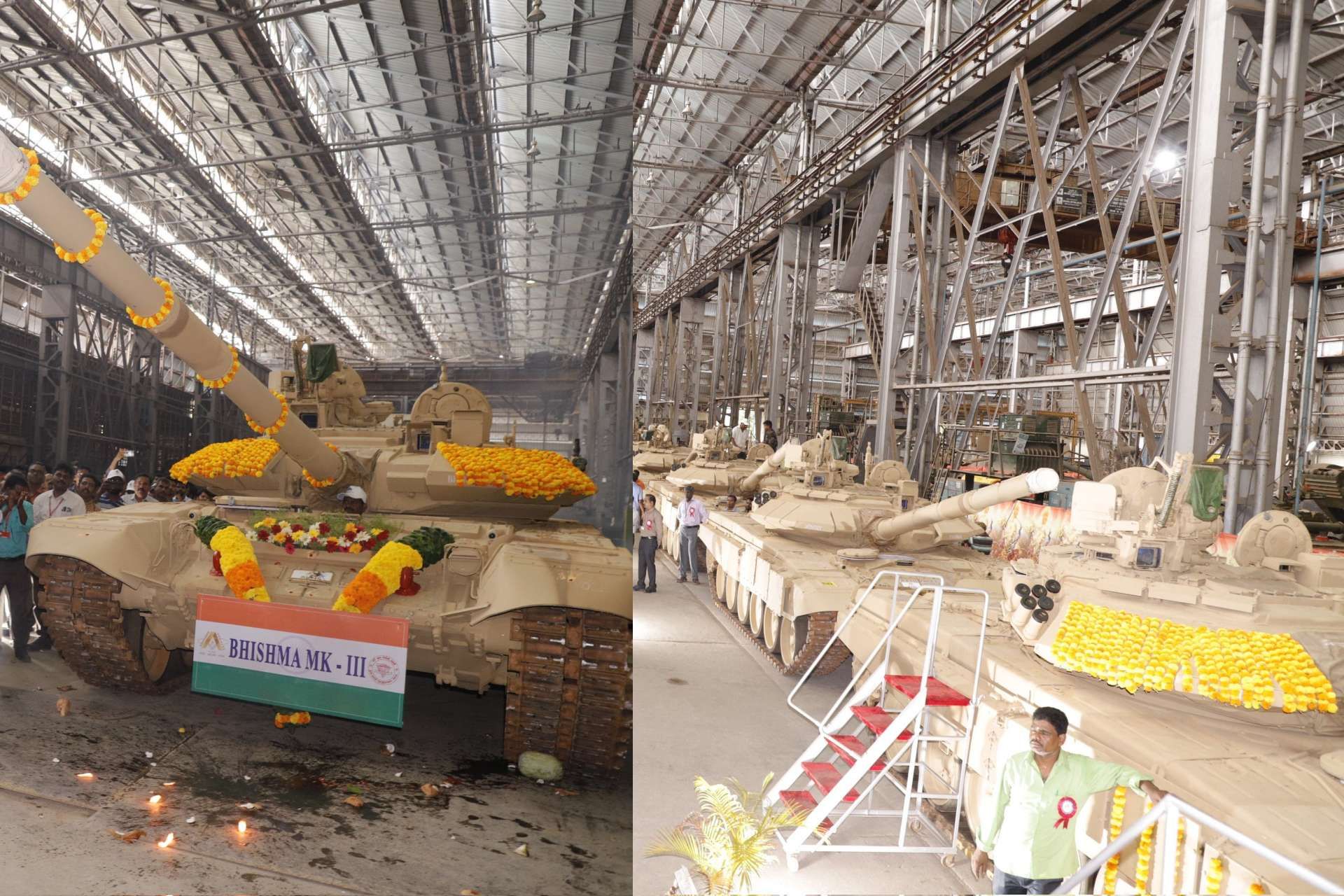
The T-90S Bhishma remains the backbone of India’s armoured formations. The T-90 is a 46.5 tonne tank with a three-man crew, 1000 hp engine and 125 mm smoothbore gun, says Armoured Vehicles Nigam Limited. It also says that India had signed the first contract for 310 tanks in 2001 and 124 of them were built in Russia, and the rest were sent to India for final assembly.
This history makes the T-90S an obvious candidate for the Trophy integration. India already has the production, overhaul and user experience on the platform. That means the Army could reduce integration risk by modernising a known combat system rather than waiting for a brand-new tank fleet.
Arjun Mk-1A and Local Production
The Arjun Mk-1A also works well. The Heavy Vehicles Factory, Avadi, will supply 118 Arjun Mk-1A tanks to the Ministry of Defense of India after the latter placed a ₹7,523 crore order in September 2021. The vehicle has 72 new features that increase its firepower, mobility and survivability, the official release said. However, low-volume production limits the fleet-wide rate of change.
So, Trophy APS for Indian tanks should not be considered just an Arjun upgrade. India needs a multi-faceted approach. It needs to upgrade T-90S units, extend the shelf life of some T-72 formations, and prepare future platforms for active protection from the design stage. Learn more about how digital survivability is changing armour by reading Defense News Today’s analysis of how main battle tank software works.
Zorawar and the China Threat
The Zorawar light tank adds another strategic dimension. The class was developed by India for high-altitude operations where heavier tanks would have mobility problems. India’s Type 15 light tank and its impact on Chinese planning in Ladakh-like terrain. This provides Zorawar tank protection without taking away its weight advantage.
Trophy integration on Zorawar would be a technical tightrope. Engineers have to deal with power draw, radar placement, weight, recoil effects and crew safety arcs. A compact APS, however, could greatly improve a light tank’s survivability against missiles and drone-launched munitions in mountain warfare.
Why T-72 Upgrades Matter
India cannot ignore the older T-72 fleet. In March 2025, Reuters reported that India signed a $248 million contract with Rosoboronexport for 1,000 hp engines for T-72 tanks. India has roughly 2,500 T-72s with 780 hp engines, and the report states that the engine upgrade enhances mobility and offensive capability.
That upgrade suggests that India still values its legacy armour. But protection must keep pace with mobility. But a faster T-72 is still vulnerable if modern missiles, drones and top-attack threats can kill it before it gets into firing range.
Impact on South Asia
The Trophy APS proposal for Indian tanks would affect South Asian deterrence. Pakistan and China will be watching the course of integration. The incorporation of India into APS across elite armoured units could enhance confidence in offensive manoeuvres under missile-heavy conditions. But enemies will adapt with salvo tactics, top-attack profiles, drones, electronic warfare, and cheaper decoys.
That is why APS should support, not replace, doctrine. India still needs to conduct reconnaissance, provide electronic protection, develop drone defense, implement counter-battery fire, and improve battlefield networking. Electronic warfare can also interfere with navigation and command systems in contested border areas. Defense News Today reports on GPS jamming near the India-Pakistan border.
Cost and Sustainment Challenges
The final deal is to depend on costs, delivery schedules, integration trials, and Indian content. APS is not a bolt-on shield. It needs sensors, interceptors, power, software, crew training, and maintenance depth.” Additionally, each of the platforms requires safe firing zones to prevent injury to nearby infantry.
Indian production can lower lifecycle costs and boost the defense industrial base in the country. It may also create future export opportunities. However, India must avoid the fragmented adoption of APS across too many platforms without common standards.
Conclusion
Rafael’s and L&T’s MoU provides India with a viable route to boost armoured survivability. Trophy APS may harden T-90S Bhishma, Arjun Mk-1A and possibly Zorawar light tanks against missile and drone-era threats.
Meanwhile, the real test is after the announcement. India has to demonstrate integration, sustainment, and affordability at scale. If successful, Trophy APS could be more than just an imported defense system. It may become a key pillar of India’s future doctrine of armoured warfare.
References
- https://www.larsentoubro.com/pressreleases/2025-02-15-rafael-and-lt-sign-mou-to-jointly-offer-trophy-active-protection-system-for-indian-defence-platforms
- https://www.pib.gov.in/PressReleasePage.aspx? PRID=1757320
- https://www.reuters.com/business/aerospace-defense/india-signs-248-million-deal-with-russia-advanced-battle-tank-engines-2025-03-07/
- https://avnl.co.in/products/t90-bhishma
About the Author


House Banao focuses on quality, transparency, and budget-friendly solutions. From planning to final handover, everything is handled by professionals. Whether you need low budget house construction or a luxury home, the team provides customized solutions based on your needs.