
Israeli F-15 Systems Reach Qatar and Saudi Arabia
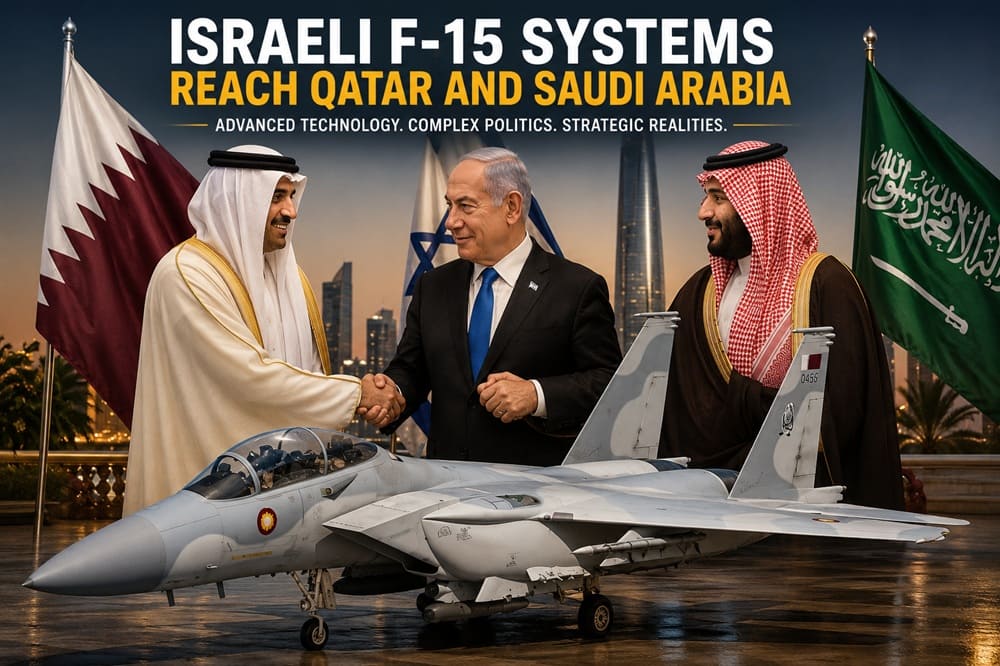
A new report says that Israeli F-15 systems are at the heart of a sensitive Gulf defense story. The Israeli aircraft protection equipment was supplied to Qatar and Saudi Arabia as part of wider aviation and fighter programmes, along with advanced pilot equipment, Israeli media citing Haaretz reported.
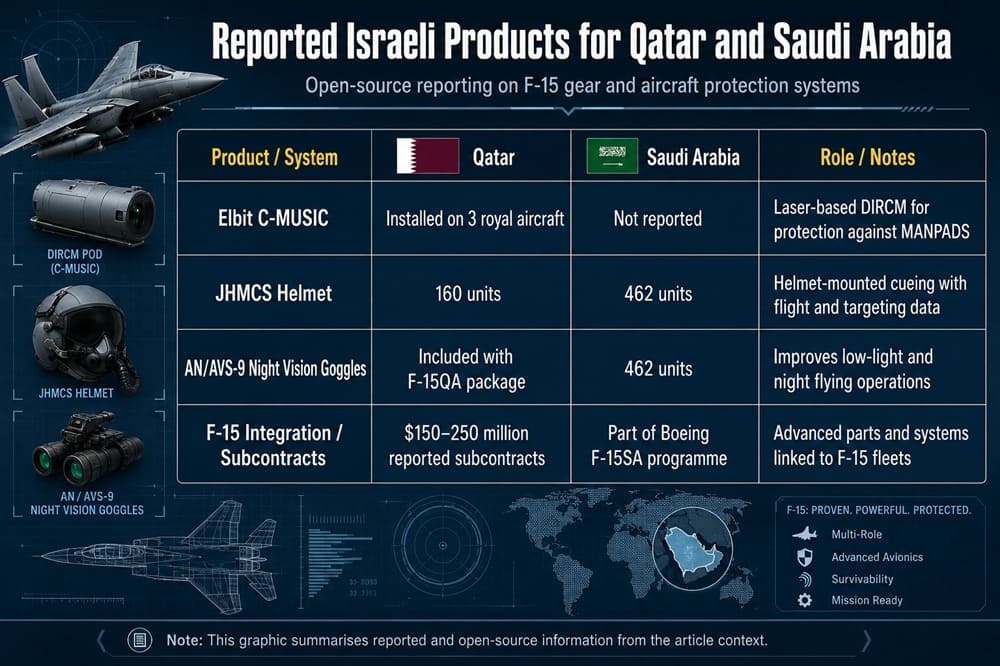
This is an important claim, as neither Doha nor Riyadh has open defense relations with Israel. The transfers are covered in two parts. Elbit’s C-MUSIC aircraft defense system is apparently being installed on three aircraft used by the Qatar royal family. [Qatar and Saudi Arabia are reportedly outfitting F-15s with JHMCS and AN/AVS-9 night vision goggles.]
Israeli F-15s in Gulf Airpower
Between 2020 and 2022, Haaretz found that the Qatari royal family equipped three of its 11 aircraft with Elbit C-MUSIC. The installation reportedly occurred during aircraft maintenance in Basel, Switzerland. Last year, the Emir of Qatar, Tamim bin Hamad Al Thani, reportedly flew to Tehran on an aircraft carrying the system. The politically striking thing is that Israeli technology is protecting the Qatari state plane visiting Israel’s chief regional adversary.
C-MUSIC is an anti-MANPADS, or anti-shoulder-launched surface-to-air missile. It senses an incoming missile and shoots a powerful laser to jam the missile guidance. The system is user-friendly and can be installed at various locations of the aircraft. The same family also guards Israel’s prime minister’s aircraft, Wings of Zion. It is also said to be employed on the French presidential aircraft and other VIP platforms.
Qatar’s F-15QA Connection
The fighter element is based on the 2017 US-Qatar deal for F-15QA Ababil aircraft. The contract revealed that Israeli companies received subcontracts worth between $150 million and $250 million, the report said. The subcontracts included advanced components and systems for Qatar’s jets, the report said. The most eye-popping items were 160 JHMCS helmets, which will cost a cool $200,000 each, and AN/AVS-9 night-vision goggles.
These systems matter because modern fighter lethality depends on what the pilot can see, track and cue The helmet visor displays flight and targeting data. This allows a pilot to designate targets faster than using only cockpit displays. The equipment adds to an already sophisticated combat fleet for Qatar. The F-15QA, along with Rafale and Eurofighter Typhoon aircraft, enhances the combat fleet. Thus, the reported Israeli F-15 systems add a politically unusual dimension to Doha’s procurement structure.
Saudi F-15SA Helmet Gear
Saudi Arabia received these through a previous Boeing F-15SA programme. In 2010, the US Department of Defense said Riyadh had received 462 JHMCS helmets and 462 AN/AVS-9 night-vision goggles of the same models supplied to Qatar. The equipment can be seen operating in online video, the report said. If the report is true, Saudi F-15 operations have used Israeli-linked helmet-cueing technology for years.
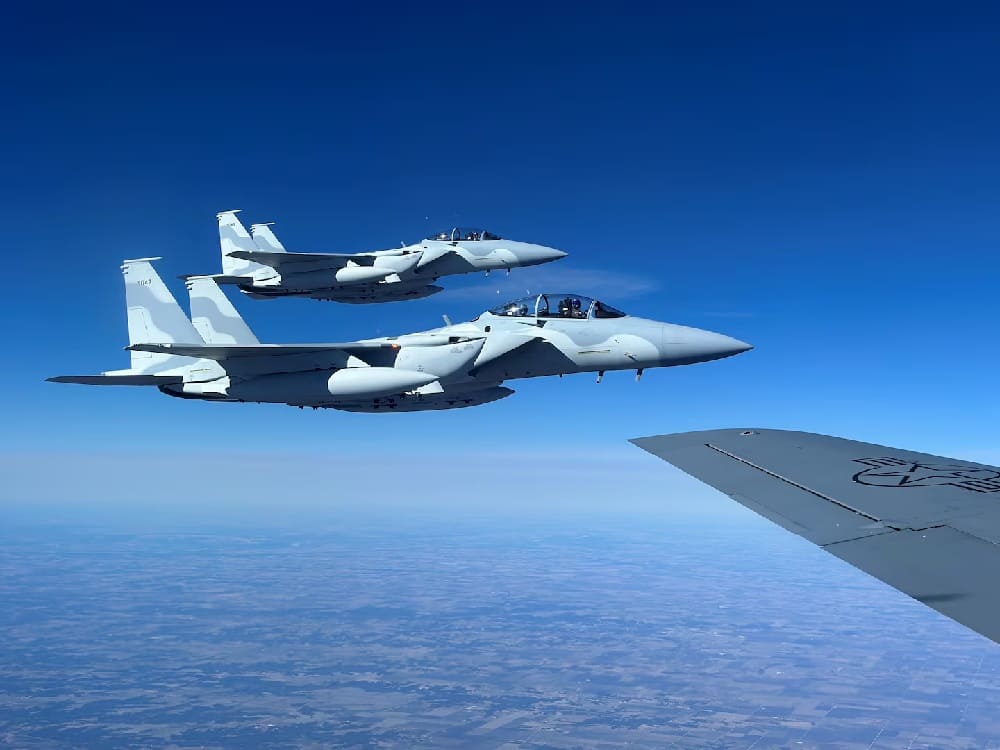
Furthermore, US-led fighter contracts can include sub-systems from a number of allied suppliers even if the ultimate customer has no formal ties to any one of them. Saudi F-15SA fighters also made an appearance on 13 May 2025 in a diplomatic setting. President Donald Trump arrives in Saudi Arabia escorted by Royal Saudi Air Force F-15s. That incident differed from the Israeli supply chain that had been reported. But it showed the high prestige of the plane.
Why This Technology Matters
JHMCS and AN/AVS-9 goggles are not fashion accessories. Helmet cueing enables quicker target designation, particularly at short ranges. Night vision goggles also enhance operations in darkness and reduced visibility. Thus, these systems enhance the value of aircraft weapons, radar and sensors. A fighter may carry capable missiles, but the pilot still needs rapid awareness and cueing.
That is, Israeli F-15 systems are part of the human-machine interface layer of modern air combat. C-MUSIC, however, is not quite the same. It protects non-combat aircraft from IR guided missile threats. Such protection is vital for VIP aircraft passing through unprotected areas or high-threat airspace. So the Qatari royal jet case is about survivability, not offensive capability.
Qatargate and Gulf Diplomacy
“The politics are tricky. Saudi Arabia had long been mooted as a potential candidate for normalisation with Israel before the Hamas-led massacre of 7 October 2023. That track was consistent with the Abraham Accords. But normalisation now seems a long way off, with the leaders of Israel and Saudi Arabia saying it is not on the table for the time being.
It’s a different spin from Qatar to Israel. Doha has faced criticism over its long-standing support for Hamas, which has included monthly cash payments to cover official expenses like buying fuel and boosting the Gaza economy. Those arrangements have come under renewed scrutiny by Israeli critics during the Gaza war.
The issue is also a link to the so-called Qatargate affair. Maj. Gen. (res.) Yoav ‘Poli’ Mordechai, deputy envoy for hostage talks in the Israel Defense Forces, was suspended last year on suspicion of his involvement in the affair. Novard and his company reportedly represented Rafael and Elbit in marketing defence products to the Qatari government. Israeli media reported that Mordechai and his partner collected thousands of dollars in brokering fees on Elbit sales to the ruling family of Qatar.
Novard also allegedly signed a contract with Perception, a public relations firm owned by Yisrael Einhorn, a former aide to Netanyahu, to improve Qatar’s image ahead of the 2022 World Cup. Mordechai continued to serve on the negotiating team even after the media exposed his links to Qatar.
Strategic Bottom Line
Available reporting points to indirect links, not direct Gulf-Israel defense ties. Israeli technology is seeping into Gulf fleets through aviation maintenance, US-led F-15 deals and subcontractor networks. That’s a big difference. Defense supply chains are often international, but politics has not yet caught up with them.
However, this case is especially sensitive because it involves Qatar, Saudi Arabia, Israel, Iran, Hamas and high-level Gulf aircraft. Simultaneously, Israeli F-15s reveal a covert level of Middle Eastern airpower. They show how to navigate complex procurement channels using advanced avionics, pilot gear and aircraft protection systems even when public diplomacy is frozen.
References
- https://defensenewstoday.info/saudi-f-15sa-iris-t-integration-riyadhs-airpower-shift/
- https://defensenewstoday.info/f-22-and-f-35-software-inside-the-code-war/
- https://www.timesofisrael.com/israel-sold-advanced-f-15-systems-and-gear-to-qatar-and-saudi-arabia-report/
- https://www.elbitsystems.com/air-space/airborne-self-protection/dircm-systems/c-music
- https://www.jpost.com/israel-news/article-859812
About the Author