

Israel Sacks Officers over Oct 7 Failure
A systemic failure
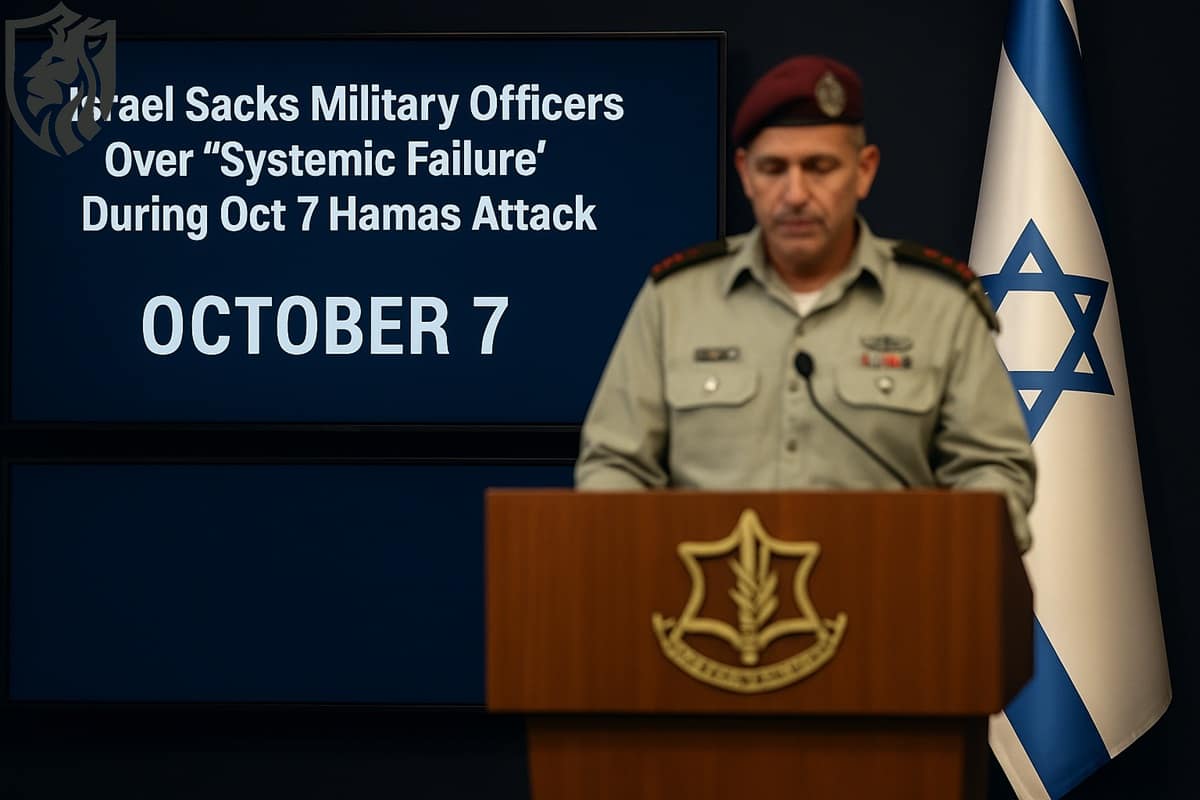
Following the October 7 Hamas attacks, Israel has dismissed military officers due to a systemic failure, which represents one of the most extensive accountability efforts in IDF history. In a sober national address, Chief of the General Staff Lieutenant General Eyal Zamir framed the moves as essential to restoring trust after the military failed in its primary duty: protecting Israeli civilians.
He stressed that the IDF cannot move forward if it ignores its worst security failure in decades. Therefore, Israel sacks military officers over systemic failure as more than a symbolic gesture. The actions aim to integrate challenging lessons into doctrine, culture, and command practice.
October 7: intelligence collapse
The context for why Israel sacks military officers over systemic failure remains stark. On 7 October 2023, Hamas and allied groups launched a coordinated land, air, and sea assault from Gaza. More than 1,200 people in Israel were killed, most of them civilians, and roughly 240 hostages were dragged into Gaza.
The attackers overran communities near the border, hit military sites, and overwhelmed local defences. Consequently, analysts now frame the day as a compounded failure of intelligence warning, force posture, and real-time command decision-making. For readers tracking the broader conflict, Defence News Today’s Israel–Hamas war coverage offers a wider operational backdrop to the announcement that Israel sacks military officers over systemic failure.
Zamir’s two missions: victory and trust
Zamir explained that, when he assumed command, he carried two urgent missions. First, he must lead the IDF towards a decisive victory in a multi-arena war spanning Gaza, Lebanon, Syria, and potentially Iran. Second, he must rebuild public confidence so that another 7 October never occurs.
Because of that dual mandate, Israel sacks military officers over systemic failure as part of a wider “systemic shaping” phase. Zamir described an in-depth inquiry that traced breakdowns from frontline units up through the General Staff. In his words, the findings offered an “unequivocal picture” that the IDF failed in its primary mission that day and that the failure was severe, resounding, and systemic.

Removed or Reprimanded?
Against this backdrop, Israel is sacking military officers over systemic failures. The focus is on those directly responsible for intelligence, operations, and south-front defence. Several major generals are being removed from reserve service, including Aharon Haliva, Oded Basyuk, and Yaron Finkelman. They held senior responsibility for the events of 7 October and now face direct consequences.
The accountability net stretches further than outright dismissals from service. Air Force Commander Major General Tomer Bar has received a formal reprimand from the military leadership. Navy Commander Vice Admiral David Saar Salama and Major General Shlomi Binder have also been formally reprimanded.
Several brigadier generals and colonels will either leave reserve roles or retire altogether. In this way, Israel sacks military officers for systematic failures, signalling that reprimands will influence future promotions.
Command responsibility
Zamir admitted that the decisions weighed heavily on him, since many affected officers had fought beside him for decades and helped deliver important wartime gains in the past two years. Nevertheless, he argued that, if senior leaders dilute responsibility, public trust will erode. Therefore, Israel fires military officers as a result of a systemic failure to hold high-ranking officials accountable.
At the same time, he warned against a political or media culture that casually undermines commanders. Israel, he argued, “does not have the privilege” of discarding experienced leaders wholesale. This tension runs through the whole announcement: Israel sacks military officers over systemic failure, yet it tries to preserve a professional command core that can still fight a long war.
For a more profound look at how other militaries balance accountability and continuity, readers can revisit Defence News Today’s analysis of command performance in high-intensity conflict.
Strategic signalling to adversaries
Zamir also used the address to send a message outward. While Israel sacks military officers over systemic failure, he insisted that ongoing operations will not slow. He pledged that Israel “will not allow threats to develop; there will be no containment”, signalling to Hamas, Hezbollah, and Iran that internal reforms do not equal hesitation on the battlefield.
For defence analysts, this dual track is notable. Israel sacks military officers over systemic failure to reassure its public while continuing multi-front operations to reassure allies and deter adversaries. External observers, including NATO partners and regional states, will watch whether the IDF can reform its intelligence and command processes without degrading its operational tempo.

Inquiry to structural reform
The phrase “period of systemic shaping” hints that Israel sacks military officers over systemic failure as only the first step. Internal IDF review panels have already pointed to long-standing weaknesses in intelligence fusion, threat assessment culture, and readiness standards ahead of the attack.
Going forward, analysts expect changes in how the IDF defines acceptable risk, allocates forces to the Gaza envelope, and supervises intelligence assumptions about Hamas’s intent and capability. If Israel sacks military officers over systemic failure but leaves these deeper habits untouched, the reforms will be cosmetic. If it follows through with doctrine, training, and technology shifts, the move could reshape Israeli deterrence for a generation.
What this means for future conflicts
Ultimately, Israel sacks military officers over systemic failure to demonstrate that even wartime militaries must confront their mistakes. For militaries worldwide, the case will feature in staff-college discussions about how to manage large-scale surprise, hostage crises, and multi-domain aggression.
For Israel itself, the test lies ahead. The public will judge whether these measures, and any future state inquiry, actually close the gaps exposed on 7 October. If they do, then the painful decision to sack and reprimand senior officers may strengthen, rather than weaken, Israel’s long-term security.
References
- https://www.defensenewstoday.info
- https://www.defensenewstoday.info/tag/israel-gaza-war
- https://www.britannica.com/event/Israel-Hamas-War Encyclopedia Britannica
- https://www.dni.gov/nctc/terrorist_groups/hamas.html Director of National Intelligence
About the Author