
Iranian F-5 Strike on Camp Buehring
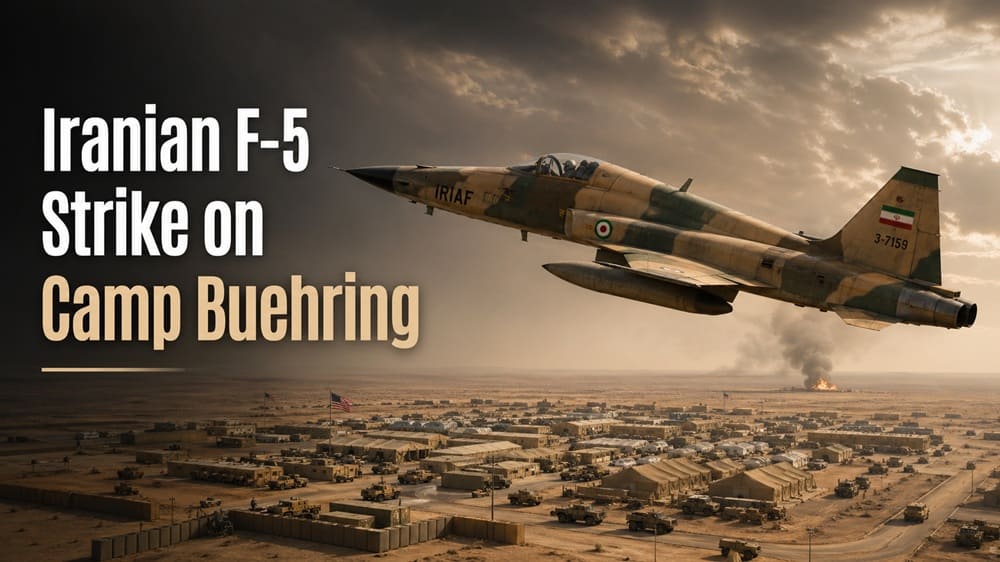
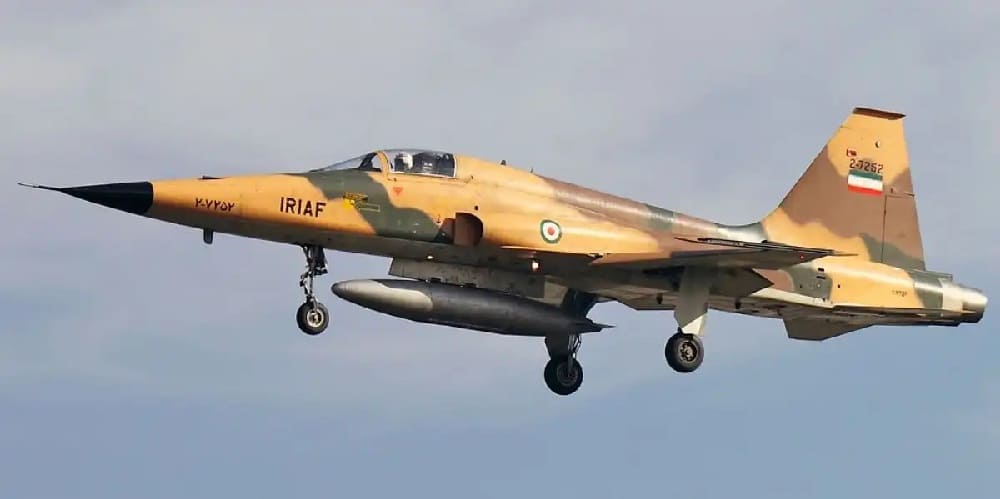
One of the oddest episodes of the recent Gulf conflict has been the alleged Iranian F-5 attack on Camp Buehring. The Aviationist reported that in the opening stages of the war an Iranian F-5 allegedly bombed Camp Buehring in Kuwait. The same report emphasized that independent verification of the claim remains difficult, so we should treat the incident as reported, not fully confirmed.
But the allegation matters because Camp Buehring is no minor desert base. It supports U.S. Army Central operations in Kuwait and is part of the larger American military footprint in the Gulf. Area Support Group-Kuwait, a persistent presence, supports theater operations in partnership with the Kuwait Ministry of Defense, according to US Army Central.
F-5 Tiger Technical Relevance
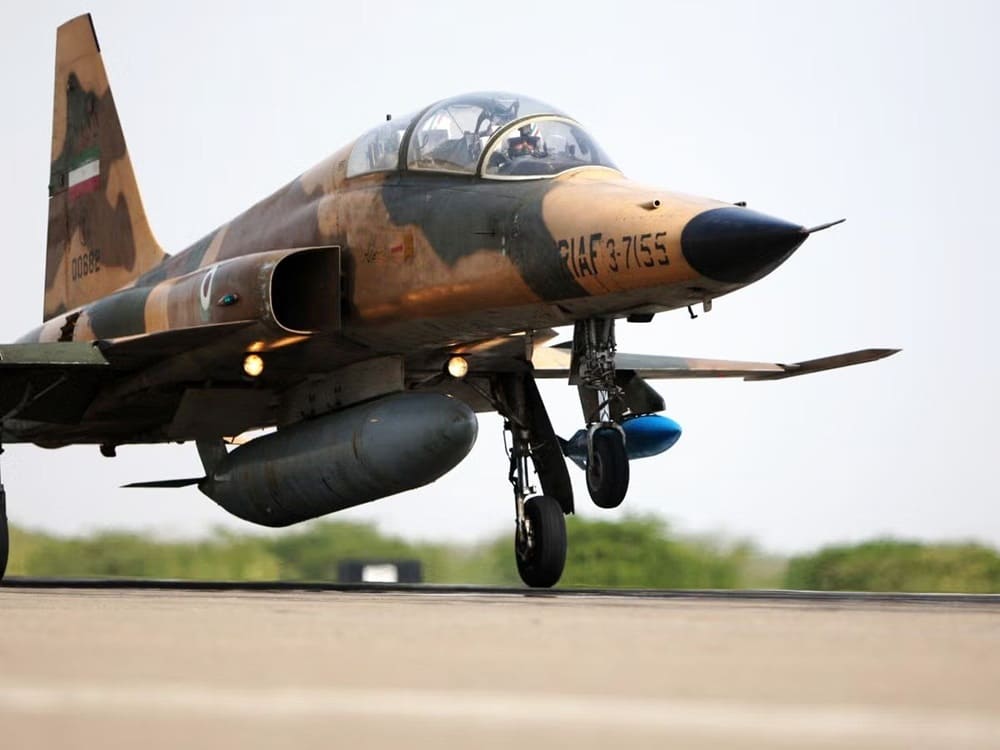
The F-5 Tiger II is an old aircraft, but in some conditions, it still has tactical relevance. NAVAIR describes the F-5 as a twin-engine tactical fighter and attack aircraft with two J85-GE-21C afterburning turbojets for propulsion. Compared to modern fighters, it is a small, agile, simple platform. It has a published speed of Mach 1.64 at altitude and a small physical profile due to its compact 8.1 metre wingspan.
The F-5’s value does not derive from stealth or advanced sensors. It isn’t. It’s derived from simplicity, speed, and low-flying maneuverability. Iran inherited American-built F-5s before the 1979 revolution and has kept several Cold War-era aircraft flying through local maintenance, upgrades, and reverse engineering.
If Iran’s F-5 strike on Camp Buehring is confirmed, it would not, by itself, prove that the Tiger II can overcome modern air defenses. Instead, the old aircraft would exploit confusion in a crowded battlespace.
Vintage Mirage vs Carrier Defense
In May 1995, during Exercise Inspired Alert, the Mirage V aircraft from the Pakistani Air Force reportedly penetrated the defensive screen of the U.S. Navy aircraft carrier USS Abraham Lincoln during a simulated maritime strike, according to Pakistani accounts. Mirage fighters were not a part of the Pakistan Navy. They were Pakistan Air Force aircraft, tasked with maritime strike roles, likely in support of naval objectives.
The aircraft is reportedly from No. 8 Squadron “Haiders,” a unit involved in anti-shipping missions and Exocet missile tactics. The Mirages flew at a very low level to reduce the radar detection range. This approach takes advantage of the radar horizon, since sea-skimming aircraft can go undetected until they are much closer to a carrier group.
Pakistani sources say the strike package came from several directions. That would have required defenders to track and prioritize multiple threats at once. A powerful carrier battle group can briefly puzzle over low-flying aircraft that show up late and at odd angles.
By the mid-1990s, the Mirage V had become an old aircraft. But it still had utility in a specialized strike role. Its speed, simplicity, and low-level attack profile made it well-suited to simulated anti-ship operations. The aircraft was reported to have flown an Exocet-style attack profile before making a close pass near the carrier.
That is no exaggeration. Military exercises have safety rules, artificial limits, and scripted boundaries. In a war situation a US carrier would depend on airborne early warning, fighter patrols, electronic warfare, escort ships, surface-to-air missiles, and close-in defence systems.
But there’s a useful lesson in the episode. Older aircraft can still be dangerous if pilots use timing, silence, low altitude, and multi-axis attack geometry to their advantage. Age of the platform is not always the difference.” More often it is planning, training, surprise, and pressure of decision that matters.
The Mirage episode is still relevant for those who are interested in defence issues. It demonstrates how saturation, low-altitude attack, and human decision-making can create short but critical gaps in even sophisticated defensive screens.
Attack Logic
One F-5 alone could not penetrate a defended U.S. military installation. Radar coverage, combat air patrols, Patriot batteries, short-range air defense and command-and-control networks should normally detect and challenge such an aircraft. Regular wartime airspace doesn’t last long enough. According to The Aviationist, Iran reportedly hit more than 100 targets at 11 bases in seven countries, damaging hangars, warehouses, command buildings, communications systems, and radar infrastructure.
The larger campaign provides the technical context for the reported F-5 incident. These threats, missiles, drones, decoys, and electronic pressure can force defenders to prioritize dangers. “Ballistic missiles are a matter of immediate attention. Cruise missiles need another chain of command. Drones can fly slowly, at low altitudes, and in large numbers and are difficult to track. Thus, a crewed aircraft might exploit a narrow window of timing. The Iranian F-5 strike on Camp Buehring probably relied on timing, not air superiority.
Air Defense Saturation Decisions
Layered air defense is most effective when operators receive clean identification, clear tracks, and enough time to act. Saturation beats all of them. It produces too many targets, too many alerts, and too much ambiguity.
Furthermore, coalition airspace introduces political and operational friction. The U.S. has forces in Kuwait, but “you’ve got to be cautious to identify when you are near friendly aircraft,” he said. In fast-moving combat, operators need to avoid both missed intercepts and friendly-fire errors.
This scenario is where the old planes can become dangerous. A legacy fighter doesn’t have to win a dogfight. It just needs to get in, drop ordnance, and get out before the defenders regain control.
Operational Limits
The F-5 does not carry a heavy strike load compared to larger aircraft. Nor does it have the standoff range of modern strike fighters armed with long-range precision weapons. So, any successful attack would likely involve a small payload and a short exposure window.
Even a small bombing raid can have major effects. It can damage infrastructure, create base lockdowns, disrupt logistics, and create strategic embarrassment. In military terms, psychological damage can be more harmful than physical damage.
This is why the Iranian F-5 strike on Camp Buehring is symbolically important. It suggests Iran could combine older planes with missiles and drones to stretch American defensive systems.
Gulf Bases Security
The main lesson is simple: base defense must be ready for mixed attacks. Patriot-class air defense batteries are still useful, but they cannot solve every problem by themselves. Bases need more effective short-range air defenses, hardened shelters, radar redundancy, decoys, dispersal plans, and rapid repair capacity.
Commanders also need to train for combined attacks, not isolated threats. A missile-only exercise is not representative of a real strike package. Nor does a drone-only exercise catch the danger. Modern base defense must be prepared for missiles, drones, aircraft, cyber pressure, and electronic warfare converging.
The Gulf region can also use sensor fusion. Better data-sharing between the host nation and U.S. forces can reduce confusion. Faster classification could narrow this gap and close the distance between detection and engagement.
Why This Case is Significant
The reported Iranian F-5 strike on Camp Buehring proves old platforms aren’t obsolete. Creative use of old aircraft by planners can still count. They are more useful as part of a larger strike architecture. But caution is necessary here as well. There is still no full official battle-damage assessment in open-source reporting.
“Analysts should not blow up the F-5’s performance or turn a reported breach into a myth. However, the event provides a serious warning. Modern air defenses can fall apart under pressure, especially when defenders face volume, ambiguity, and simultaneous threats.
Conclusion
The reported Iranian F-5 attack on Camp Buehring was not extraordinary because the Tiger II had become a modern combat aircraft. It was remarkable, because a legacy fighter might have taken advantage of the stresses of modern air defense.
If later confirmed, the incident will demonstrate that survivability today is a function of integration, redundancy, training, and quick decision-making. Advanced interceptors are important but they cannot replace disciplined base defense So Gulf military planners should take the F-5 case as a warning: Old birds, too, can be deadly in a carefully timed saturation attack.
References
- https://theaviationist.com/2026/04/26/report-claims-iranian-f-5-bombed-us-base/
- https://www.navair.navy.mil/product/F-5-Tiger-II
- https://www.usarcent.army.mil/About/Units/ASGKuwait/
- https://defensenewstoday.info/defense-branches/air-force/
About the Author