
War Thunder Database inspired by U.S. Army’s ODIN Database
It sounds like the U.S. Army ODIN database is just a simple archive. In reality, it’s a lot more than that. The Army’s digital hub for threat data, training materials, and resources for opposing forces is called ODIN, or Operational Environment Data Integration Network. So, it gives soldiers, trainers, and planners one place to make realistic exercises instead of having to look for information in different systems.
That matters because readiness now depends on the situation as much as the strength of the troops. Units need to get ready for operations in more than one domain, changing conditions, and smarter enemies. Because of this, the Army needs a platform that brings together scenario design, enemy force portrayal, and knowledge of the operational environment in one place. Both Army and Military Review articles show that ODIN and DATE (Decisive Action Training Environment) are part of a bigger movement toward threat-informed training.
Inside the U.S. Army ODIN Database
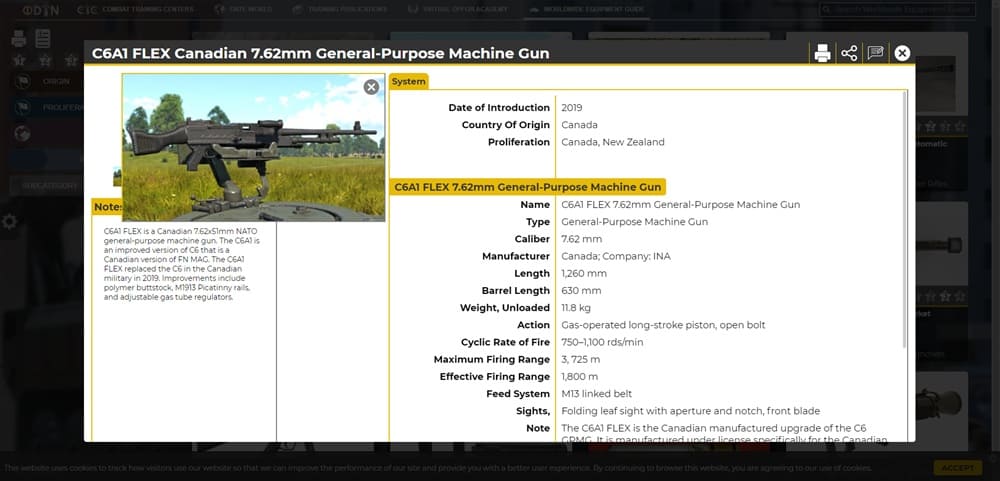
The Worldwide Equipment Guide (WEG) is the first big part of ODIN. The Army says that the WEG helps with U.S. Army training and showing OPFOR in constructive, virtual, live, and gaming settings. In short, it helps units show how foreign systems might work, which American forces might have to deal with now or in the near future. So, the WEG is less about gathering random facts and more about making the threat picture the same across all training programs.
The second pillar is DATE, which stands for the Decisive Action Training Environment. The Army uses DATE as its official scenario-development tool and as an unclassified training environment. It gives trainers a single, scalable framework that looks like real operational environments but can be used in a wide range of schools, units, and exercises. Because of this, commanders can train in conditions that are similar to real life without having to link every event to a secret intelligence package.
Military Review said in 2025 that DATE helps soldiers train in real life, online, and in a constructive way throughout their careers. The same article says that DATE now includes twenty-four imaginary countries that are based on real-world conditions and covers Africa, Eurasia, the Indo-Pacific, and the polar regions. Because of this, DATE has grown from a smaller Army training tool to a larger tool for getting ready for combat in many areas and on a large scale.
Why ODIN Is More Than Data
The U.S. Army ODIN database gets more intriguing here. A normal database keeps track of data. ODIN connects information to training activities. The official Army pages say that the platform is a central hub for WEG, DATE, Threat, and OPFOR doctrines, training materials, the Virtual OPFOR Academy, and Combat Training Center content. The real benefit of that integration is that it lets users go from equipment to doctrine to scenario design without having to switch between tools that aren’t connected.
That structure also makes things more consistent. Without a common framework, one unit might see an enemy in one way while another unit builds a very different threat model. ODIN helps keep things from getting too far apart by giving Army users a common starting point for equipment, doctrine, and operating conditions. Still, it gives trainers the freedom to change a scenario to fit their own needs. The DATE World material from T2COM makes the same point: DATE is the setting, not the situation itself.
That difference is important. DATE gives the background conditions, geography, enemies, and tensions, while trainers add the specific events. In other words, the U.S. Army ODIN (Operational Data Integration Network) database first makes a believable world, and then it lets units choose the exact fight they want to practice. That’s why ODIN is better thought of as a training system than just a database.
Why the OPFOR Academy Matters
The Virtual OPFOR Academy (VOA) is another important part of ODIN. The Army says that the VOA gives users the tools and resources they need to learn, use, and copy OPFOR counter-tasks that are related to their unit’s training goals. That is useful, not just for looks. A believable enemy has to do more than just show up on a slide. It needs to move, trick, react, and make friendly units solve tough problems while under stress.
That’s why doctrine is still important, along with lists of equipment. A tank, drone, or air defense system alone does not make a realistic enemy. Tactics do. Decision cycles do. Survivability, deception, and fire control do. The U.S. Army ODIN (Operational Data Integration Network) database is important because it links enemy hardware to enemy behavior, which is where useful training turns into hard training.
ODIN also helps combat training centers (CTCs) by giving them custom content tailored for their specific training needs. The public CTC ODIN pages provide details on force organization, equipment ordering, and connecting to major training sites. Because of this, rotating units can train for the Army’s toughest group training events from a more standard threat baseline.
Why ODIN Matters More Widely
The growth of DATE and the operational-environment enterprise behind it give ODIN more meaning. Military Review says that DATE has grown to include the joint, multinational, and interagency spaces. The article says that the U.S. Marine Corps, the Defense Intelligence Agency, and the Department of State are some of the users. That growth shows that shared training environments now help both readiness and interoperability. The DATE World material from T2COM adds another level. It says that DATE World is the Army’s official, unified, and scalable training environment, not just a set scenario.
The user community also includes partners from other countries, such as the United Kingdom, Australia, Canada, and New Zealand, in addition to the U.S. Army. Moreover, Military Review notes that ABCANZ partners have formal arrangements around DATE use, which reinforces its role in coalition training. The U.S. Army’s ODIN database is also a useful example of how to prepare for military service digitally for people who read about defense. It shows how the Army makes threat-informed training into a system that can be used again and again.
Final Assessment
In the end, the U.S. Army ODIN database isn’t a normal database. It is a structure for training. It brings together the Worldwide Equipment Guide, DATE, OPFOR doctrine, training materials, CTC tools, and the Virtual OPFOR Academy all in one place. Because of that, it helps the Army show threats more consistently, make better exercises, and train leaders in ways that feel more like real war, ultimately enhancing their preparedness for contemporary combat scenarios.
That is why ODIN is important. Being ready for the modern world doesn’t just mean having weapons, money, or a certain number of troops. It also depends on whether soldiers train in a realistic operational setting with believable enemies and new ideas. The Army can do that in a structured way with ODIN. It also shows that digital knowledge systems are now at the center of combat preparation, not on the edges.
References
- https://oe.t2com.army.mil/odin-oe-data-integration-network/
- https://www.armyupress.army.mil/Journals/Military-Review/English-Edition-Archives/July-August-2025/Training-Environment-Indo-Pacific/
- https://oe.t2com.army.mil/2022/01/31/date-world-users-blog-2-what-is-date-world/
- https://odin.tradoc.army.mil/WEG
About the Author