
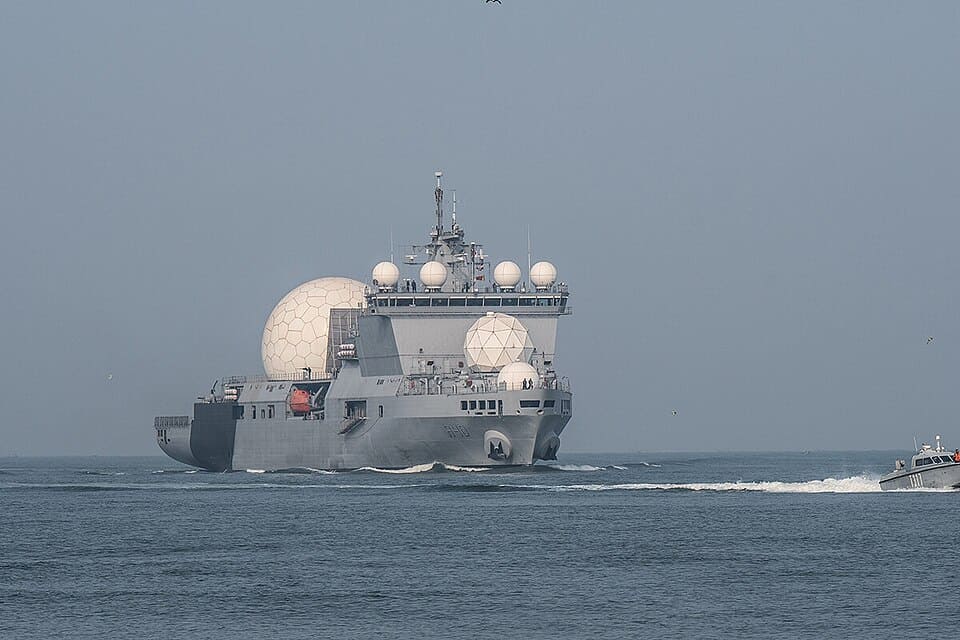
INS Dhruv Tracks Pakistan Missile Test at Sea
The news of Pakistan’s missile window in the northern Arabian Sea has turned a routine launch notice into a more important strategic story. According to open-source reports, Pakistan set up a big air and sea exclusion zone near Karachi, Ormara, Gwadar, and Sonmiani from April 14 to 15. Reports said that at the same time, India sent its specialist tracking ship, INS Dhruv, to the Arabian Sea. This mix is vital because it shifts the focus from the launch to the data both sides want to protect or obtain.
The story about the INS Dhruv Pakistan missile test is important because it has to do with deterrence, naval surveillance, and technical intelligence. There is still no official word from the Indian Navy or the Pakistani military about what the ship’s exact mission is. However, the news reports provide sufficient detail to clarify the reasons behind the event’s significant attention in the area.
Importance of INS Dhruv
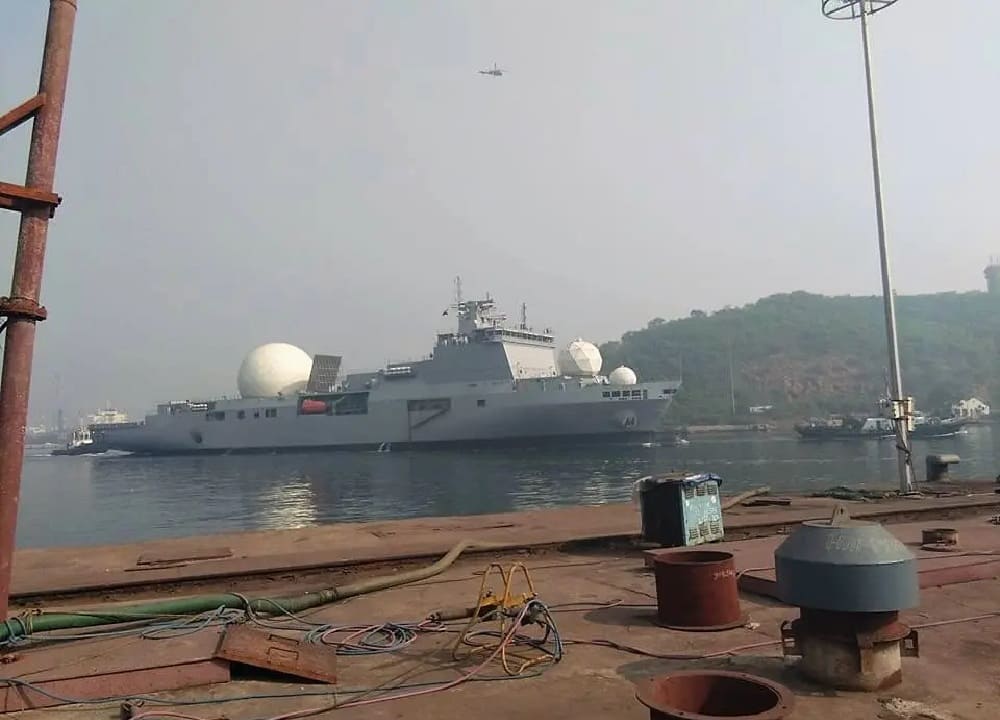
INS Dhruv is a specialized platform for tracking missiles and monitoring the ocean, rather than a regular patrol ship. India added it in 2021 as a specialized platform for tracking missiles and watching the ocean. The ship is capable of monitoring missile tests, collecting electronic intelligence, and assisting with anti-ballistic missile operations. Hindustan Times also said that it was India’s first naval ship that could track nuclear missiles from a long way away.
Because of that role, timing is crucial. If a missile test is coming up, a ship like Dhruv can get telemetry, radar behavior, and flight-profile data from outside the launch zone. Therefore, even a deployment during peacetime can seem politically charged. One side thinks that monitoring is legal. The other sees an effort to reveal the technical signature of a dangerous weapon.
What the Warning Zone Suggests
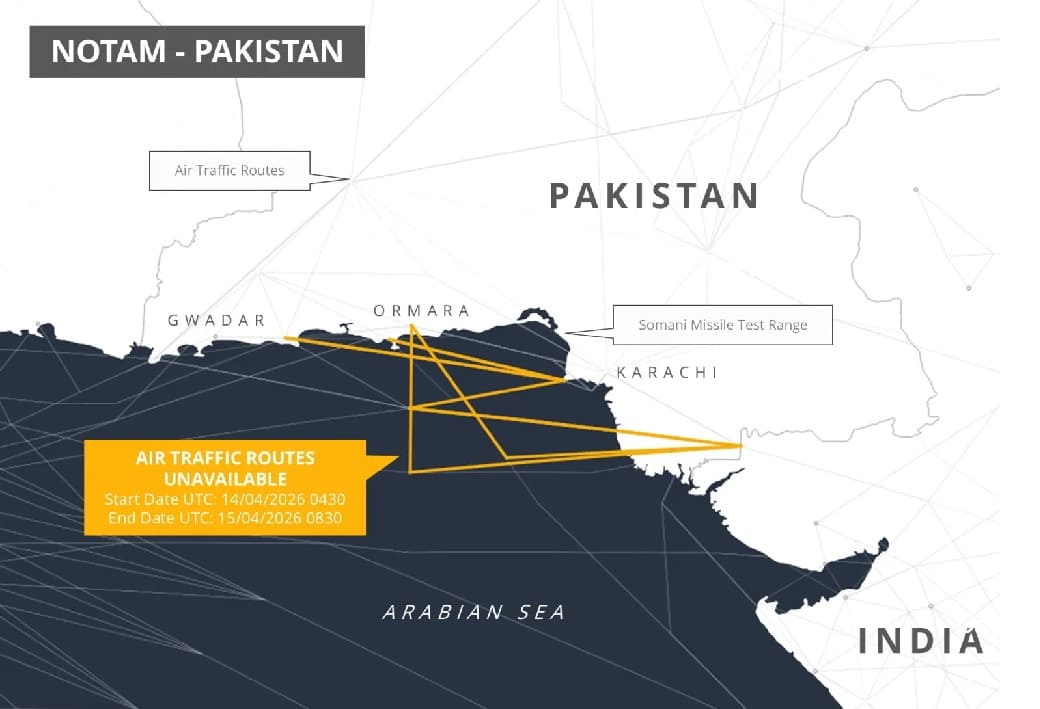
Open-source reporting said that Pakistan’s danger zone was about 415 km to 450 km wide across the northern Arabian Sea. The zone reportedly covered waters near Karachi, Ormara, Gwadar, and Sonmiani and stayed active from sea level to an unlimited height between April 14 and 15. Those details are important. They suggest a launch corridor that is bigger than a regular gunnery drill or a short-range naval firing.
That doesn’t show what kind of missile it is. Pakistan hasn’t said what kind of weapon system it is in public. Analysts suggest that the geography still connects the systems to Pakistan’s long-range precision-strike network or maritime deterrent. People often talk about Ormara and Sonmiani when they talk about Pakistan’s test infrastructure and access to launch sites on the sea.
Why Babur-3 Matters
The Babur-3 submarine-launched cruise missile is probably the most well-known public reference point. In January 2017, Reuters said that Pakistan tested the Babur-3, which can carry nuclear weapons, from an undisclosed location in the Indian Ocean. The Babur-3 has a range of 450 km. Reuters also said that Pakistan said the missile would give them a “Credible Second Strike Capability.” The Missile Threat project at CSIS recorded the same test and said that Pakistani statements talked about advanced guidance, navigation, underwater launch, sea-skimming flight, and stealth-related features.
That history doesn’t prove that Babur-3 cruise missile was involved this week. But it does explain why the story about the INS Dhruv Pakistan missile test became so sensitive. Any launch connected to a sea-based deterrent system would be more important to Indian observers and more secret for Pakistan. Furthermore, even partial telemetry can help an enemy improve its tracking models and plans for defense.
Why the Episode Matters Politically
Missile-tracking ships operate in a legally ambiguous area. If Dhruv stayed in international waters, it wouldn’t automatically break Pakistan’s declared exclusion zone. But legality doesn’t change the strategic effect. The real competition is for signatures: trajectory data, electronic emissions, staging behavior, and seeker performance. The future construction of missile defense and warning systems could undergo significant changes due to these details.
The logic is simple for India. A rare test window might show more in minutes than satellites do in months. The risk is also clear for Pakistan. A sovereign test can turn into a free technical sample for its main regional rival. Because of this, both sides have a reason to see a single launch as more than just a practice run.
Arabian Sea Joins Deterrence Map
Most of the military crises between India and Pakistan over the years have been about land and air power. Things are changing. Pakistan has worked harder on modernizing its navy and on the idea of a sea-based deterrent that is harder to destroy. India, on the other hand, has added to its surveillance, maritime domain awareness, and ballistic missile defense support systems. Dhruv fits in well with that bigger Indian way of doing things.
Because of these developments, the Arabian Sea is now important for more than just moving ships. It is turning into a live intelligence battleground. Every NOTAM, patrol, and naval exercise can set off a matching surveillance response. Even in the absence of missile launches, the political temperature can escalate rapidly.
Why Missile Defence Planners Care
Not only range is not the only most important technical issue here. It’s the quality of the data. A ship like INS Dhruv can help us understand better how a missile rises, cruises, changes direction, and acts near the end of its flight. That kind of information can help with planning interceptors, tracking models, and early-warning systems in the future. Hindustan Times stressed that Dhruv was connected to India’s anti-ballistic missile role and mission to watch over the region.
This episode goes beyond a typical naval observation. India benefits from every extra piece of information that comes from Pakistan’s testing of a strategic or quasi-strategic system. On the other hand, Pakistan has every reason to keep launch conditions, emissions, and flight behavior hidden from foreign sensors. In short, both sides are trying to learn as much as they can before they fight. This is an inference based on the ship’s expected launch time and purpose.
What’s next
There is currently no solid proof of a naval crisis. Pakistan frequently issues warnings regarding missile launches, while India consistently employs various sensors to monitor Pakistan’s missile activities. The difference here is that you can see it. Dhruv is a well-known strategic asset, so its reported presence sends a stronger message than a satellite pass or a mission by a less visible aircraft.
That visibility may affect how people act in the future. Pakistan could make warning zones bigger, make emissions control stricter, or use more tricks in future tests. Conversely, India might persist in utilizing specialized platforms to collect real-time technical data whenever opportunities arise. This cycle doesn’t guarantee that things will get worse, but it does make it more likely that people will misread things.
Conclusion
The primary question is not whether INS Dhruv fired a weapon or violated the law. The main point is that modern deterrence now includes the fight to see. In that way, the INS Dhruv Pakistan missile test might be more important as an intelligence case than as a launch story. It indicates that the naval competition in South Asia is moving toward constant monitoring, collecting signatures, and counter-surveillance at sea.
References
- https://defencesecurityasia.com/en/india-ins-dhruv-arabian-sea-pakistan-missile-test-notam-intelligence-showdown/
- https://www.hindustantimes.com/india-news/ins-dhruv-india-gets-its-first-nuclear-missile-tracking-ship-today-details-here-101631233967587.html
- https://www.reuters.com/article/world/pakistan-fires-first-submarine-launched-nuclear-capable-missile-idUSKBN14T1EJ/
- https://missilethreat.csis.org/pakistan-conducts-first-test-submarine-launched-babur-3-cruise-missile/
About the Author