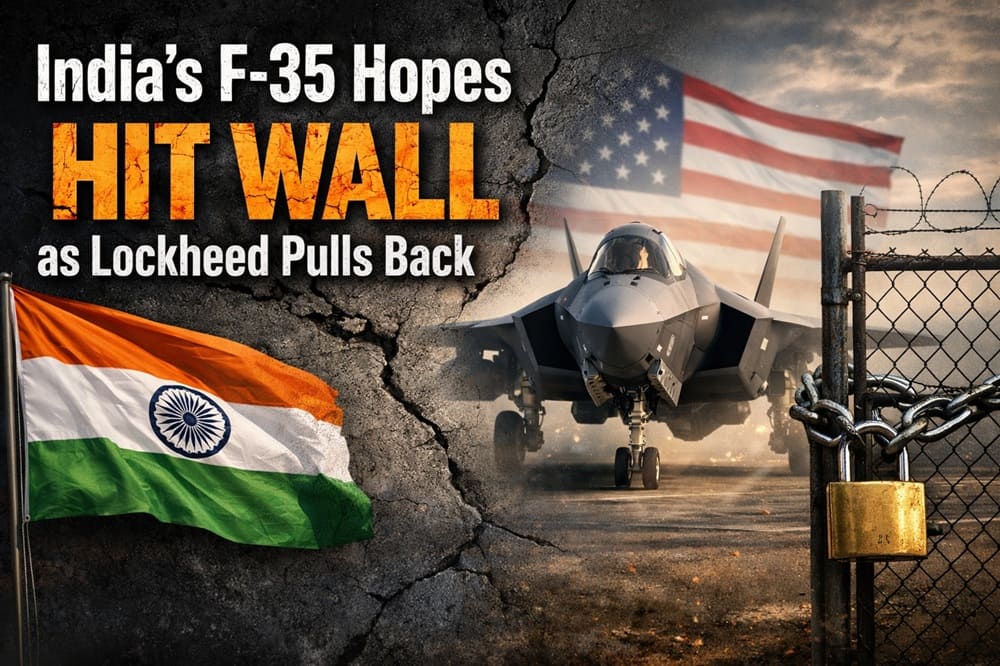
India’s F-35 Hopes Hit Wall as Lockheed Pulls Back
The talks about India’s F-35 are back in the news, but there is still a big difference between symbolism and buying. Lockheed Martin has stressed that any Indian path to the F-35 must go through official U.S.-India government channels, not direct company-to-company dealings. This is significant because it indicates that the plane remains a tightly controlled strategic asset rather than a mere export fighter. It also suggests that the Indian F-35 option, which has been discussed a lot, is more of a political message than a real attempt to buy something.
Why India Isn’t Getting Direct F-35 Talks
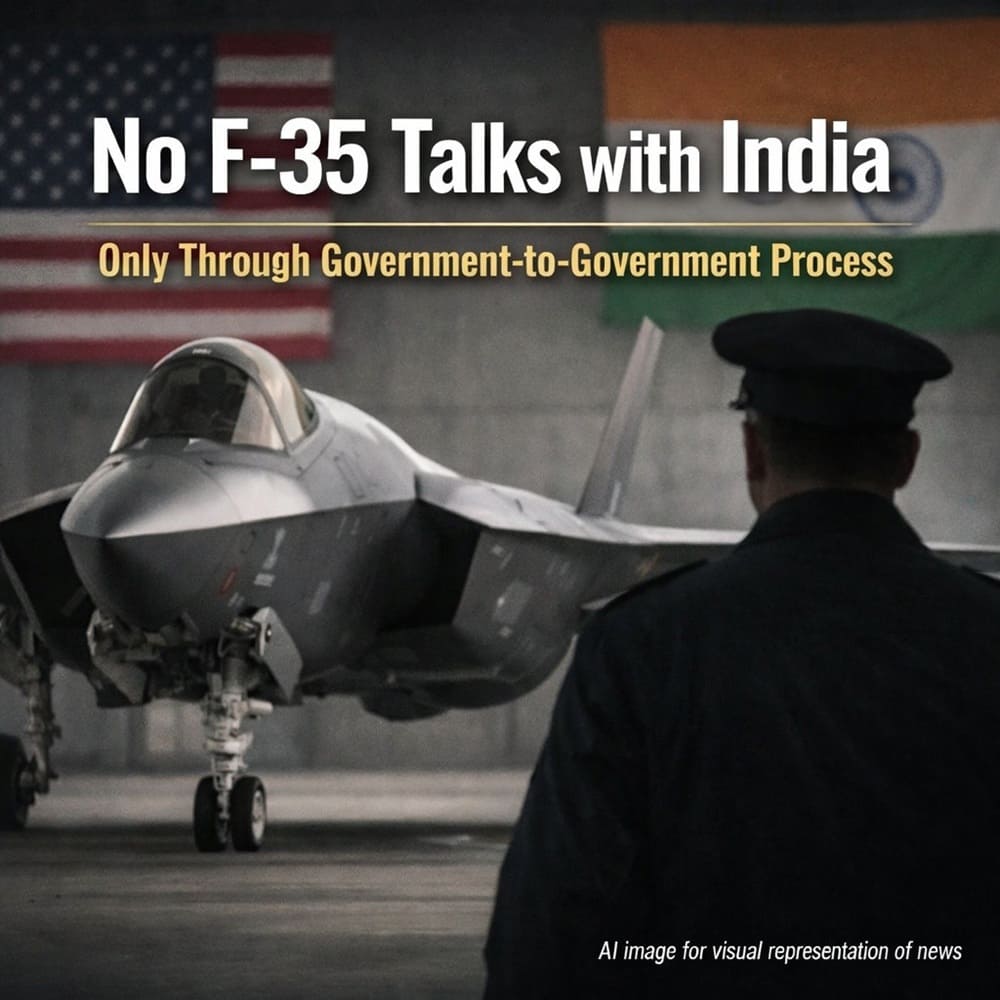
The F-35 is part of the U.S. Foreign Military Sales system, which is different from a regular fighter sale. In practice, a potential buyer must first send a formal Letter of Request. Thereafter, the Pentagon, State Department, and, if necessary, Congress look at the case before a Letter of Offer and Acceptance can go ahead. Lockheed Martin only becomes the manufacturer at this point, not a separate business negotiator. That framework explains why business leaders keep sending questions about India back to Washington and New Delhi.
In February 2025, President Donald Trump added to the debate by saying that Washington was “paving the way” for India to get F-35 fighters. India’s foreign secretary later said, though, that no formal process had begun. Lockheed Martin echoed this sentiment to Reuters, stating that any such move would require one government to communicate with another. So, even though the news stories said otherwise, the talks about India’s F-35 never turned into an open sales campaign.
Why New Delhi Keeps Its Distance
The issue for India is not just the price. It is power. Centralized digital support systems have been a big part of the F-35’s maintenance model for a long time. ALIS and later ODIN were made to keep track of diagnostics, maintenance, and data for the whole fleet. That design makes support better, but it also makes people more dependent on an ecosystem controlled by the United States. That is a big political problem for a country that values strategic autonomy.
Software sovereignty is just as important. The United States has always kept the essential F-35 software code confidential, even from close allies. This is because the aircraft’s stealth management, sensor fusion, and mission software give it an edge in combat. Mission data files are just as important because they help the jet find threats and decide which targets to attack first. So, when India discusses buying F-35s, it quickly runs into a question that people in New Delhi are used to asking: how much real control would India have over the planes it buys?
Cost is another factor that makes things harder. For years, U.S. officials and defense reporters have said that the F-35A costs about $36,000 per flight hour to operate, even though the program has tried to lower that number. India has to balance spending on fighters, missiles, engines, and the navy all at once, so these recurring costs would be difficult to ignore. So, the talks about India getting F-35s don’t just go against policy; they also go against long-term budget logic.
India’s Preferred Force Structure
India’s current strategy for fighters goes in a different direction. In May 2025, Defense Minister Rajnath Singh approved the AMCA program execution model. This gave India’s fifth-generation project a new boost through partnerships with industry. That move is important because AMCA is more than just a fighter plan. It is also an industrial sovereignty project linked to domestic design, integration, and future production. Here is your internal AMCA article.
At the same time, New Delhi has kept buying and using non-stealth fighters that it can use more quickly. India and France reached a $7.4 billion agreement in April 2025 for 26 Rafale Marine aircraft for the Indian navy. The Indian Air Force has also ordered almost 180 Tejas Mk1A planes, but GE engine supply problems have delayed their delivery. In other words, the talks about India’s F-35s are happening at the same time as a procurement pipeline that is already busy, costly, and linked to local production in a political way. Here is your internal analysis of the Rafale or Tejas.
Even what people saw in public matched that reality. The F-35A was on display at Aero India 2025 as part of the U.S. static display package. That made Washington look good at Asia’s biggest air show, but it didn’t show that India was really buying something. So, symbolism moved faster than policy.
Why Russia Still Matters
The Russian Su-57E got involved in this debate for a simple reason: people thought Moscow was more open to talking about making things locally and sharing technology more broadly. In February 2025, Reuters said that Russia offered to make things in India, which fit with the “Make in India” campaign. That doesn’t mean New Delhi is ready to buy the planes. It does mean that India will keep using foreign fighter offers to see how much technology each side is eager to give.
This situation is where the talks about India’s F-35s become a bigger strategic issue. The US wants India to do more to keep China in check in the Indo-Pacific. However, Washington safeguards its most confidential air combat technologies behind impenetrable barriers, preventing their sale. On the other hand, India wants advanced technology without giving up software, industrial power, or operational freedom. We can reconcile those differing viewpoints, but they remain distinct. For background, the official U.S. Foreign Military Sales framework explains the government-controlled route.
What Lockheed’s Stance Means
Lockheed Martin hasn’t given up on the idea of India buying F-35s in the future. Instead, it has repeated the legal and political facts about the plane. Washington can look at India’s formal request if it ever makes one. But until that happens, the F-35 is still just a talking point in diplomatic circles.
That’s why you should read the talks about the India F-35 cautiously. The question isn’t if India likes the jet. The question is if the US will give up some control and if India will accept the platform’s dependence. The answer to both questions still seems to be no for now. Because of this, India is more likely to keep supporting AMCA, Rafale, Tejas, and upgraded legacy fleets than to quickly move toward America’s most secretive fighter.
References
- https://www.dsca.mil/Programs/Defense-Trade-and-Arms-Transfers/Foreign-Military-Sales
- https://www.reuters.com/business/aerospace-defense/markets/commodities/trump-says-india-agreed-purchase-more-us-oil-gas-2025-02-13/
- https://www.pib.gov.in/PressReleseDetailm.aspx?PRID=2131528
- https://www.reuters.com/world/india/india-signs-74-billion-deal-with-france-buy-26-rafale-fighter-jets-2025-04-28/
About the Author