

India GPS NOTAM — South Asian Electromagnetic battle begins
India issues a GPS interference NOTAM over Mumbai FIR just as tri-service drills and regional naval moves ramp up. For defence watchers, the timing suggests that electromagnetic warfare has quietly arrived as a frontline tool in South Asia’s security competition.
Mumbai FIR: Not a routine NOTAM
The focus on India issues GPS interference NOTAM over Mumbai FIR is not a niche aviation detail. The Mumbai Flight Information Region is one of Asia’s busiest crossroads, linking Europe and the Gulf to Southeast Asia and Australia. Thousands of daily movements lean on satellite navigation, particularly on RNAV routes like L639 and P574.
When pilots suddenly face unreliable GPS in this airspace, cockpit workload jumps. Crews must cross-check inertial, radio and procedural navigation, while controllers tighten separation and reroute flows. Therefore, even a short-lived interference window can ripple into delays, extra fuel burning, and holding stacks that stretch already tight schedules.
Civil aviation, first visible victim of EW
For most passengers, the India-issued GPS interference NOTAM over Mumbai FIR will never appear in a news alert. Yet the first place electromagnetic warfare shows up is usually in civil aviation logs, not on TV tickers. No, the problem is not just your airline Wi-Fi having a terrible day; it is the spectrum itself misbehaving. Airlines must plan alternates, file conservative fuel margins and brief crews for degraded navigation and potential GPS spoofing.
Moreover, modern airliners integrate GPS into terrain awareness, timing, and datalink systems. When GNSS interference creeps in, seemingly unrelated alerts or glitches can multiply in the cockpit. Regulators from ICAO and EASA–IATA have warned that jamming and spoofing pose a tangible safety risk if crews are surprised and procedures are weak. ICAO+1 As Defence News Today noted in its recent analysis of GPS spoofing risks for civil aviation, procedures and crew training often matter more than raw avionics sophistication.

Stress-testing India’s airspace
From New Delhi to Mumbai, repeated warnings about GNSS disruption effectively turn the whole network into a live stress test. Indian media have already catalogued multiple GPS interference NOTAMs affecting Delhi, Mumbai and now Kolkata. Business Today+1 Airspace managers must prove they can run a complex hub system while the GPS layer flickers. That is exactly the scenario most war plans assume in the opening hours of a high-end conflict.
In practice, this means reverting to ground-based aids where possible, widening separation minima and accepting lost capacity. It also means rehearsing playbooks for diversions, lost-comm events and mixed-performance traffic. If India issues a GPS interference NOTAM over Mumbai FIR as part of controlled testing, then civil aviation is now a full participant in that rehearsal.
India, Pakistan, China: the electromagnetic war
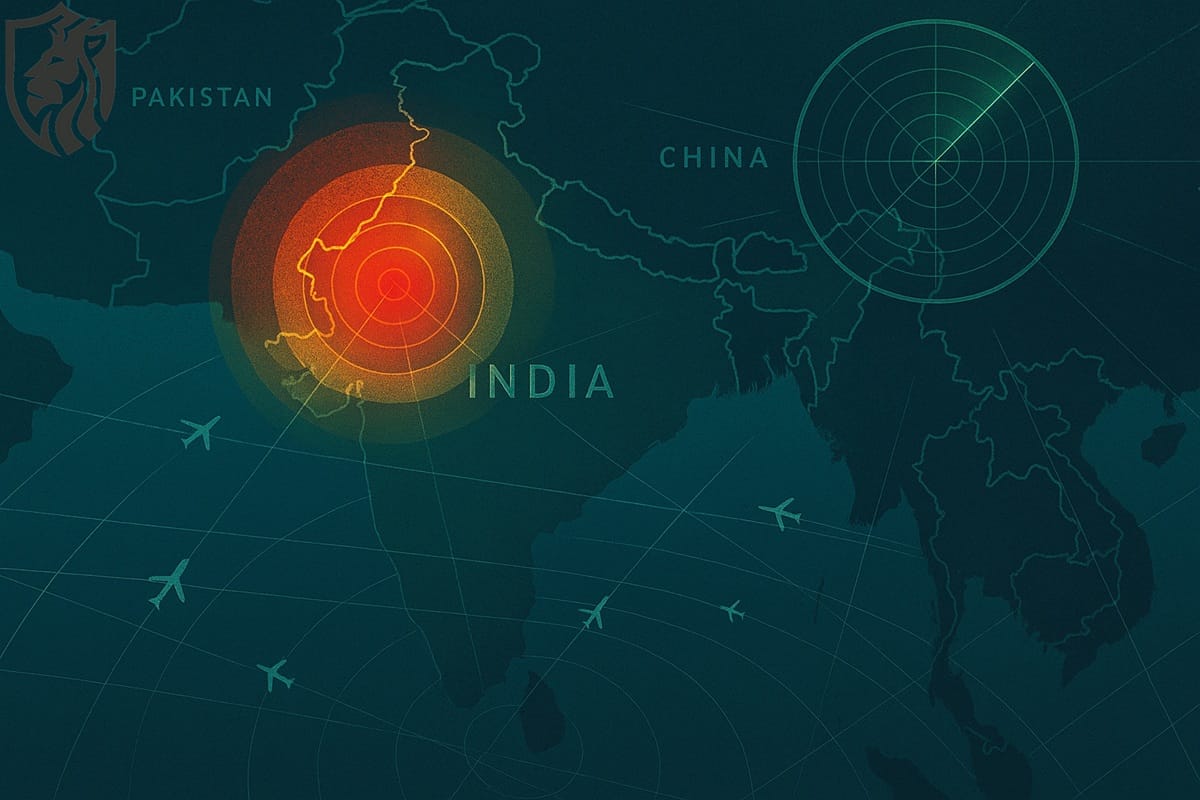
Zoom out, and the GPS interference near Mumbai and New Delhi sits inside a crowded operational picture. India’s tri-services are running large-scale drills from the Arabian Sea to the northern theatre. Pakistan’s Navy has declared firing zones and missile exercises in adjacent waters. China maintains heightened readiness in Tibet and continues to expand its EW and ISR footprint into the Indian Ocean.
In such an environment, electromagnetic friction is almost inevitable. Triangulating who is jamming whom is usually complex. Signals can bounce, spill over and overlap, especially when powerful shipborne radars and electronic-attack suites operate near major air routes. Defence News Today’s breakdown of air power balances among India, Pakistan, and China provides useful context for readers seeking a broader comparison of military forces. However, the message is clear enough: the subcontinent’s competition has moved beyond visible hardware into the invisible spectrum.
Deliberate jamming, calibration, or collateral?
Analysts looking at why India issues GPS interference NOTAM over Mumbai FIR tend to frame three broad options. First, domestic testing: Indian forces may be probing how resilient their own civil-military systems are under controlled GNSS interference. Second, cross-border or maritime emissions: Pakistani or Chinese assets could be generating fields strong enough to spill into Indian FIRs, whether intentionally or accidentally.
Third, there is simple EW collateral. Large multinational exercises increasingly combine cyber-, space-, and electronic effects. Civilian systems, even if not directly targeted, can absorb some of the noise when many emitters operate in a confined area. Therefore, Mumbai’s NOTAM could serve as both a warning and a diplomatic signal, indicating the approaching thresholds.

A new normal for South Asian air power
Regardless of the exact source, India’s issuance of a GPS interference NOTAM over the Mumbai FIR signifies a psychological shift. For years, South Asian airpower debates focused on platforms, ranges and missile types. Today’s conversation must also cover spectrum dominance, GPS spoofing resilience and backup navigation architectures.
For the Air Force, that translates to more hardened receivers, better EW training, and joint drills that integrate civil ATC. Include airlines; it means accepting that GNSS interference will be an enduring background risk, not a freak anomaly. For regional planners, it is another reminder that the first steps in tomorrow’s crisis will likely be silent, software-driven and plausibly denied.
Expectations
Defence professionals should now track several indicators. Do future NOTAMs expand to cover Kolkata or oceanic sectors, confirming a wider pattern? Do Indian regulators publish more detailed GNSS interference circulars, mirroring global best practice and ICAO guidance on GNSS vulnerabilities? ICAO Could Pakistan and China discreetly update their advisories and navigation warnings in response?
Equally, watch how quickly India and its neighbours invest in interference detection networks, multi-constellation receivers and robust civil-military coordination cells. Those choices will determine whether the next wave of jamming triggers only paperwork and minor delays or whether it exposes dangerous seams in the region’s air power architecture.
References
- https://www.businesstoday.in/india/story/high-risk-airspace-list-india-issues-third-gps-spoofing-warning-as-kolkata-joins-delhi-mumbai-502254-2025-11-14 Business Today
- https://www.deccanchronicle.com/nation/notam-issued-over-gps-threat-near-mumbai-airspace-1916933 Deccan Chronicle
- https://www.icao.int/sites/default/files/Meetings/a42/Documents/WP/wp_108_en.pdf ICAO
- https://www.gpsworld.com/easa-iata-release-4-point-plan-to-mitigate-gnss-interference-risks/
About the Author