How the GBU-57 MOP Bunker Buster Works
How the GBU-57 MOP bunker buster works
The GBU-57 MOP bunker buster was designed to hit targets that were buried deep underground and shielded by layered engineering, rock, and concrete. It depends on more than just blast, unlike a regular bomb. Rather, it uses a hardened steel body, extreme mass, precise guidance, and delayed detonation to reach underground facilities before going off. The Pentagon testing literature identifies hardened and deeply buried bunkers and tunnels as its primary target set, while the U.S. Air Force characterizes it as a weapon for attacking well-protected facilities.
What makes the GBU-57 different
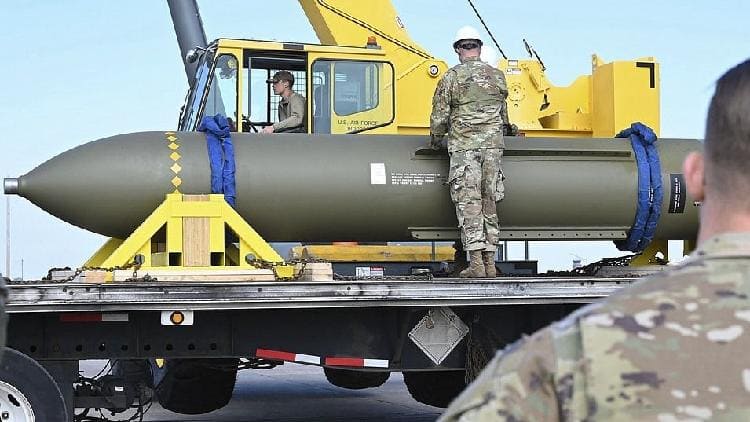
The size of the GBU-57 MOP bunker buster is the first thing that makes it different. The U.S. The Air Force and the Air & Space Forces describe it as a 30,000-pound-class precision-guided penetrator. It measures about 20.5 feet long and 31.5 inches wide. That size matters because penetration depends on speed and explosive force. The weapon strikes first like a giant steel spear. Then it explodes like a bomb.
The bomb body is also not made like a general-purpose bomb with thin walls. Pentagon test reports say a special high-performance steel alloy forms the warhead case and prevents breakage during impact. That design lets the GBU-57 MOP bunker buster penetrate soil, rock, and reinforced buildings. Then the explosive fill detonates and delivers its effect. So, the design logic is to break through first and then destroy the inside.
How guidance gets it to the aim point
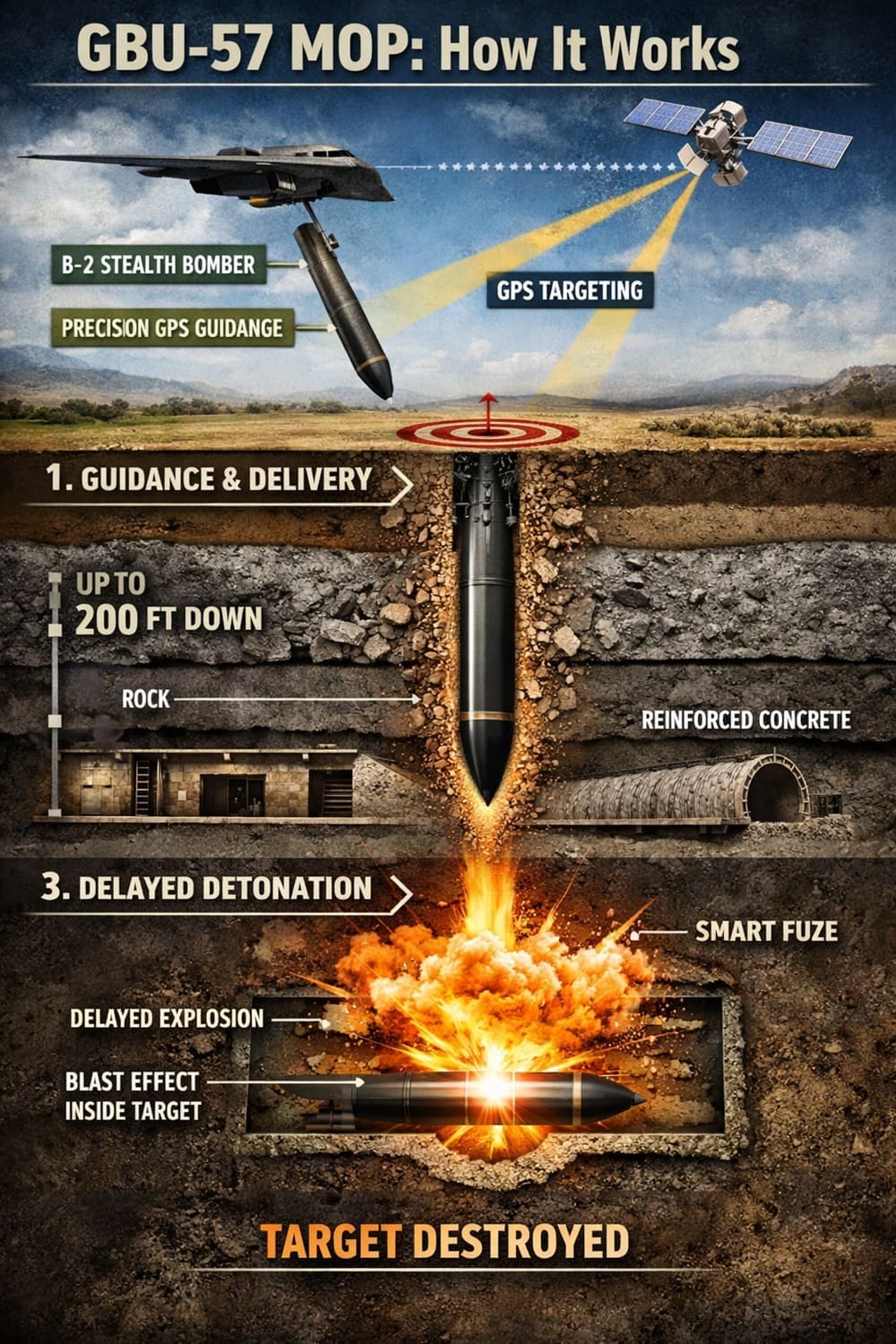
The GBU-57 MOP bunker buster is a weapon that uses GPS to find its target. That guidance is important because a bomb can only hit a deep target if it lands in the right spot. A near miss might leave scars on the surface but not damage the buried chamber. The Pentagon and the Air and Space Forces both say that the weapon is GPS-guided. The MOP program as a whole has also focused on making it more accurate and deadly against hard and deeply buried targets.
This is also why the platform for delivery is important. According to both the Air Force fact sheet and DOT&E reporting, the B-2 Spirit is the only plane in the U.S. Air Force that is programmed to use the MOP in real life. In practice, this means that the weapon has a stealthy carrier that can get close to protected airspace and drop the bomb with the range, payload margin, and survivability that the mission needs.
What happens after release
After being released, the GBU-57 MOP bunker buster uses guidance to stay on course and then relies on its speed, weight, and casing strength when it hits. It doesn’t go off right away like a blast-fragmentation bomb. It should keep going down instead. Reports about the weapon in the past have said that it can penetrate to depths of about 200 feet before exploding in some situations. However, how well it works depends on the target material, layout, angle of impact, and local geology. That means that rocks, concrete, and earth don’t all have the same problem.
The fuze is the most important part of the kill chain after penetration. According to DOT&E’s 2021 report, the Large Penetrator Smart Fuze (LPSF) was made to make it more likely that a target will be killed by reducing the effects of uncertainty in target intelligence. In simple terms, the fuze makes sure that the weapon goes off at a better time, either inside or near the buried structure, instead of wasting energy too soon. The same report also says that the Air Force kept testing this fuze because timing is almost as important as penetration.
Why one bomb may not be enough
The GBU-57 MOP bunker buster is very strong, but it’s not magic. A very deep site may use layered concrete, voids, shock-isolated chambers, or tunnel bends to reduce blast effects. Because of this, planners may hit the same target multiple times. According to Reuters, seven B-2 bombers dropped 14 GBU-57s on Iranian nuclear sites during Operation Midnight Hammer in June 2025. Analysts who looked at images of Fordow saw a pattern that showed repeated impacts on the same places. It was also the first time the weapon was used in battle.
The first time the weapon was used in combat also made a point that defense experts should remember: it works as part of a strike system, not on its own. Reuters said that the 2025 operation included deception, aerial refueling, supporting aircraft, and cruise missile launches as part of a bigger plan. When people ask how the GBU-57 MOP bunker buster works, the full answer includes the bomber, route planning, suppression support, intelligence preparation, and post-strike assessment. The mission architecture is just as important as the bomb.
What the GBU-57 cannot guarantee
The GBU-57 MOP bunker buster, on the other hand, can’t guarantee that it will destroy every underground target. According to Reuters, experts warned that satellite images alone could not show how much damage had been done below ground at Fordow. Bunker-busting warfare has one main limit: analysts can quickly spot entrances and measure visible surface damage. They need more time and better intelligence to confirm interior collapse, equipment destruction, or a lasting mission kill. Severe damage does not always mean complete destruction.
Why the weapon matters
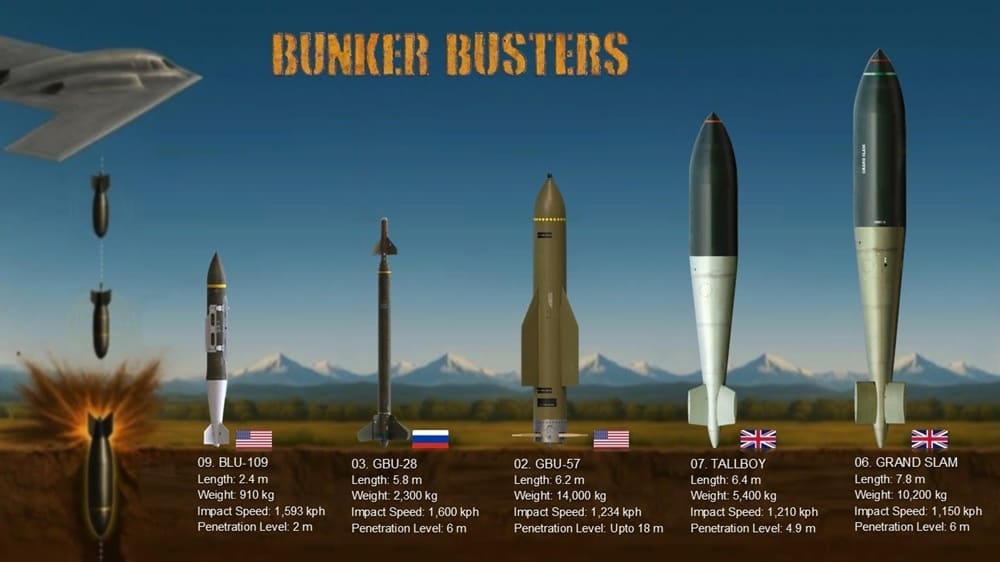
The bigger strategic lesson is obvious. The GBU-57 MOP bunker buster exists because countries keep moving important military equipment underground. As air defense systems get better, hardened underground targets become more appealing. So, weapons like the MOP give the US a choice against facilities that smaller penetrators might have trouble getting to. The Air Force has said that the MOP is stronger than older penetrators like the BLU-109. DOT&E has also linked it to the problem of targets that are hard to reach and buried deep.
References
- https://www.af.mil/About-Us/Fact-Sheets/Display/Article/104614/massive-ordnance-penetrator/
- https://www.airandspaceforces.com/weapons/gbu-57-mop/
- https://www.reuters.com/business/aerospace-defense/us-bombing-iran-started-with-fake-out-2025-06-22/
- https://www.reuters.com/world/middle-east/satellite-images-indicate-severe-damage-fordow-doubts-remain-2025-06-22/
About the Author