
Grumman RQ-180 in Greece: Why Larissa Matters
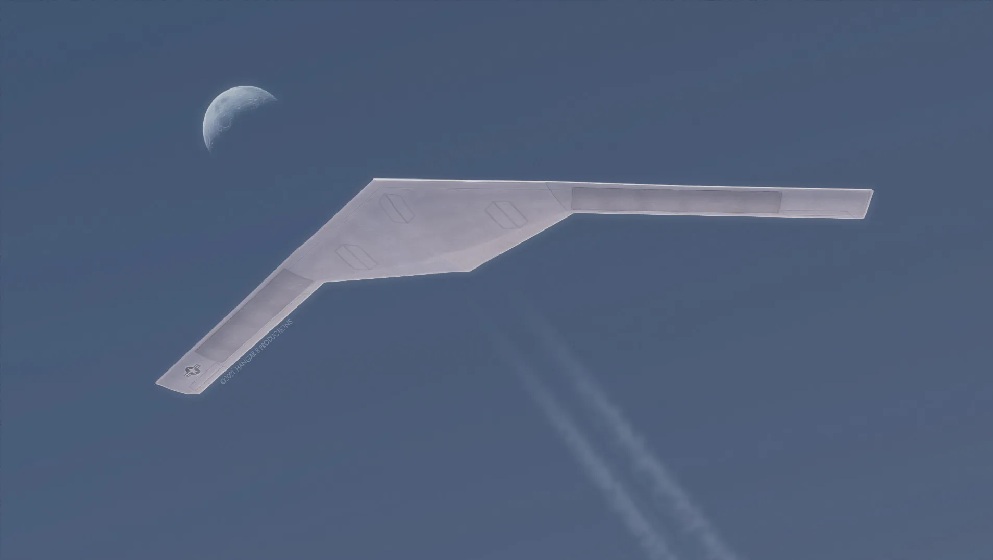
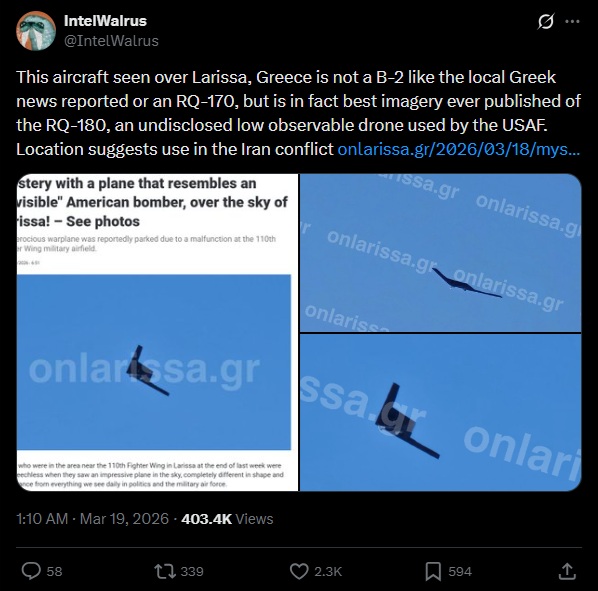
In Greece, the Grumman RQ-180 might be the best public view of one of America’s most secret drones. Pictures that the Greek news site and several OSINT accounts later examined showed a dark flying-wing plane landing at Larissa Air Base in central Greece. At first, local news called it a B-2, but the shape doesn’t match that bomber.
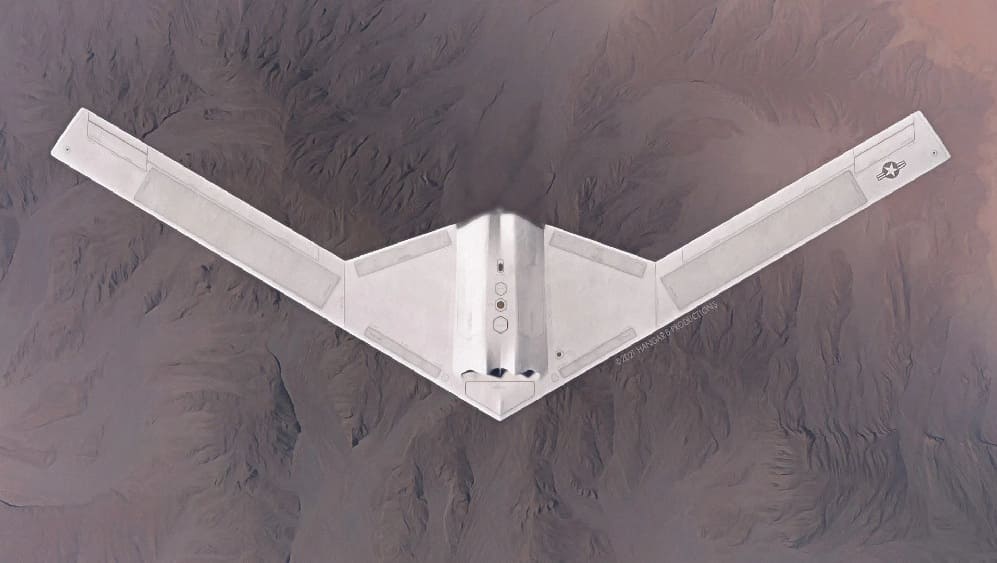
The trailing edge of the plane is not like the B-2 Spirit’s. Instead, it looks a lot more like the RQ-180 profile that analysts have been talking about for years. It looks a little like the B-21 family, but not enough to call it a bomber. That doesn’t show that the plane is an RQ-180. But it makes it very difficult to keep the original B-2 explanation going.
What Larissa’s Photos Show
The proportions of the RQ-180 in Greece make it stand out. The plane’s wide, flying wing shape and spaced-out landing gear layout give it a grand appearance. That matters because that kind of setup means there is a lot of space inside and a wide span. Those are the exact traits that a high-altitude, long-endurance intelligence platform should have.
The sighting is also important because it happened during the day in a busy area. People have been seeing the plane known as the RQ-180 in the American Southwest for years, including around Edwards, Palmdale, and the Area 51 ecosystem. So, a diversion in Greece would give you a view of a platform that is usually hidden by distance, darkness, and classification.
Greek news reports said that the plane may have landed because of a technical issue and may stay on the ground for repairs. The Pentagon and the U.S. Air Forces in Europe have not confirmed that detail yet. So, the safest thing to say is that the claim of an emergency landing is possible, but not yet official.
Why Larissa Matters
RQ-180 would not be showing up at a random airfield in Greece. The 110th Combat Wing of the Hellenic Air Force is based in Larissa, and the base has hosted American MQ-9 activity in the past. That matters because Larissa has already helped the U.S. with unmanned operations and the infrastructure that goes with them. The MQ-9 Reaper fact sheet also underlines the type’s established ISR role.
The Aviationist also wrote about U.S. Air Force C-17 flights from Edwards Air Force Base to Larissa in late February and early March. That alone doesn’t prove that there is a secret drone unit. Still, it gives us useful background. Edwards is the center of advanced U.S. flight testing, and Palmdale, which is close by, is the center of Northrop Grumman’s work on stealth aircraft.
The Aircraft’s Likely Role
RQ-180 in Greece only makes sense if the plane can do something that regular drones can’t. The Reaper is a decent way to gather intelligence, but it is not a stealthy platform that can get through walls. Stealth changes the mission completely in a heavily defended area.
Analysts have long considered the RQ-180 to be a valuable tool for gathering information, spying, and reconnaissance. In short, it would be made to collect data in places where radar coverage, air defenses, and political risk make regular drones too simple to spot. If the plane seen at Larissa is from that line, it makes sense for the mission.
The B-21 link matters here, too. The official B-21 Raider fact sheet describes the bomber as a long-range penetrating stealth aircraft for high-end threat environments. Analysts have long argued that an RQ-180-type platform could share design logic, manufacturing lineage, or program risk reduction with that wider Northrop ecosystem.
Why the Region Matters
The timing and shape of the RQ-180 in Greece have both gotten a lot of attention. Both TWZ and The Aviationist said that the plane’s location makes sense given the current tensions and operations related to Iran. A stealth ISR plane would be an excellent tool for monitoring air defense nodes, missile activity, and changes in a larger battle space, while avoiding the attention-grabbing nature of a regular plane.
That does not mean every claim online is right. It does mean the geography is credible. Readers looking for wider context can connect this sighting to How a Long Iran War Could Bleed American Power and IRGC Hadid-110 Drone: Iran’s Fast Stealth Threat, both of which help frame how survivability and reconnaissance now shape regional conflict.
Conclusion
The RQ-180 in Greece is important because it means that the plane is no longer just a rumor based on blurry desert sightings. If this identification is correct, this is the best public view yet of a secretive American stealth drone that may have been flying for more than ten years. That alone makes the sighting of Larissa important.
Still, the most disciplined conclusion is also the most useful one. We don’t have any solid proof that the plane is officially called RQ-180. But we have a strong visual case that it is not a B-2 Spirit or a regular UAV. For people who keep an eye on defense, the Larissa appearance is a big clue about how the US might be doing high-end reconnaissance missions right now.
References
- https://www.twz.com/air/secret-rq-180-stealth-drone-appears-to-have-made-an-emergency-landing-at-a-greek-air-base
- https://theaviationist.com/2026/03/18/could-this-be-our-best-ever-look-rq-180/
- https://www.af.mil/About-Us/Fact-Sheets/Display/Article/104470/mq-9-reaper/
- https://www.af.mil/About-Us/Fact-Sheets/Display/Article/2682973/b-21-raider/
About the Author