
F-22 Drone Wingman Test — MQ-20 Cockpit Control
F-22 drone wingman test: A new era
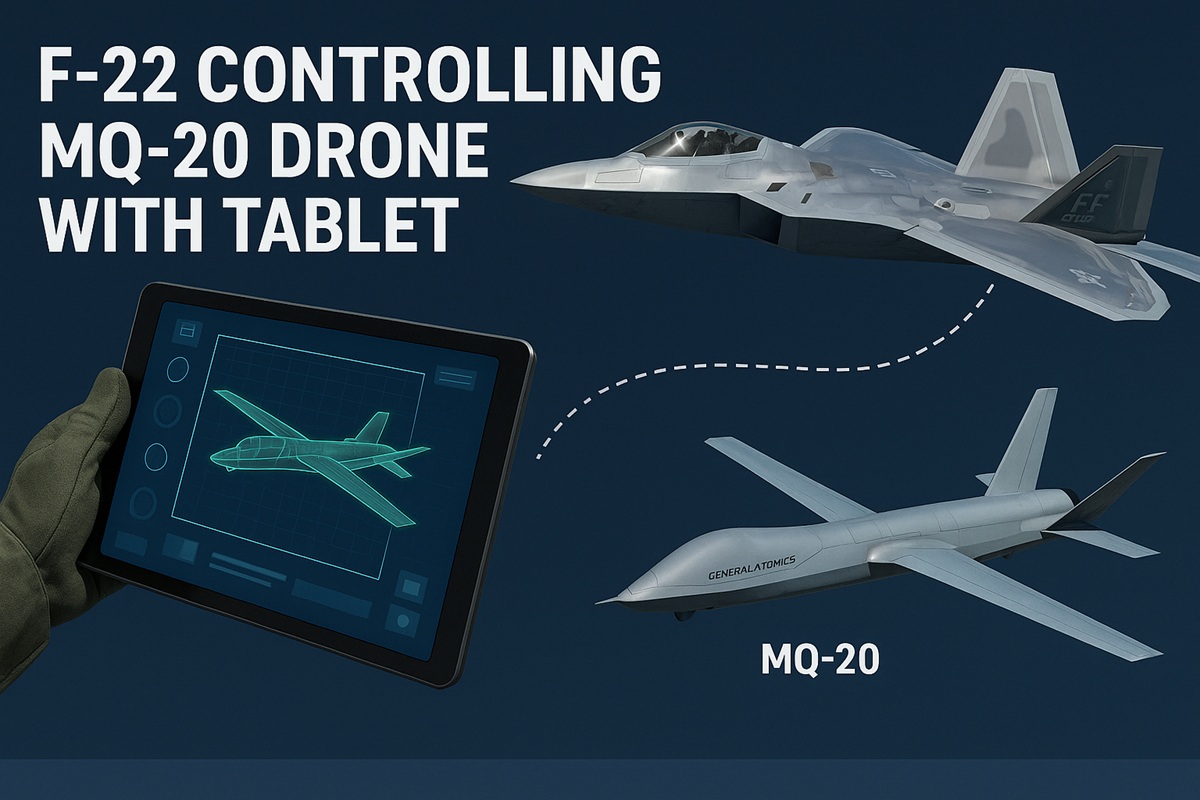
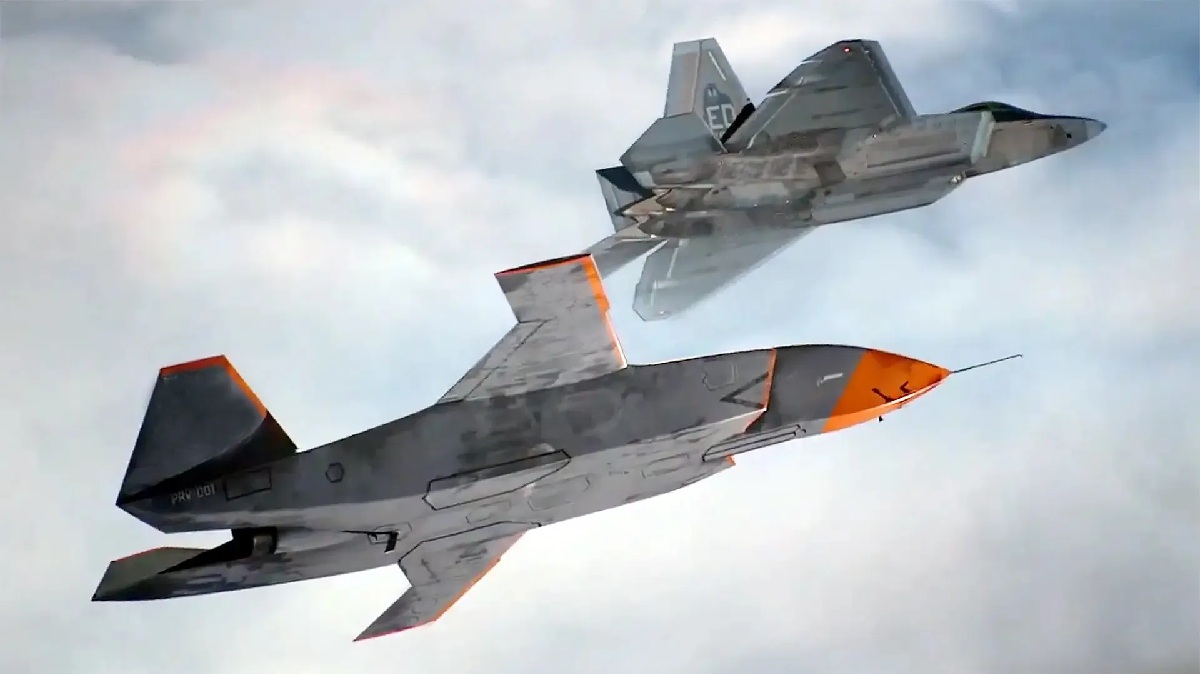
In late October 2025, an F-22 Raptor pilot did more than fly his jet. During a landmark F-22 drone wingman test over the Nevada Test and Training Range, he used a cockpit tablet to command an MQ-20 Avenger combat drone in real time.
This exercise was not a lab simulation or a simple telemetry trial. Instead, it was a live, crewed-unmanned mission that showed how future collaborative combat aircraft (CCA) could fight alongside fifth- and sixth-generation fighters in contested airspace.
F-22 took control of its drone wingman
The F-22 drone wingman test relied on a familiar interface: a tablet in the Raptor cockpit. Using this device, the pilot issued “command and control” inputs to the MQ-20, directing the drone’s mission profile while still flying the fighter.
General Atomics, Lockheed Martin Skunk Works, and L3Harris worked together to use flexible communication systems and shared technology, ensuring that the setup remains open and In practice, that means future CCAs should plug into multiple platforms without each contractor locking the Air Force into a closed ecosystem.
For defence professionals, such arrangements are critical. If a single F-22 pilot can manage a drone wingman through an intuitive tablet today, tomorrow’s F-47 or other sixth-generation jets could control whole mixed packs of CCAs with only incremental cockpit changes.
MQ-20 Avenger as a CCA surrogate
General Atomics framed the F-22 drone wingman test around the MQ-20 Avenger, a jet-powered unmanned aircraft already used for advanced experimentation. With its internal weapons bay, high subsonic dash speeds, and open mission systems, the MQ-20 is a useful stand-in for future CCA designs.
Although the Air Force has now designated General Atomics’ CCA prototype as the YFQ-42A, the Avenger still offers a real flying testbed for autonomy and teaming software. This allows engineers to trial behaviours such as autonomous repositioning, sensor sharing, and threat reactions without waiting for brand-new airframes to leave the factory.
For planners, this approach reduces risk. The service can validate core CCA tactics, techniques, and procedures with MQ-20 surrogates, and it can migrate proven codes and concepts to the operational YFQ-42A line as it matures.
General Atomics vs Anduril
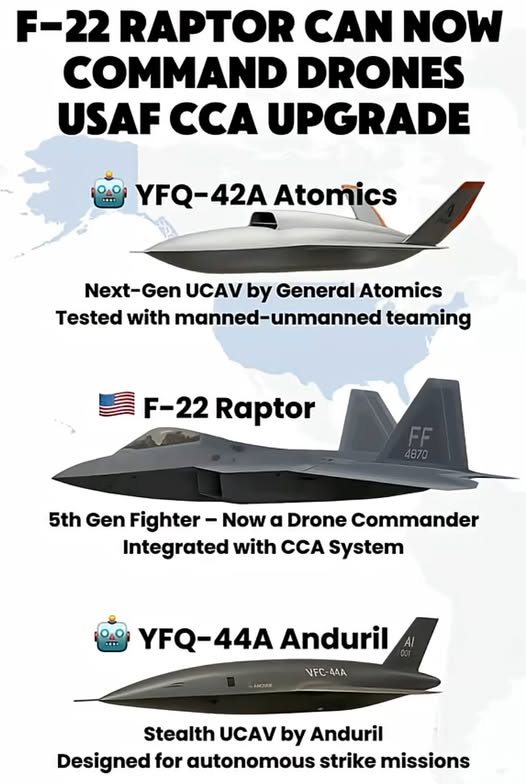
The F-22 drone wingman test also sits inside a fierce industrial competition. General Atomics and Anduril are the two main CCA design teams, with the Air Force expecting to award a first-increment production contract in 2026.
While General Atomics shows off its F-22–MQ-20 teaming credentials, Anduril has flown its own YFQ-44A jet drone and showcased the Fury AI fighter concept, designed to operate as a loyal wingman or in autonomous packs. Both companies emphasise modularity, software-centric upgrades, and rapid manufacturing to keep unit costs lower than those for crewed fighters.
From an operator’s perspective, this competition is healthy. It pushes both teams to prove that their drones can keep pace with frontline fighters, survive dense threat environments and still be affordable enough to buy in large numbers.
F-22 as the bridge to the CCA future
The U.S. Air Force has been clear that the F-22 remains the threshold platform for CCA integration. Recent planning documents describe Raptor-CCA teaming as “key to controlling highly contested future environments” and list F-22 modernisation as a priority partly because of its role as an airborne controller.
In practical terms, the F-22 drone wingman test validates the idea that a single-seat fighter, originally designed in the late Cold War, can still command a constellation of uncrewed assets. This circumvents a situation in which only state-of-the-art, brand-new jets can effectively collaborate with CCAs. Instead, the Raptor becomes a bridge to the F-47 era, enabling pilots, tacticians and maintainers to gain experience before sixth-generation aircraft arrive in significant numbers.
From Nevada to the Indo-Pacific
The Nevada test range sits far from the Western Pacific. Yet the F-22 drone wingman test clearly prepares crews for combat in that future theatre. In a major war, Chinese long-range missiles would pressure American bases, airfields and refuelling tankers.
Collaborative combat aircraft with greater range than F-22s and F-35As could then move further forward.
They would push sensors and weapons deeper into heavily contested airspace while crewed fighters operate at a safer distance behind.
Within this scheme, Raptors would act as forward quarterbacks for the wider strike package. Their stealth and high-end sensors would cue MQ-20-class drones into efficient attack or reconnaissance geometries. If losses occur, commanders can replace expendable drones faster than highly trained pilots. They also cost less than elite fifth-generation or future sixth-generation fighters.
Technical and doctrinal implications
Technically, the F-22 drone wingman test proves crewed-uncrewed teaming is now real, not just presentation material. A stealth fighter actually commanded a jet-powered drone through a live mock mission over Nevada test airspace. Secure links and government-controlled radios carried the data, instead of locked, proprietary vendor networks.
Doctrinally, the test pushes the Air Force beyond traditional one-jet, one-pilot employment models.
In future strike packages, a single Raptor could control a small wolfpack of collaborative combat aircraft.
Those drones might soak up missile fire, jam radars, scout ahead, or execute the riskiest attack profiles.
For engine performance and survivability context, readers can revisit Defence News Today’s analysis of U.S. and Russian jet engines.
Strategically, Washington wants to stay ahead in crewed-uncrewed integration, not just in stealth airframe technology. China is exploring its own advanced fighter concepts, including the notional JXDS program and related loyal wingman families. Earlier Defence News Today coverage of the J-XDS concept highlighted how quickly potential adversary capabilities can evolve.
Why does this test matter?
For defence planners, analysts, and operators, the F-22 drone wingman test is early but valuable data. It should be read as a trial run, not a polished, field-ready product. Software will evolve, cockpit interfaces will mature, and automation levels will rise with each new build. The future YFQ-42A and YFQ-44A airframes will also diverge from today’s MQ-20 Avenger surrogate.
Yet one insight will endure, regardless of the hardware and software refresh cycles. A frontline fighter can command a capable unmanned jet in realistic threat conditions through a relatively simple interface.
Scaled across multiple F-22 squadrons, that skill turns Raptors into force multipliers, not just elite shooters. Pushed later into F-47 fleets, the concept will reshape thinking around mass, attrition, and acceptable risk.
References
- General Atomics – GA-ASI, Lockheed Martin and L3Harris Collaborate on Crewed-Uncrewed Teaming Flight Test – https://www.ga.com/ga-asi-lockheed-martin-and-l3harris-collaborate-on-crewed-uncrewed-teaming-flight-test General Atomics
- U.S. Air Force – Air Force designates two Mission Design Series for collaborative combat aircraft – https://www.af.mil/News/Article-Display/Article/4092641/air-force-designates-two-mission-design-series-for-collaborative-combat-aircraft/ Air Force
- The War Zone – F-22 Pilot Controls MQ-20 Drone From The Cockpit In Mock Combat Mission – https://www.twz.com/air/f-22-pilot-controls-mq-20-drone-from-the-cockpit-in-mock-combat-mission The War Zone
- The Aviationist – F-22 Raptor Takes Control of MQ-20 Avenger During Test – https://theaviationist.com/2025/11/17/f-22-raptor-controls-mq-20-avenger/ The Aviationist
About the Author