
Drones Are Making Attack Helicopters Obsolete
It would be a bold claim to make that attack helicopters are now redundant, thanks to drones. But recent wars make it technically feasible. It is not about whether helicopters can still fly or shoot. However, does their classic role as crewed low-level tank hunters still make sense operationally? In a drone-dominated battle, the answer is increasingly no.
Attack helicopters are designed for a different kill chain. They used terrain masking, thermal sights, anti-tank missiles and rapid reaction time to ambush armour. The idea made sense during the Cold War. Cheap sensors now constantly cover the same terrain. So it’s not just a bumper sticker that attack helicopters are obsolete anymore. It’s the style of the field.
How Drones Changed the Equation
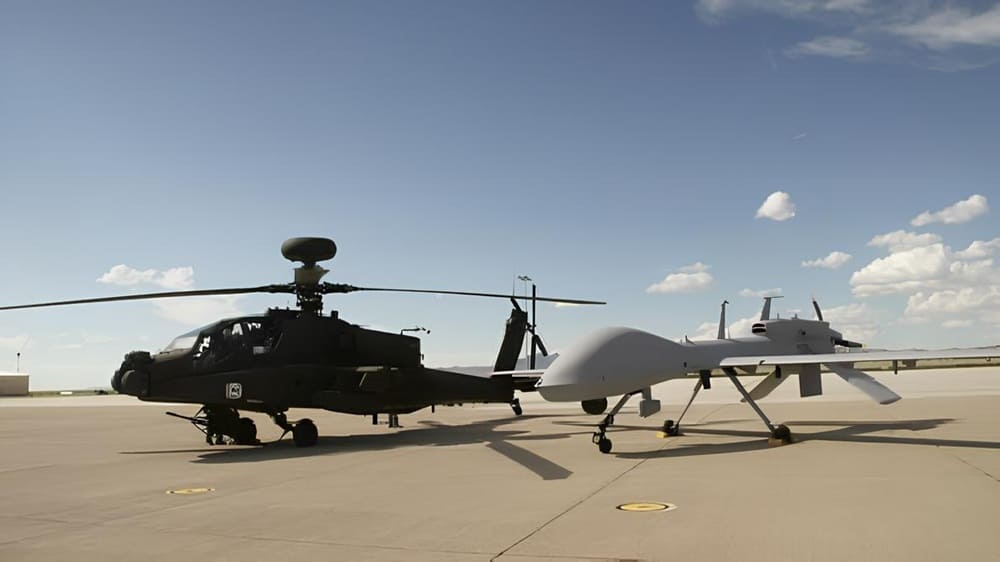
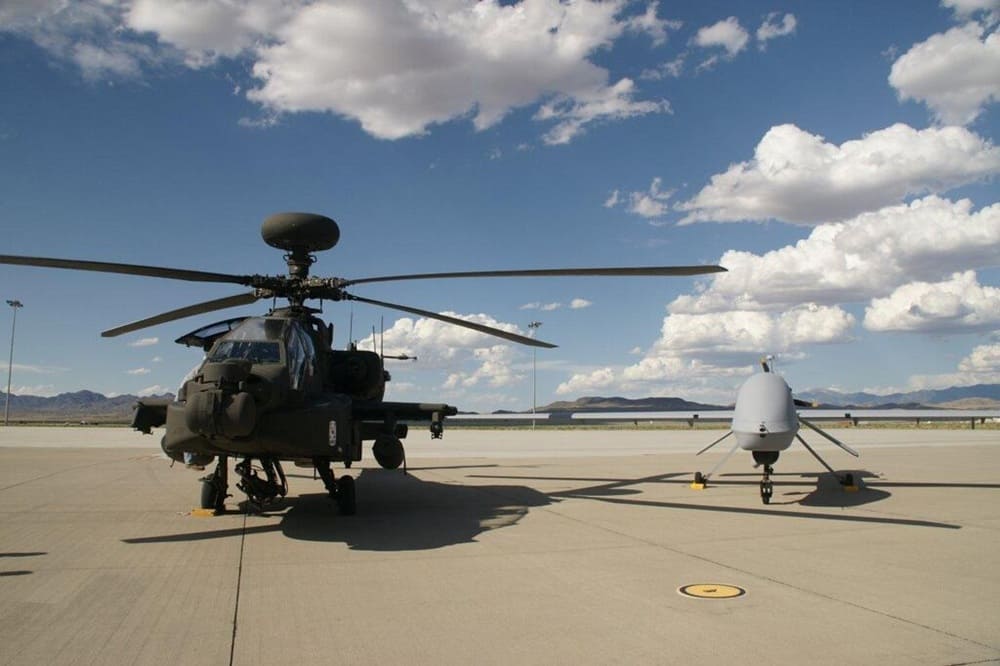
Modern drones attack the helicopter’s biggest asset: proximity. The AH-64E Apache can carry 16 Hellfire missiles, 76 rockets and 1,200 rounds for its 30mm gun. That’s a heavy one. But it still has to fly into contested airspace, give away its heat signature and protect two very well-trained crew members.
In contrast, the MQ-9A Reaper can stay airborne for over 27 hours, fly up to 50,000 feet, and carry a payload of 3,850 pounds. The smaller Bayraktar TB2 has an endurance of more than 20 hours and a payload of 150 kg. Small FPV drones are also a fraction of the cost of a guided missile. They can hang out, scout and strike without putting a pilot at risk.
Cost-Exchange
The cost-to-exchange ratio is now unfavourable for crewed rotary-wing aviation. A modern attack helicopter needs engines, armour, avionics, maintenance crews, secure bases and pilot training. So if you lose one aircraft, you lose a big chunk of your combat package all at once.
Drones increase that risk. A force can shoot down dozens of quadcopters and still make the mission. In Ukraine, mass-produced FPV drones have destroyed tanks, radars, artillery and logistics vehicles at very low cost. So the drone force doesn’t have to be 100 % reliable. It requires effective arithmetic.
This is why the obsolescence of attack helicopters has become a serious issue in defense planning. “A helicopter can bring you heavier weapons, but drones bring you persistence, quantity and replaceability.”
Ukraine and the New Battlefield
The Russia-Ukraine war has revealed the limitations of conventional helicopter tactics. Russian Ka-52 Alligator crews fired Vikhr missiles from stand-off positions initially. They achieved tactical effects, primarily against Ukrainian armoured vehicles. Meanwhile, Ukrainian air defenses, electronic warfare and battlefield surveillance restricted their freedom of movement.
As the threat grew, Russian helicopters would frequently launch unguided rockets in lofted attacks. That kept crews farther from danger but meant less accuracy. Essentially, a pricey attack chopper is starting to act like mobile area artillery. That is indicative of the platform’s dilemma. It risks destruction if it approaches too closely. If it stays far away, it loses its accuracy and its purpose in tactics.
Ukraine had also provided the alternative. Ukraine made some two million drones in 2024. Over 96 percent of its armed forces’ UAVs were domestic systems. The scale is important. No helicopter fleet can regenerate combat mass that quickly.
Lessons from Nagorno-Karabakh
The 2020 Nagorno-Karabakh war was a wake-up call. Azerbaijan used Bayraktar TB2 drones and loitering munitions to locate, track and destroy Armenian armour, artillery and air-defense systems. The campaign did not show that drones win wars. On the other hand, it demonstrated that autonomous systems can carry out reconnaissance-strike missions that used to be the domain of crewed aircraft.
Military Strategy Magazine estimated that about 38 % of the sampled drone-killed targets were artillery. Trucks accounted for some 28%, while tanks and armoured fighting vehicles accounted for about 22%. These figures show how drones attack the whole enemy battle system.
Japan Replacing Apaches with Drones
Japan is becoming more willing to trade its Apache attack helicopters for sophisticated drones, a big shift in battlefield priorities. The decision reflects lessons from Ukraine, where unmanned systems have proven more survivable, less expensive and faster to deploy than crewed aircraft. Drones can scout, attack and provide targeting info without risking pilots. In the case of Japan, it supports island defence, rapid reaction and operations in contested maritime zones. Tokyo is likely to invest in unmanned combat platforms, loitering munitions and networked surveillance drones for future missions rather than costly helicopters vulnerable to missile and air-defense attacks.
The U.S. Army Read the Signal
Institutional decisions now confirm the trend. The U.S. Army has cancelled its Future Attack Reconnaissance Aircraft programme after re-evaluating the cost and survivability of the program. GAO estimated the cost of developing and procuring FARA to be $5.3 billion. Then the service shifted to sensors, autonomous systems and other aviation needs.
That decision is important because FARA was not an old aeroplane. It was to replace the armed reconnaissance capability after the retirement of the OH-58D Kiowa Warrior. So its cancellation means a larger takeaway: the armed scout mission is migrating to autonomous networks.
Attack Helicopters Can Still Do
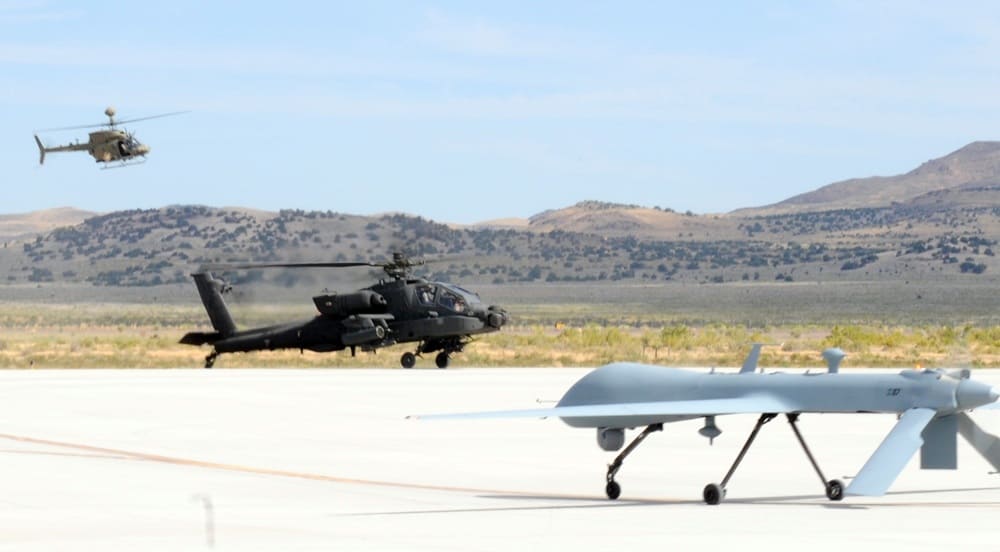
Attack helicopters are valuable. “They can still escort air assaults, support special forces, operate in permissive environments, and control autonomous teams. Future Apaches may act as command centres for launched aircraft and drones It is a reduced role, however, not the old dominance.
No longer is it a question of which aircraft can carry the most missiles. The network, however, is the decisive system which is ceaselessly detecting, tracking and striking. Now, drones deliver this network at scale. So there is a strong reason to think that attack helicopters are becoming obsolete in their traditional anti-armour role.
Conclusion
Drones have not completely killed off rotary-wing aviation. They have shattered the idea that crewed attack helicopters can safely dominate the forward edge. Modern air defense, passive sensing, EW and cheap UAVs have changed the risk curve. To say that attack helicopters are obsolete is not an emotional statement. It is a technical judgement of survivability, endurance and cost; Drones provide commanders with more eyes, more strikes and more palatable losses on the modern battlefield.
References
- https://www.boeing.com/defense/military-rotorcraft/ah-64-apache
- https://www.ga-asi.com/remotely-piloted-aircraft/mq-9a
- https://baykartech.com/en/uav/bayraktar-tb2/
- https://www.gao.gov/products/gao-26-108025
About the Author