
Chinese Companies controls one third of African Ports
Africa’s ports are located at the intersection of revenue generation and resilience. They also shape wartime logistics. So, when Chinese companies in African ports move from building into finance and operations, governments must think like strategists, not just planners. A mapping study by the Africa Center for Strategic Studies reports Chinese state-owned firms as stakeholders in an estimated 78 of Africa’s 231 commercial ports, across 32 countries.
West Africa hosts 35 of these engagements, compared with 17 in East Africa, 15 in Southern Africa, and 11 in North Africa. By comparison, Latin America and the Caribbean host 10 Chinese-built or operated ports, while Asian countries host 24. This footprint can lift trade efficiency. However, Chinese companies in African ports can also shift leverage over access, data, and crisis decisions.
What does the term “Stake” mean?
A “stake” can mean three different things: building, financing, and operating. A country can accept the first two and still keep control. Yet the third—operations—often decides who moves, when, and at what cost. The Africa Center report flags cases where Chinese firms dominate the full stack from finance to construction, operations, and share ownership. It also notes how CCCC can win prime work and then pass subcontracts to CHEC. That structure matters. It can lock in kit standards, software choices, and vendor dependence for decades.
Why Operations Matter
Operators allocate berths, manage queues, and prioritize cranes. They also control key process data inside terminal systems. In a crisis, those choices can become a hard security lever. The Africa Center study estimates China gains as much as $13 in trade revenues for every $1 invested in ports. It also notes Chinese firms hold operating leases in 10 African ports. At the same time, many African ports face a real performance gap. The same report estimates delays and weak management can raise handling costs by about 50% above global rates. So, governments often weigh control risks against urgent efficiency needs.

Lekki: How Influence Compounds
Nigeria’s Lekki Deep Sea Port shows how influence grows when one player touches finance, building, equity, and operations. The Africa Center report says CHEC led construction and engineering, secured loan financing from the China Development Bank, and took a 54% financial stake in the port. It also operates the port on a 16-year lease. Meanwhile, CMA CGM’s terminal arm has operated the container terminal under a sub-concession structure. The takeaway is simple: equity does not always equal control, yet a lease plus systems and finance can still deliver leverage.
Beijing’s Planning Signals
Chinese port choices often align with national planning. China’s 2021–2025 Five-Year Plan describes a “connectivity framework of six corridors, six routes, and multiple countries and ports” linked to Belt and Road construction. Three corridors run through Africa, landing in Kenya/Tanzania, the Egypt/Suez region, and Tunisia.
The same Africa Center report connects those places to “overseas strategic strongpoints” and to standards for “civil-military fusion,” meaning that civilian shipping and cargo can also support military needs. This does not prove that every port will become “dual-use.” However, it provides an explanation for the potential blurring of lines through design.
Djibouti’s Dual-Use Model
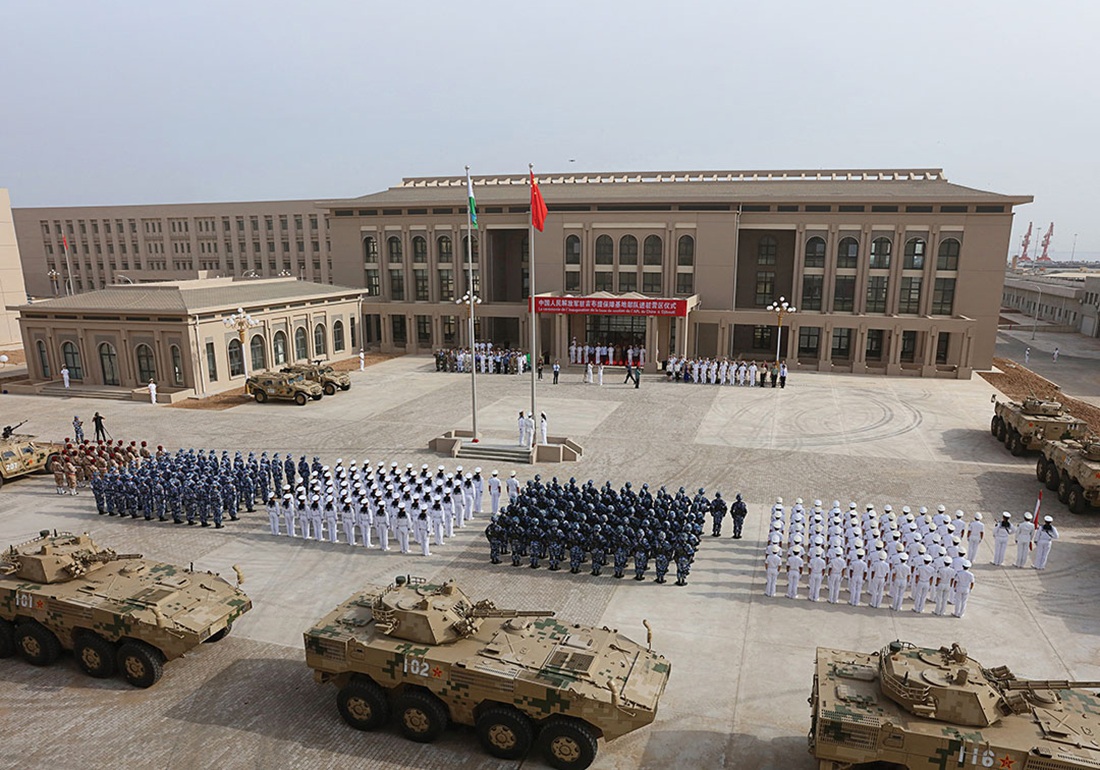
Djibouti remains the clearest case where a commercial port and a military base converged. The Africa Center report states China’s development of Doraleh was extended to fit a naval facility in 2017, becoming China’s first known overseas military base two months after the main port opened. A Council on Foreign Relations analysis also describes the tight sequencing between the port inauguration and base completion. So, planners now ask a sharper question: which ports have the specs and the politics that could support a similar bolt-on support site?
Dual-Use: Practical Signs
The engineering is measurable. A sustained naval support site usually needs:
- deep water and long berths
- heavy cranes and secure yards
- fuel storage and replenishment access
- The facility features controlled perimeters, a stable power supply, and resilient communication systems.
Many commercial ports can host a visit. Fewer can sustain a task group. So, track changes in berth length, fuel farms, and access controls—not just ownership headlines.
PLA Access Testing Since 2000
The Africa Center study ties port footprint to military activity. It notes some Chinese-involved ports have hosted PLA Navy port calls or served as staging grounds for PLA exercises, including Dar es Salaam, Lagos, Durban, and Doraleh. It also lists Chinese-built facilities used for drills, including Tanzania’s Kigamboni Naval Base, Mapinga training center, and Ngerengere Air Force Base, plus Ethiopia’s Awash Arba War Technical School.
Most importantly, the report counts 55 PLA port calls and 19 bilateral and multilateral exercises in Africa since 2000. That history suggests China tests access repeatedly, not once. Furthermore, it means some ports have already proven basic compatibility for Chinese naval visits.
Abu Qir: Quiet Access via Contracts
Ship visits are visible. Contracts are quieter and often more durable. The Africa Center report cites a 38-year lease from the Egyptian Navy for Hutchison Ports to operate a terminal at the Abu Qir Naval Base. Trade reporting and Hutchison’s own project material also describe a 38-year concession tied to the terminal inside the base. This model matters because it puts a commercial operator inside a military perimeter. That can tighten links between trade infrastructure and naval logistics.
Where Basing Risk Clusters
Analysts often fixate on equity thresholds. Yet the Africa Center report warns that share size alone is not decisive, noting Doraleh involved 23% Chinese stakes in the port development. Still, high equity can reduce friction. The same report highlights West African ports where Chinese firms hold 50% or more, including Kribi (66%), Lomé (50%), and Lekki (about 52–54%).
Previous PLA engagement is another filter. Of the 78 ports with known Chinese involvement, 36 have hosted PLA port calls or exercises. However, the report also stresses political criteria such as strategic location, party-to-party ties, investment exposure, and public opinion. In summary, engineering establishes the boundaries, while politics determines the course of action.
Conclusion
Chinese companies in African ports sit at the intersection of commerce and security. In practice, Chinese companies in African ports can reshape who controls trade chokepoints. The data is clear: 78 ports, 32 countries, and a long record of PLA access activity since 2000. Yet outcomes are not inevitable. African governments can modernize ports and still protect sovereignty. However, they must treat ports as strategic assets, write enforceable leases, and build real oversight capacity. When they do, they gain efficiency without surrendering control.
References
- https://africacenter.org/wp-content/uploads/2025/04/Mapping-Chinas-Port-Development.pdf
- https://www.cfr.org/blog/chinas-strategy-djibouti-mixing-commercial-and-military-interests
- https://www.seatrade-maritime.com/terminals/hutchison-ports-inks-agreement-with-egyptian-navy-for-730m-container-terminal
- https://www.hutchisonportsabuqir.com/about-us/
- https://www.csis.org/analysis/responding-chinas-growing-influence-ports-global-south
About the Author