
China Type 100 Tank — Redefining Future Armored Warfare
China’s Type 100, next-gen armour
China’s new Type 100 hybrid tank is among the most ambitious armored projects today. It already shapes how US planners think about their next generation of vehicles. Instead of chasing ever thicker armor, Beijing now bets on sensors, networks, drones, and active defenses. These, it believes, will decide who survives in the next high-intensity war.
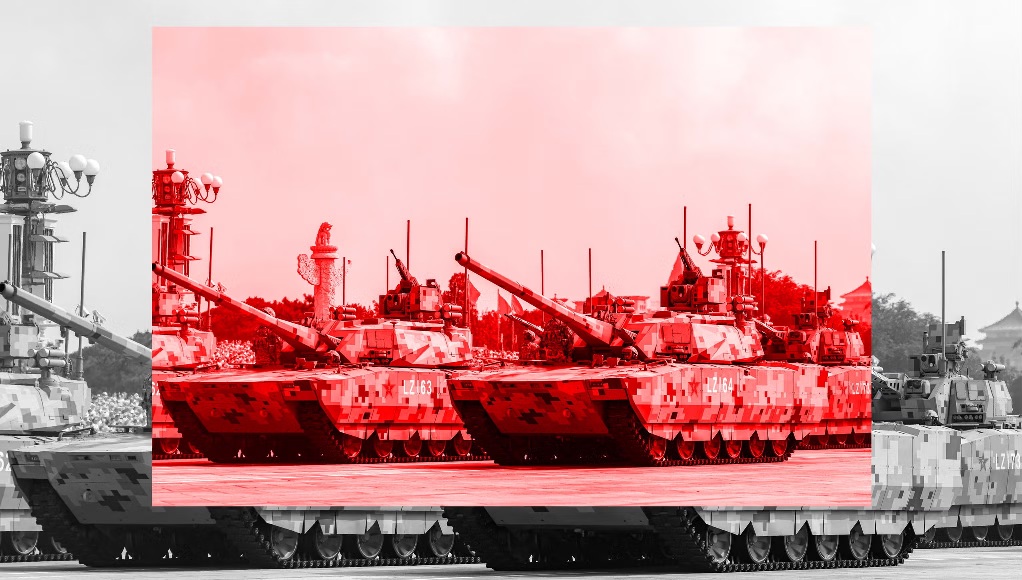
China unveiled the Type 100 tank and its ZBD-100 partner during a recent Beijing parade. Both vehicles are clearly optimized for expeditionary operations rather than static, heavy front-line battles. If the PLA moves towards Taiwan’s beaches or deep into Himalayan valleys against India, these platforms matter. Their 40-tonne weight makes them easier to deploy, recover, and sustain than 60–70-tonne main battle tanks.
For wider context on Chinese land modernization, Defense News Today tracks shifting armored doctrine and force structure. It shows how the China Type 100 tank fits a broader move toward lighter, better connected formations.
Hybrid power and unmanned turret
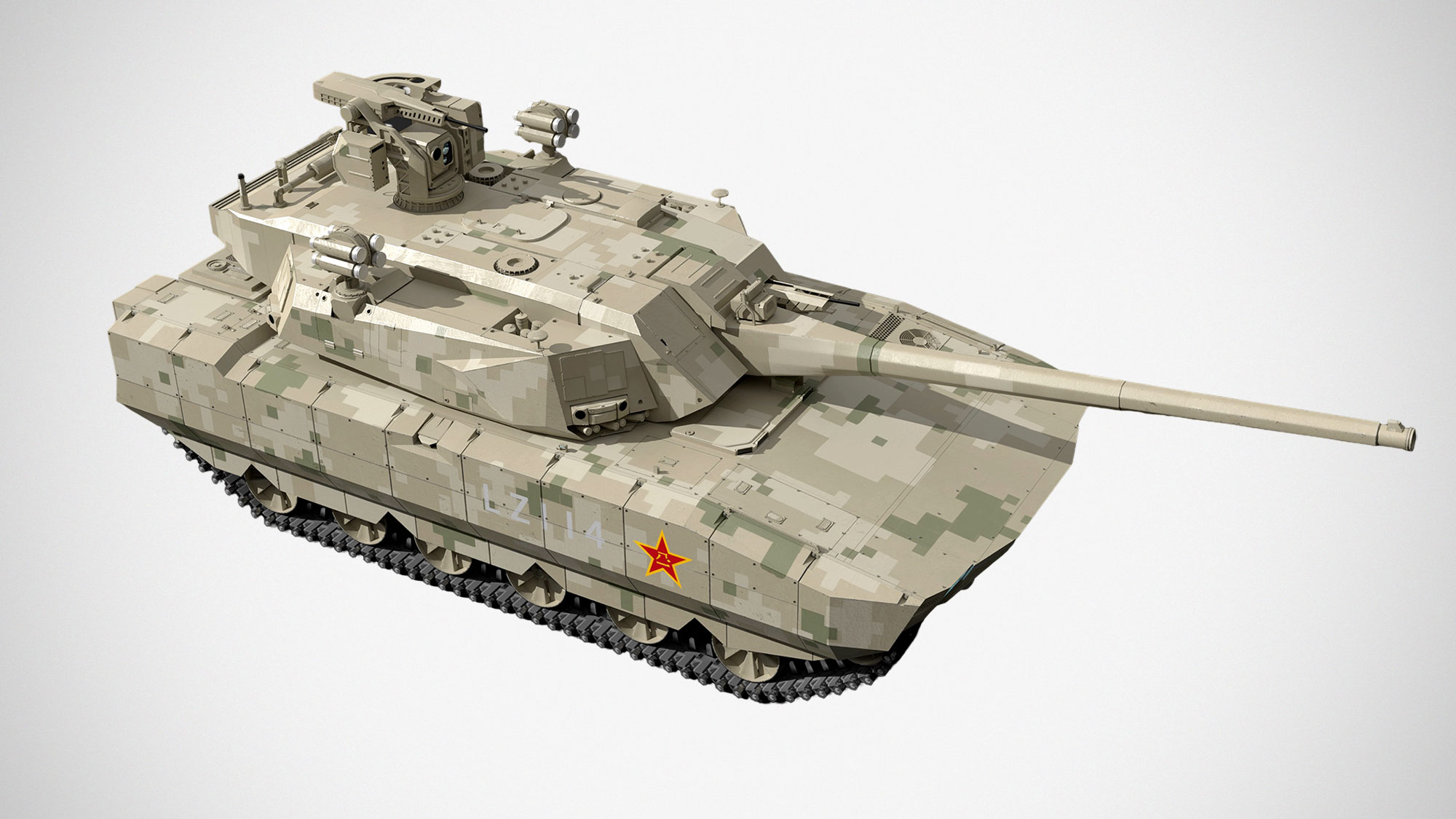
At around 40 tonnes, the China Type 100 tank sits in the “medium” class, closer to the cancelled US M10 Booker than the latest M1 Abrams. However, it retains a powerful 105 mm gun, a fully robotic turret, and a hybrid diesel–electric powertrain that affords it unusual flexibility on the battlefield.
The hybrid drive allows the China Type 100 tank to creep forward on battery power with a much lower acoustic signature. It can keep sensors and battle-management systems energized while stationary in an ambush, and it should still move short distances even if the diesel engine fails. Moreover, lower fuel demand simplifies logistics, which matters in mountains, rice paddies, and island chains.
Survivability follows a crew-first logic. Designers place the crew of the China Type 100 tank in a protected armored capsule inside the hull, separated from ammunition stored in the unmanned turret. At least 13 day-night optical and laser sensors provide 360-degree coverage, while augmented-reality goggles stitch those feeds together so crews can “see” through the hull.

Active protection, soft-kill defenses
Modern battlefields swarm with anti-tank missiles and drones, so the China Type 100 tank needs strong protection. Engineers rely heavily on its GL-6 hard-kill active protection system to keep the vehicle alive. Four side-mounted Active Electronically Scanned Array radars watch each quadrant around the tank for incoming threats.
A fifth radar looks upward, creating a protective hemisphere that constantly scans the air above the vehicle. When the GL-6 detects a rocket, missile, or low-flying drone, it immediately alerts the crew. It then automatically slews two roof-mounted launchers and prepares a precisely timed counter-shot. Each China Type 100 tank carries four interceptor rounds in every launcher for repeated engagements. The ZBD-100 support vehicle carries two rounds per launcher, adding depth to the shared defensive bubble.
Together, a small platoon of China Type 100 tank vehicles can create a dense protective umbrella. That shield is designed to defeat kamikaze drones, diving munitions, and top-attack anti-tank weapons. Soft-kill systems add a second defensive layer around the China Type 100 tank in combat. The tank reportedly mounts laser and radar warning receivers that sense hostile targeting and range-finding activity. It also uses rapid-launch smoke grenades and a JD-4 laser dazzler to confuse some optically guided weapons.
A remote-controlled heavy machine-gun turret offers another way to engage small drones and exposed infantry. Despite its medium weight, the China Type 100 tank still delivers serious firepower from its main gun. Its 105 -millimeter cannon reportedly fires kinetic armor-piercing shells at about 1,706 meters per second.
That muzzle velocity is roughly comparable to the many rounds fired from an American Abrams 120-millimeter gun. However, forcing such high pressures through a relatively small barrel can accelerate wear over time. Chinese armored units will therefore need strict maintenance regimes to preserve accuracy and barrel life.
ZBD-100: drones, radar and infantry in support
The ZBD-100 fire support vehicle transforms the China Type 100 tank into the central component of a compact combined-arms “team of systems.” Although it carries only a 30–40 mm autocannon, it shares the same hybrid drive, digital backbone, and armor philosophy.
On the roof, the ZBD-100 mounts a retractable AESA radar mast to watch the airspace, plus externally stowed reconnaissance quadcopters. It also carries four to six vertically launched loitering munitions. Deployed alongside a troop of China Type 100 tank platforms, those drones can scout ridgelines, spot minefields, and mark targets for indirect fire before the tanks roll forward.
In addition, the ZBD-100 can transport a small infantry element in its rear compartment. Those soldiers can clear dead ground, secure observation points for the China Type 100 tank, and launch or recover drones in cluttered urban or forested terrain where line-of-sight is limited.
This approach mirrors wider PLA experiments with “informatized” and now “intelligentized” warfare. Instead of single tanks fighting what they can see through their sights, the China Type 100 tank family is meant to operate as a node in a wider sensor-to-shooter grid. For a comparison with Western concepts, readers can review Defense News Today’s analysis of US next-generation combat vehicles.
Vulnerabilities and lessons for the US
However, advanced hardware does not guarantee battlefield overmatch. German officers who have studied open-source footage of the China Type 100 tank concept point out that every extra sensor, processor, and launcher creates new failure points. Battle damage, software bugs, or electronic attacks could degrade the very systems that provide these vehicles their edge.
Moreover, current active protection systems still struggle against high-velocity kinetic penetrators. In a classic tank-versus-tank fight, the China Type 100 tank would still face severe risk, particularly against heavy Western or Russian main battle tanks firing long-rod penetrators at close range.
China Type 100 tank and ZBD-100
Doctrine may be the deciding factor. To exploit the full potential of the China Type 100 tank and ZBD-100, PLA armored units must rehearse complex drills where drones, artillery, engineers, and infantry all feed data into the same network. Russia’s troubled T-14 Armata program shows how ambitious designs can stall when production, training, and combat employment do not align.
For the United States and its allies, the message is uncomfortable but clear. While the Army works on the M1E3 Abrams upgrade and longer-term Next-Generation Combat Vehicle concepts, the China Type 100 tank offers a live example of what a lighter, hybrid, highly networked armor family might look like in service. Analysts at institutions such as the US Army and RAND Corporation already argue that any future American vehicle must defeat not just other tanks, but swarms of drones and smart munitions.
Conclusion
Rumors in Chinese media suggest that reconnaissance, heavier guns, and other specialized variants could join the China Type 100 tank and ZBD-100 in coming years. If China can mature this ecosystem faster than Russia did with the Armata family, Beijing may become the first power to field a broad, drone-centric armored force at scale. Whether that force can survive sustained combat will depend on how quickly its doctrine, training, and active defenses adapt to the accelerating race between drones and armor.
Reference
- https://www.army.mil/
- https://www.rand.org/
- https://nationalsecurityjournal.org/chinas-new-type-100-tank-just-broke-cover-and-we-have-questions/
- https://militarnyi.com/en/blogs/type-100-china-s-vision-for-a-modern-tank/
- https://defencesecurityasia.com/en/china-type100-tank-bvr-revolution-pla-ground-force/
About the Author