

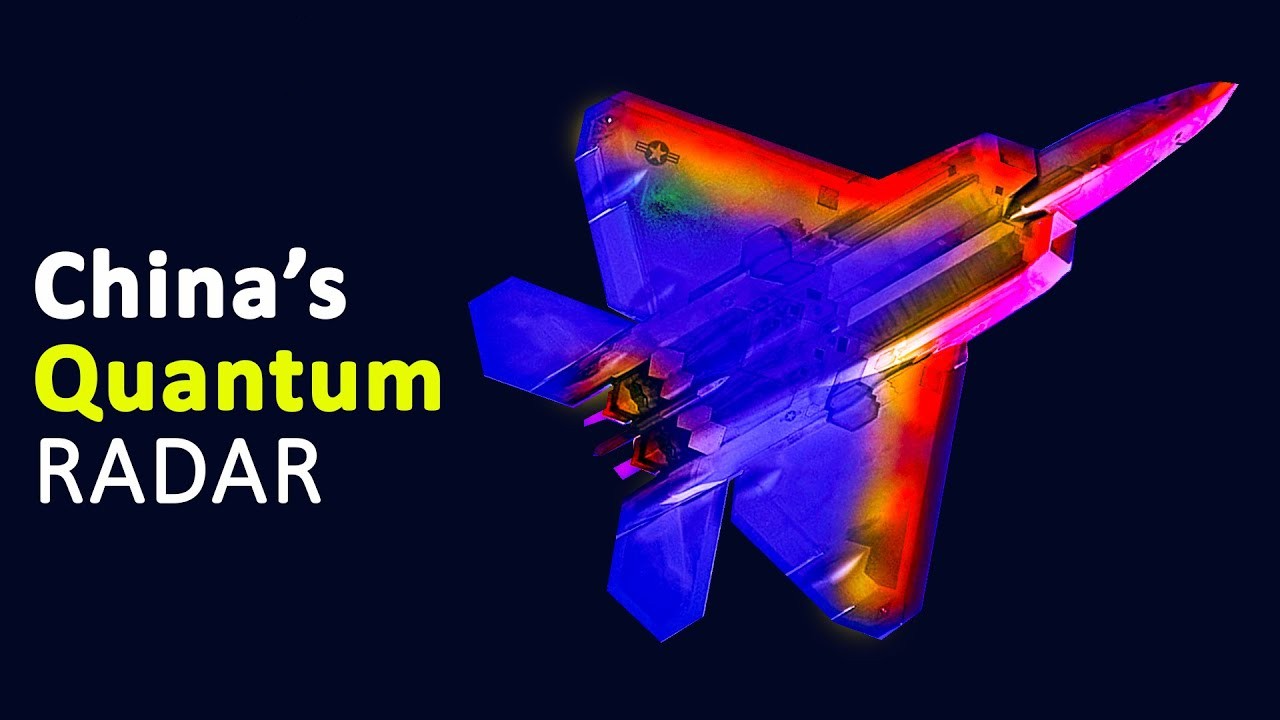
China Quantum Radar Claim — Hype vs Physics
Introduction
Viral posts keep recycling the claim about China’s quantum radar: a “quantum radar” that detects stealth aircraft at 100+ km, therefore making low observability obsolete. The story sounds believable because quantum entanglement is real, and China has produced world-class quantum communications results. However, radar engineering punishes hype fast. Range, losses, clutter, and false alarms decide whether a sensor changes the battlefield.
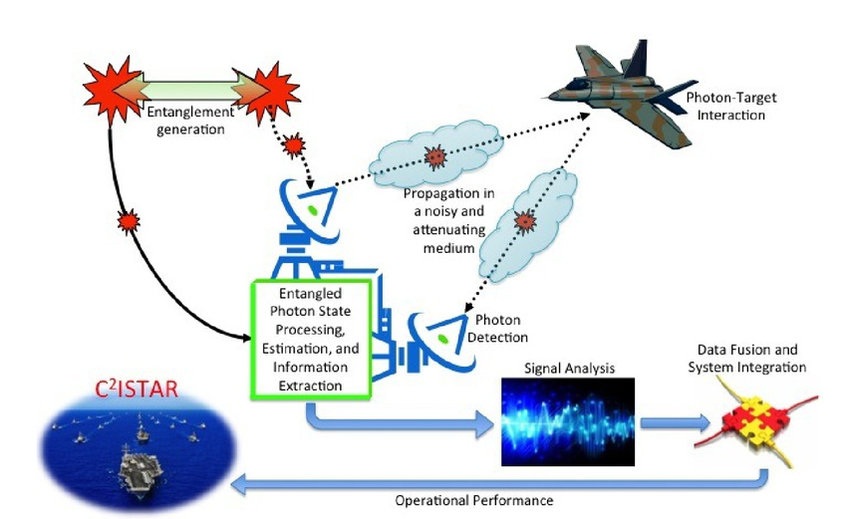
This model is the grounded version. “Quantum radar” in open literature often points to quantum illumination concepts: you generate paired signals (often described as signal and idler). You transmit the signal toward the target while you keep the idler at the receiver. If a tiny correlation survives the trip through noise, a clever receiver can detect weak returns that classical methods might miss in very specific regimes. That promise is real in the lab. It is also narrower than the meme implies.
Origin of the “100 km” Claim
The 100 km figure traces back to 2016 media reporting about a Chinese prototype, commonly linked to CETC-related coverage. The reporting framed it as a stealth counter. The core issue is that the claim lacks proof. Open reporting skipped the test details needed to verify the claim. It did not describe the test layout or geometry and did not specify the target type or shape.
It also omitted the frequency band and transmit power. Moreover, it did not explain the processing chain step by step. It gave no detection-versus-false-alarm statistics. Finally, it offered no evidence of repeatable, consistent results. Therefore, most analysts treat it as intriguing but unproven. They do not describe it as a fielded capability.
Biggest Myth: “The Twin Knows Instantly”
Entanglement does not establish a message channel that transmits faster than light. Quantum networks can distribute correlations over long distances, but they still do not enable instantaneous signaling. That matters because many viral explainers rely on the wrong mental model: “one photon hits the target, and its twin instantly reports the result.” That is not how sensing works.
For radar-like sensing, there is another practical constraint: once the outgoing signal interacts with the real world—air, clutter, and especially a rough target surface—pristine entanglement typically does not survive. What may survive is a weaker correlation “fingerprint” that a receiver can exploit statistically. Phys.org’s summary of a prototype makes this point directly: the return loses true entanglement, yet some correlation can remain useful.
What’s Been Demonstrated So Far
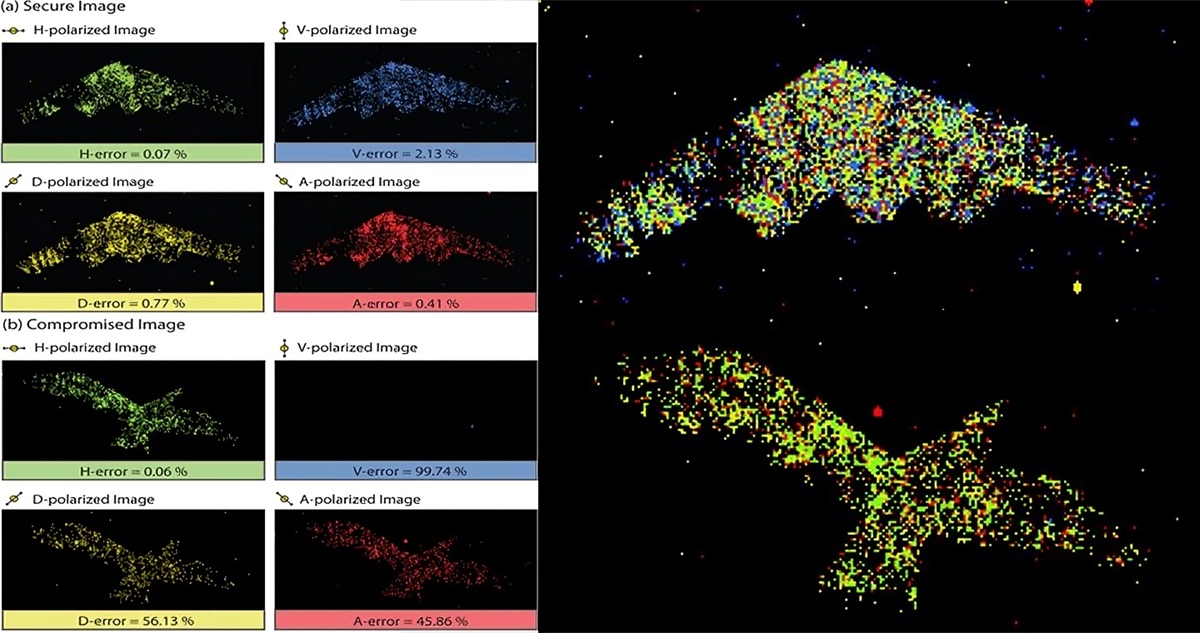
Researchers have provided real examples of quantum-illumination-style tests, including microwave prototypes, usually in controlled settings and often using special equipment. Those experiments matter because they prove correlation-based detection can work in noisy environments.
However, a proof of concept does not equate to an operational air-defense radar system. A fielded system must cope with weather, clutter, multipath, platform motion, electronic attack, calibration drift, maintainability, and cost. Therefore, the right question is not “can it work?” But can it work at militarily relevant ranges with reliable track quality?
Range Limits: Losses and Thermal Noise
The claim about China’s quantum radar typically exceeds the limits of physics at certain ranges. Radar suffers severe losses outbound and again on the return path. In common microwave bands, the environment also contains abundant thermal background photons at room temperature, which erodes any quantum advantage unless the system design controls noise extremely well.
A 2024 peer-reviewed analysis focused on microwave quantum radar range limitations delivers a blunt bottom line: for typical aircraft-class targets, the maximum practical range is intrinsically limited to under 1 km, and “in most cases” to tens of meters, once realistic loss and noise enter the model.
Other technical discussions explore kilometer-class performance under favorable assumptions. For example, an arXiv preprint derives conditions under which a two-mode-squeezed (entangled) radar could reach on the order of a couple of kilometres, emphasizing bandwidth and system parameters as critical constraints. Even that optimistic class still sits well below the viral 100-kilometer narrative.
Does Quantum Radar Kill Stealth?
It is unlikely that stealth will become obsolete in the near future, especially not in the simplistic manner that social media portrays it. Stealth is not invisibility. It is radar cross-section management across bands and aspects, combined with tactics, emissions control, electronic warfare, stand-off weapons, and decoys. Even if a future sensor improved weak-return detection in a specific niche, stealth aircraft would still gain survivability from shaping, coatings, threat-aware routing, and coordinated jamming.
Moreover, detection is not the same as fire-control quality tracking. To generate an engagement-quality track, a defender needs stability, update rate, and confidence against deception and clutter. In practice, the kill chain is multi-sensor by design—mixing active radar, passive RF, EO/IR, and networked cueing.
For a useful internal baseline of how real anti-stealth sensing often leans on passive detection and system integration, see VERA-E passive radar and stealth detection on Defense News Today.
For a second internal example of why networks and cueing matter as much as a single sensor, see networked kill chains and BVR engagements.
Countries Experimenting with Quantum Radar Tech
Several countries are experimenting with “quantum radar” ideas, usually under the broader banner of quantum sensing and quantum illumination. State-linked defense electronics groups in China have publicly discussed prototype work, often citing long-range anti-stealth claims. In Canada, university-led teams have run well-known quantum radar studies and lab demonstrations focused on detecting weak signals in heavy noise.
Whereas in the United States, defense-funded research programs support quantum-assisted sensing, better readout methods, and next-generation detectors. In the UK and across Europe, national quantum programs and large research hubs fund enabling technologies—sources, receivers, and timing—because those building blocks matter before anyone can field a rugged radar system.
Methods, Metrics, and Replicability
If quantum sensing becomes militarily meaningful, credible progress should show up in measurable, publishable ways:
- Performance curves, not slogans: Look for Pd vs Pfa curves (probability of detection vs probability of false alarm), not a single headline range number.
- Test realism: Demand details: band, power, antenna size, dwell time, clutter type, target RCS assumptions, jamming environment, and track formation performance.
- Engineering practicality: Watch for demonstrations that work at practical temperatures and bandwidths, with maintainable hardware, and with clear integration into existing air-defense architectures.
We still lack consistent, repeatable proof for the headline claim. China and others are investing in quantum sensing research. Labs have demonstrated related effects in controlled conditions. However, the bold 100-kilometer antistealth claim remains unconfirmed. It also looks unlikely based on published range limitations. Therefore, stealth technology is not “useless” in any practical sense.
References
- https://www.scmp.com/news/china/article/2021235/end-stealth-new-chinese-radar-capable-detecting-invisible-targets-100km
- https://www.mdpi.com/2072-4292/16/14/2543
- https://phys.org/news/2020-05-scientists-quantum-radar-prototype.html
- https://www.defenseone.com/ideas/2018/07/chinas-quantum-tech-quest-hype-reality-and-what-comes-next/149755/
About the Author



That’s very enlightening