


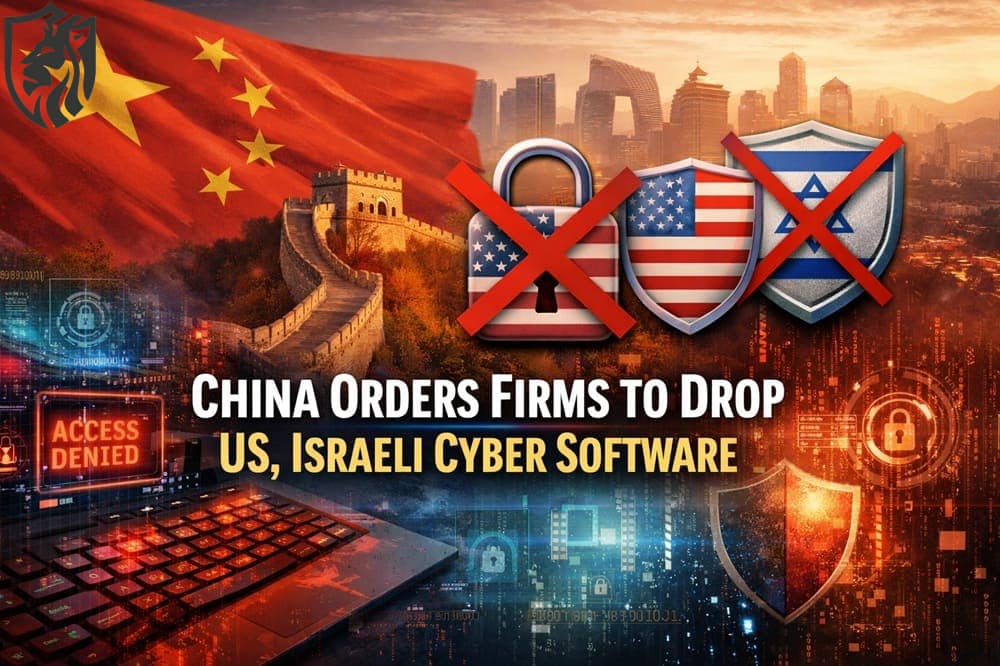
China orders firms to drop US, Israeli cyber software
China has reportedly told domestic firms to stop using cybersecurity tools from roughly a dozen US and Israeli vendors, according to two people briefed on the matter. The instruction, issued recently, sits squarely inside Beijing’s wider push to reduce reliance on Western tech as strategic competition intensifies. For defense and security observers, the move is not a routine procurement tweak. Instead, it is a signal about trust, supply-chain control, and how states now treat commercial security platforms as potential intelligence collection surfaces.
Beijing’s Reported Order
According to the sources, Chinese authorities instructed companies to phase out certain foreign cybersecurity software on national security grounds. Reuters could not confirm how many firms received the notice, which suggests the rollout may vary by sector and sensitivity.
Officials reportedly worry these products could collect sensitive operational data and transmit it overseas. That fear matters because modern security platforms ingest rich telemetry: endpoint events, network flows, identity logs, cloud configuration states, and sometimes decrypted inspection metadata.
Named Vendors
The sources cite firms such as Broadcom-owned VMware, Palo Alto Networks, and Fortinet from the United States, along with Israel’s Check Point Software Technologies. The Cyberspace Administration of China, China’s Ministry of Industry and Information Technology, and the named companies all did not respond to requests for comment or inquiries.
Why Cyber Tools Become a National Security Issue
Cybersecurity software sits in privileged positions by design. It monitors endpoints, inspects packets, manages identities, and often integrates deeply with cloud and virtualization layers. Therefore, when a government frames “data leaving the perimeter” as a strategic risk, security vendors become political targets as much as technical suppliers.
Beijing has been progressively focusing on replacing foreign equipment and software with domestic alternatives throughout the technology stack. Cybersecurity is a natural early candidate because it touches government networks, critical infrastructure, and defense-adjacent industry.
Impact on Chinese Networks
If organizations comply at scale, they face short-term friction and long-term redesign.
- Short-term: migration planning, contract exits, and urgent replacement of monitoring, firewall policy, and incident-response workflows.
- Mid-term: re-baselining security telemetry, retraining SOC teams, and rebuilding integrations with SIEM/SOAR tooling.
- Long-term: more standardization around domestic ecosystems, with procurement aligning even tighter to state risk models.
However, transitions can create coverage gaps. Any rushed swap risks misconfigurations, blind spots, and weakened detection until teams stabilize the new baseline.
Why It Matters Beyond China
For Western militaries and defense primes, the message is clear: the world is splitting into trust zones. In practice, that raises three questions.
- Data sovereignty: where logs, threat intel, and telemetry live—and who can compel access.
- Toolchain resilience: whether security posture depends on foreign updates, signatures, or cloud backends.
- Interoperability: how joint operations and coalition networks handle divergent vendor stacks.
Consequently, “China orders firms to drop US, Israeli cyber software” should be read as a strategic marker, not just a commercial dispute.
Conclusion
China orders firms to drop US, Israeli cyber software because Beijing sees security platforms as both shields and sensors. The immediate effect is procurement churn; the deeper effect is accelerated tech decoupling in a domain that sits close to national command, critical infrastructure, and defense industrial capacity.
References
- https://www.reuters.com/world/china/beijing-tells-chinese-firms-stop-using-us-israeli-cybersecurity-software-sources-2026-01-14/
- https://www.reuters.com/technology/china-rushes-swap-western-tech-with-domestic-options-us-cracks-down-2023-10-26/
- https://www.bloomberg.com/news/articles/2026-01-14/china-bans-cyber-products-from-top-us-israeli-security-firms
- https://www.dawn.com/news/1967047
About the Author