
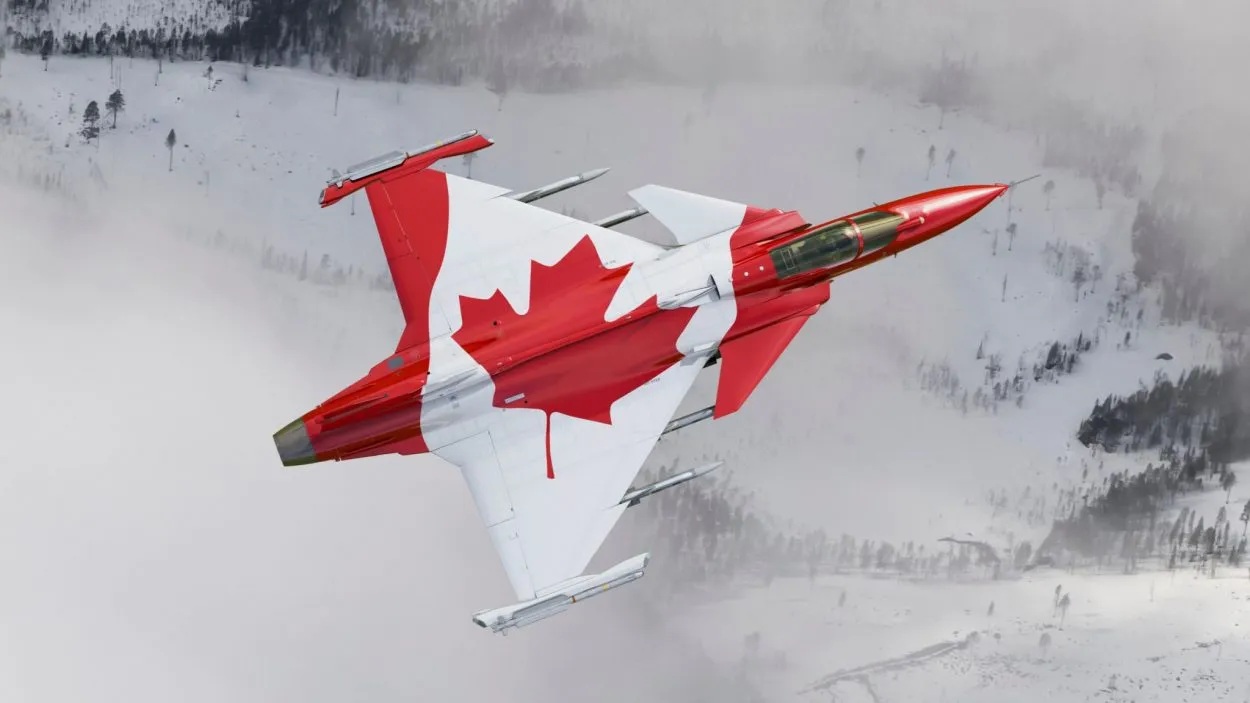
JAS 39 Gripen
As Canada reassesses its role in the F-35 program amid escalating trade tensions with America, concerns are growing about the fallout. Ottawa’s withdrawal from the agreement would severely impact Canada’s aerospace industry, which relies heavily on U.S. defense contracts.
The F-35 Controversy and Canada’s Re-Evaluation
As criticism of the F-35 purchase grew in public opinion, newly elected Canadian Prime Minister Mark Carney directed a formal review of the $19 billion CAD (US$13 billion) 2023 purchase deal for 88 fifth-generation fighter aircraft. The purchase is still on, but Canada’s defense ministry has emphasized ensuring the purchase deal is in the national security interests as well as the economic interests of Canadians.

In spite of this criticism, Canada has already made the initial payment for the first 16 planes, which will be ready for delivery in early 2025. The massive investment has sparked controversy, and Bombardier Inc. CEO Eric Martel has stated that cancellation of the deal would lead to retaliatory actions by the United States. Canadian companies hold several contracts with the Pentagon that could be at risk if Ottawa withdraws from the F-35 program.
Economic and Strategic Considerations
The F35 program has added immense value to Canada’s aerospace sector by generating well-paying jobs and putting domestic companies in the global defense supply chain. Bombardier itself still retains two significant U.S. contracts—communications and surveillance aircraft—firmly placing them in the American defense system.
One such example is Bombardier’s Global 6500, a next-generation intelligence, surveillance, and reconnaissance (ISR) aircraft that is critical to the U.S. Army’s High Accuracy Detection and Exploitation System (HADES) program. Bombardier has also finished delivering some aircraft for the U.S. Air Force’s Battlefield Airborne Communications Node (BACN) program, showcasing Canada’s central role in American defense infrastructure.
As 60% of Bombardier’s trade is in the U.S., a deterioration in Canada-U.S. defense relations would be fiscally expensive. Martel has noted that two-thirds of the nation’s aerospace exports are based on American cooperation, and that makes it even harder to undo the F-35 deal.
The Search for Alternatives and US Influence
In answer to increasing domestic criticism, Canada’s Defence Minister Bill Blair announced that the government is considering alternative fighter jet solutions. The second choice in Canada’s original procurement review, the Swedish Saab JAS-39 Gripen, is up for consideration. Blair also mentioned European fighters like the Eurofighter Typhoon and France’s Dassault Rafale as remaining in the running.
Yet, Canada itself might have a tough time acquiring these jets. The United States has a strong hold on military plane sales from around the world because it controls vital parts, including jet motors. The Gripen, for example, relies on an American-produced General Electric F414 engine, which means Washington can veto any possible purchase.
Defense analyst Martin Shadwick. In terms of European options, the Rafale is the least U.S. component-dependent and thus the best bet if Canada chooses to look away from the F-35. Even the Rafale, however, incorporates American technology in its European-built aircraft, as companies like Lockheed Martin, Northrop Grumman, and Collins Aerospace supply key avionics, navigation, and targeting systems.

Precedent for U.S. Veto Power
Current events show Washington’s readiness to exercise control over foreign military sales. The United States previously shut down Colombia’s attempt to purchase Gripen E fighter aircraft due to limitations on the export of the General Electric F414 engine. This incident establishes a precedent, raising concerns about potential restrictions on Canada’s ability to find alternative aircraft.
President Trump’s trade measures have strained relations between two North American allies. They have also fueled public frustration across Canada. Many Canadians now urge less reliance on American military equipment. His administration imposed 25% tariffs on Canadian steel and aluminum. That decision has added to the public’s anger. A Canadian citizen wrote a letter to the Eurasian Times reflecting this mood. They warned that dependence on U.S.-owned aircraft invites political pressure. In their view, it could leave Canada open to blackmail.
The Road Map to Canada’s Future
Prime Minister Carney has started talks with European leaders about building fighter jets in Canada. This could cut U.S. leverage over procurement and boost domestic aerospace output. However, cancelling the F-35 program would be costly and complicated. Any replacement must meet Canada’s operational and strategic needs. It must also navigate geopolitical limits set by U.S. defense policy. As Ottawa weighs options, it must balance security, economics, and diplomacy. Only then can it find a workable path to modernize the air force.
Reference
- EurAsian Times – Canada’s F-35 Purchase Controversy
- Defense News – Canada’s Review of F-35 Deal
- Global News – Canada-US Trade Relations and Defense Industry
- The Aviationist – US Restrictions on Fighter Jet Exports
- FlightGlobal – Canada’s Defence Procurement Strategy
About the Author