

Cambodia–Thailand Border Clashes — Ceasefire at Risk
Clashes Erupt on Disputed Border
Cambodia–Thailand border clashes intensify as fighting spreads along multiple sections of their 800-kilometer frontier. Both armies insist they fired only in self-defense, yet each accuses the other of initiating the latest round of violence.
The crisis escalated after a Sunday-night skirmish in which a Thai soldier died. Within 48 hours, fresh artillery exchanges and small-arms fire shattered a fragile calm, forcing tens of thousands of civilians to flee villages near the frontier.
Cambodia reports seven civilians killed and at least 20 wounded since the new clashes began. Thailand, meanwhile, confirms additional military casualties and damage near key border provinces. Although casualty figures remain fluid, both sides acknowledge that the death toll is rising.
How the Clash Unfolded
The current phase began with the fatal clash that killed a Thai soldier near the disputed frontier. According to Bangkok, Cambodian troops opened fire first, using indirect fire and grenades close to Thai positions.
Subsequent reports from the Thai army describe artillery falling into Sa Kaeo province and fresh incidents near Surin and the Preah Vihear temple area, a UNESCO World Heritage site. Thai officials also claim Cambodian forces used mortars and grenades close to civilian areas.
Phnom Penh tells a starkly different story. Cambodia’s Senate President Hun Sen, still viewed by many as the country’s de facto leader, says Thai forces escalated first and that Cambodian units initially held their fire. Only after enduring sustained pressure, he argues, did Cambodia respond with counter-battery fire and targeted counterattacks.
In online statements, Hun Sen frames Cambodia–Thailand border clashes as a test of national resolve. He promises to “weaken and destroy enemy forces through counterattacks” if Thai troops keep pushing into disputed zones.
Dueling Claims and a Trump-Backed Truce
These renewed Cambodia–Thailand border clashes intensify pressure on a ceasefire originally brokered by Malaysia and ASEAN, with backing from China and the United States. Then-US President Donald Trump reportedly reinforced the deal by threatening to suspend trade benefits if either side broke the truce.
An October follow-on agreement required both militaries to withdraw heavy weapons from the front line, tone down hostile rhetoric, clear land mines, and rebuild confidence through joint mechanisms. However, implementation never matched the ambitious text. Heavy weapons remained near the border, and information campaigns on both sides stayed confrontational.
Cambodia argues that Thailand still detains 18 Cambodian fighters seized just as the ceasefire took effect. Thailand counters that Cambodia has laid new landmines in contested zones, several of which have maimed Thai soldiers on patrol. These unresolved grievances now undercut whatever credibility the Trump-backed peace framework once had.
Defense News Today has examined Trump’s tariffs and their impact on Indonesia’s F-15EX agreement in detail, providing readers with a broader view of how external powers shape regional arms deals in this analysis of US–Indonesia fighter politics.
Unequal Cambodia–Thailand Military Balance
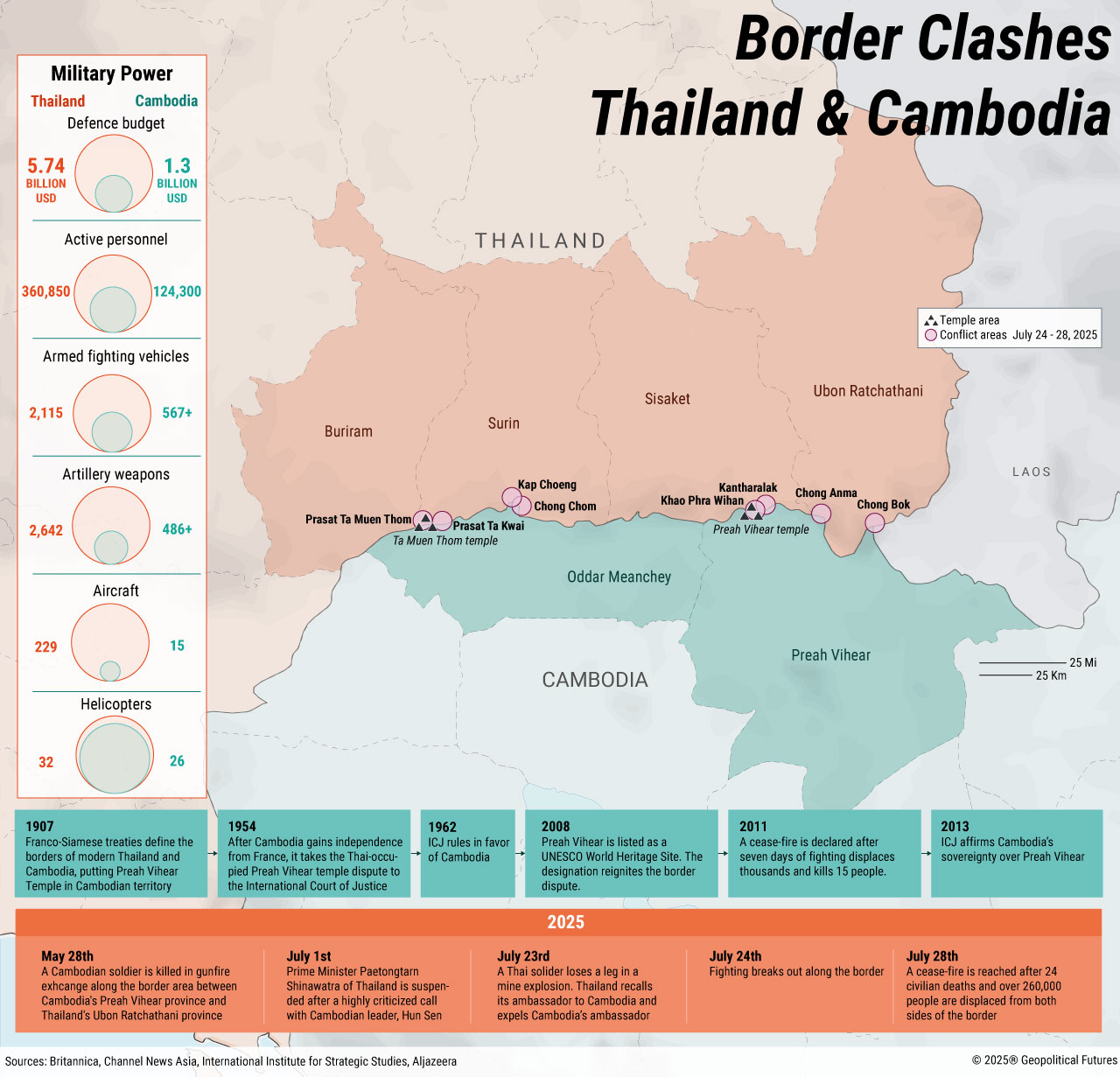
Behind the political rhetoric, Cambodia–Thailand border clashes intensify against a backdrop of deeply asymmetric military power. Thailand fields a far larger, heavier, and more technologically advanced force across all domains.
Cambodia’s Small but Determined Military
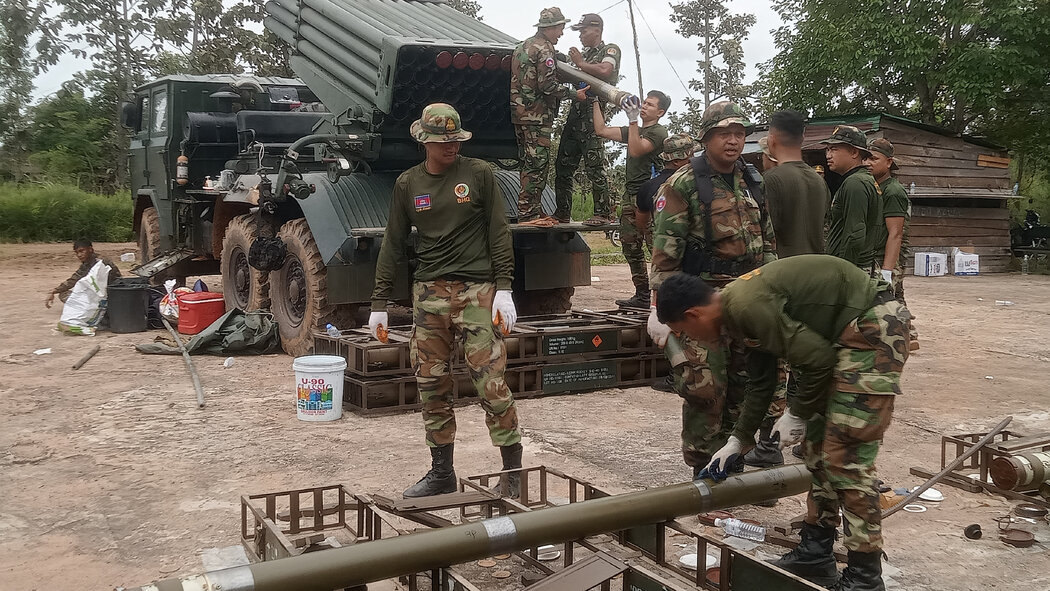
Cambodia’s defense budget is estimated at $1.3 billion. Its armed forces comprise roughly 124,000 personnel, with an army of around 75,000 troops. Most Cambodian ground troops are lightly equipped, relying on older armor, towed artillery, and limited air defense systems.
Crucially, Cambodia has no operational fighter aircraft. Its air arm consists mainly of training platforms and rotary-wing assets, limiting its ability to contest Thai air superiority. Armor and artillery inventories remain modest, focused on territorial defence and internal security rather than expeditionary operations.
At sea, the Royal Cambodian Navy operates just over a dozen patrol craft. These vessels can police coastal waters and rivers but offer little deterrence against a neighbor with a sizable blue-water fleet.
Thailand’s Heavier Modern Arsenal
Thailand spends about $5.73 billion on defenses and maintains more than 360,000 personnel across its armed forces. Its army fields hundreds of main battle tanks and thousands of armored vehicles and artillery systems, including modern self-propelled guns and multiple rocket launchers.
The Royal Thai Air Force deploys over 100 combat aircraft, making it one of Southeast Asia’s stronger air arms. This fleet includes F-16s, Gripens, and upgraded legacy platforms capable of precision strike and air-defense roles. In any sustained air campaign, Cambodia would be unable to match these capabilities.
Thailand’s navy, with close to 70,000 personnel, operates an aircraft carrier, amphibious ships, and a range of surface combatants. These assets allow Bangkok to project power along its long coastline and into contested maritime approaches, adding another layer of pressure in any crisis with Cambodia.
For comparison, Defence News Today has explored how small and medium powers try to offset conventional disadvantages using advanced sensors, such as Pakistan’s adoption of the Czech VERA-E passive radar system. The Cambodia–Thailand standoff similarly highlights the importance of intelligence, surveillance, and reconnaissance in contested border zones.
Why the Dispute Keeps Reigniting
Although Cambodia–Thailand border clashes intensify today, the roots of the conflict stretch back more than a century. Both countries share an approximately 800-kilometer (500-mile) land border that cuts across sparsely populated jungle, farmland, and highland plateaus.
Their competing claims center on a 1907 colonial-era map drawn while Cambodia fell under French control. Thai officials have long argued that the map is inaccurate and that certain strategic areas, including land surrounding temples like Preah Vihear, fall on their side of the border. Cambodia insists the map and related International Court of Justice decisions support its claims.
Because much of the boundary remains poorly demarcated, both militaries maintain forward positions, observation posts, and patrol routes in overlapping areas. Old minefields further complicate movement and raise the human cost of every skirmish, even when both sides try to avoid deliberate escalation.
Nationalist politics on both sides amplify these structural risks. Leaders in Phnom Penh and Bangkok face domestic pressure not to “back down” over historical claims. As a result, even small incidents—such as a patrol crossing a disputed line or a flag raised near a temple—can rapidly escalate into artillery duels.
Regional Security Risks from the Clashes
As Cambodia–Thailand border clashes intensify, the Trump-backed ceasefire risks becoming a dead letter rather than a living framework. Each exchange of fire further erodes trust, making it harder for ASEAN mediators to re-establish meaningful dialogue.
Several scenarios now compete. In the best case, sustained diplomatic pressure from ASEAN, China, and the United States pushes both sides back to the table. Verified pull-backs of heavy weapons, transparent prisoner arrangements, and joint de-mining would then anchor a more durable truce.
In a worse scenario, a miscalculation—perhaps a mass-casualty strike on a refugee convoy or a temple—could trigger wider mobilization and more intense air and artillery use. Given Thailand’s conventional superiority, Cambodian planners might respond by leveraging asymmetric tactics, information operations, and deeper reliance on external partners.
Conclusion
For defense analysts, the crisis highlights how legacy border disputes can collide with modern capabilities, from precision artillery to social media information campaigns. It also emphasizes that there must be verifiable arms control and early-warning mechanisms in regions where historical grievances remain raw.
Ultimately, whether this round of fighting becomes another bloody episode or a catalyst for a stronger settlement will depend on political decisions in Phnom Penh and Bangkok—and on how long regional and global actors are willing to invest in keeping the peace.
References
- https://www.reuters.com/world/asia-pacific/thailand-cambodia-fighting-spreads-along-contested-border-2025-12-09/
- https://www.britannica.com/event/Thailand-Cambodia-Conflict
- https://www.thedailyjagran.com/opinion/thailand-cambodia-clash-a-political-battle-in-the-name-of-religious-heritage-10256642
- https://www.bbc.com/news/articles/c93dy2kk7vzo
About the Author