

Bitcoin Price Prediction as Iran War Escalates
Bitcoin price predictions have become much less reliable since President Donald Trump’s April 1 speech, which stressed that the U.S. would take a harder military path against Iran instead of a quick diplomatic exit. For a short time, the markets thought things might calm down. Instead, traders heard that there would be more aggressive action in the next two to three weeks, but there was no clear plan for reopening the Strait of Hormuz or ending the crisis. That change is important because crypto doesn’t usually trade alone when geopolitical stress affects energy, interest rates, and stock market sentiment.
The way the market reacted right away showed why this Bitcoin price prediction now seems more defensive than bullish. Oil prices went up because traders thought there was a greater risk of supply problems. Stocks lost momentum, and the dollar got stronger. After Trump’s speech, Reuters said that Brent was above $106 a barrel. In other words, the macro backdrop deteriorated in hours, not days. Reuters on Trump’s threat and Reuters on the oil shock frame the immediate trigger clearly.
Why Iran Matters for Bitcoin
The main point is easy to understand for readers interested in defense and geopolitics. The Strait of Hormuz is more than just a naval hotspot. It is a tool for figuring out how much inflation will happen around the world. When the risk of war goes up around Hormuz, traders do more than just change the price of oil. They also change the prices of growth, monetary policy, transportation expenses, and business profits. That bigger shock could still affect Bitcoin, even if the blockchain itself stays the same. Your own related analysis on Trump Warns Iran Over Strait of Hormuz Mines and How a Long Iran War Could Bleed American Power fits neatly into this wider picture.
That’s why the old “digital gold” story can’t be the only thing that Bitcoin price prediction is based on. In this episode, traders saw Bitcoin as a risk asset that was sensitive to liquidity rather than a safe place to hide from war. Bloomberg said that Bitcoin dropped to the mid-$65,000s as stocks fell after Trump’s comments. Caroline Mauron of Orbit Markets said that Bitcoin was mostly following stocks. That suggests Bitcoin is a viable hedge over long periods of time. It does mean that institutions often treat it like a high-beta expression of broader sentiment when there is a big macro shock.
Why the Safe-Haven View Weakens
Gold didn’t provide a clear offset, which makes the safe-haven case look weaker as well. In March, gold had its worst month since 2008, falling 11.8%. It fell again as the dollar got stronger and fears of inflation caused by rising oil prices pushed up rate expectations. Even safe havens can be shaky when yields go up and the dollar gets stronger. That means that Treasuries, cash, and the dollar are taking in more of the defensive flow than Bitcoin.
That change is important for predicting the price of Bitcoin because the asset still depends a lot on marginal demand. Bloomberg explains that CryptoQuant said that the apparent demand for Bitcoin was down by about 63,000 BTC at the end of March. In simple terms, there was more supply on the market than there were new buyers. Even though there is interest in ETFs and institutions are getting involved, that kind of demand makes it easier for rallies to fade and harder for breakdowns to stop.
Key Chart Levels to Watch
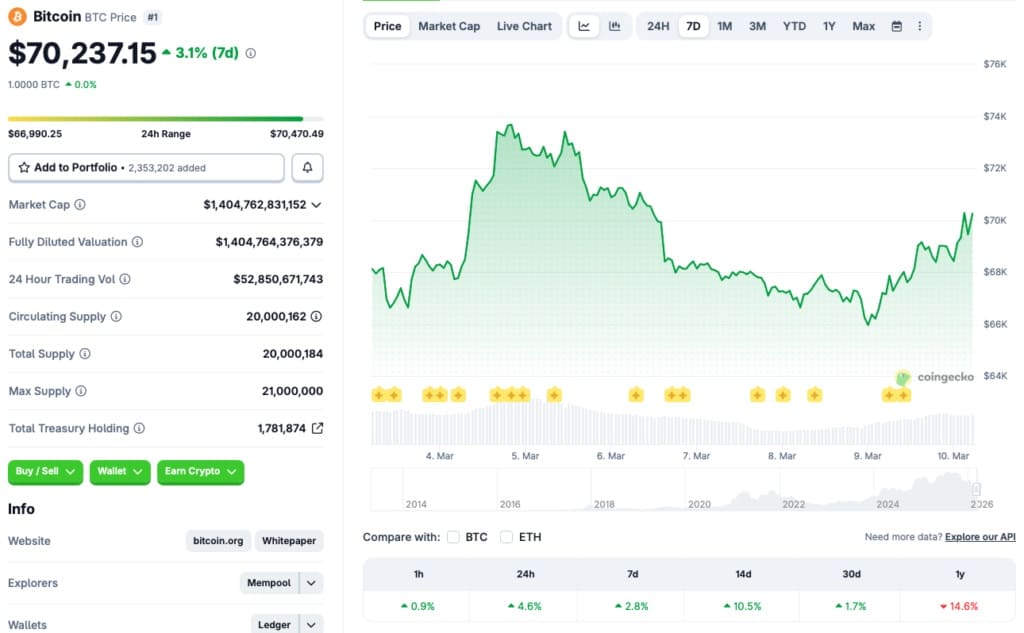
From a technical standpoint, the Bitcoin price prediction now concentrates on a small but crucial area of conflict. Since its peak of around $76,000 in March, BTC has been making lower highs. Every time the market has gone up, it has looked weaker than the last time. Selling pressure has repeatedly stopped attempts to recover before they could build up momentum. That weak structure doesn’t mean there will be a crash, but it does show that bulls haven’t taken control again.
The $64,000 to $65,000 support zone is the most important level. If that floor holds again, Bitcoin might stabilize and try to bounce back. If sellers break it cleanly, though, the next clear downside magnet is $60,000, which is close to the February washout area that many market technicians have talked about. On the other hand, bulls must return to $68,000 and then surpass $70,000 before anyone can trust a serious recovery narrative. Until then, this market is still trying to fix things.

What Comes Next
If you’re interested in defense, the best way to read this Bitcoin price prediction is through the effects of the war on the supply chain. Pay close attention to four key factors: the continuation of the Hormuz disruption, the stability of Brent above the low $100s, the persistence of Treasury yields pricing sticky inflation, and the clarity of Washington’s end state. If those pressures ease at the same time, Bitcoin could bounce back faster than people think. If they get worse together, $60,000 stops looking baffling and starts to make sense.
The main point is that Bitcoin is still not completely separate from the strategic system that surrounds it. The same big factors that affect stocks and commodities can also affect the crypto market. These include war risk, shipping bottlenecks, rising energy prices, and uncertainty about government policy. Therefore, the issue isn’t just a story about crypto. It tests the idea that Bitcoin can act like digital gold during a real-world security crisis in a geopolitical way. The evidence right now shows that it is still acting more like risk than safety.
References
- https://defensenewstoday.info/trump-warns-iran-over-strait-of-hormuz-mines/
- https://defensenewstoday.info/how-a-long-iran-war-could-bleed-american-power/
- https://www.reuters.com/world/middle-east/trump-threatens-hit-iran-extremely-hard-over-next-two-three-weeks-2026-04-02/
- https://www.reuters.com/business/energy/oil-prices-drop-hopes-us-pullback-iran-war-2026-04-02/
About the Author