

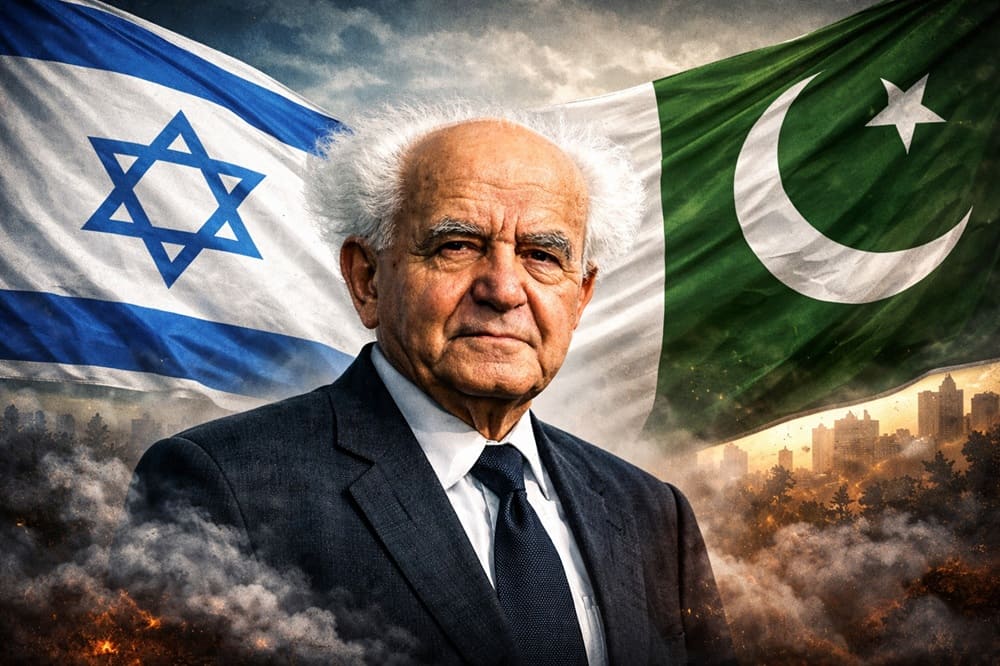
Ben-Gurion’s Remarks on Pakistan After Arab-Israeli War
David Ben-Gurion, Israel’s first prime minister, made several critical observations about Pakistan during a visit to France after the Arab-Israeli War of 1948. While his concerns primarily revolved around Israel’s immediate Arab neighbors, he increasingly viewed Pakistan as a serious and long-term threat.
In this article, we explore what David Ben-Gurion said about Pakistan in France after the Arab-Israeli war and why Pakistan’s involvement in the Arab-Israeli wars made it an arch-nemesis of Israel.

Ben-Gurion’s Speech Syntax
The world Zionist movement should not be neglectful of the dangers Pakistan poses to it. Pakistan should now be the first target of the world Zionist movement, as this ideological state poses a threat to our existence. The entire country of Pakistan hates the Jews and loves the Arabs. This lover of the Arabs is more dangerous to us than the Arabs themselves.
For that matter, it is most essential for world Zionism that it should now take immediate steps against Pakistan. Whereas the inhabitants of the Indian peninsula are Hindus whose hearts have been full of hatred towards Muslims, therefore, India is the most important base for us to work from against Pakistan.
We must exploit this base to strike and defeat Pakistanis, who are enemies of Jews and Zionism, using all available covert and secret strategies. David Ben-Gurion, the first Israeli prime minister, made this statement during a Knesset speech in December 1949.
Pakistan in the Arab–Israeli Wars
Although Pakistan is geographically distant from Israel, its military played a crucial role in the Arab-Israeli conflicts, particularly the wars of 1967 and 1973. The Pakistani military, particularly the Pakistan Air Force (PAF), sent pilots and ground forces to support Arab nations. PAF pilots, renowned for their professionalism, engaged Israeli fighter jets and scored several successes during these wars, enhancing Pakistan’s standing in the Arab world.
This direct involvement turned Pakistan into a formidable adversary for Israel. Ben-Gurion’s concerns in France were valid. What David Ben-Gurion said about Pakistan in France after the Arab-Israeli war highlighted Israel’s concern over Pakistan’s increasing involvement in the region. Israel felt threatened, especially considering Pakistan’s military effectiveness in supporting the Arab cause.
Is Pakistan a Bigger Threat Than Iran?
While Israel has always been wary of its Arab neighbors and Iran, Ben-Gurion sees Pakistan as an even greater threat. Pakistan’s military achievements in the Arab-Israeli wars made it clear that it was a formidable opponent. What David Ben-Gurion said about Pakistan in France after the Arab-Israeli war reflected his belief that Pakistan posed a unique danger to Israel, more so than Iran or any of the combined Arab states.
Unlike other nations, Pakistan had a history of military professionalism, and its ability to stand its own against Israel during the wars caused a long-lasting impression. Ben-Gurion acknowledged that Pakistan’s support for the Palestinian cause, combined with its growing military prowess, could present a significant challenge for Israel in the long term.

Pakistan’s Strategy to Contain India
One reason Israel saw Pakistan as a bigger threat was its ability to hold back a much larger adversary, India. For over 70 years, Pakistan has maintained military parity with India, a nation seven times its size. This shows Pakistan’s military professionalism and strategic skill, a point Ben-Gurion emphasized after the Arab-Israeli war.
Israel expressed concern about the potential misuse of this capability in the Middle East. Pakistan’s military is battle-hardened from multiple wars with India while keeping a strong defensive posture. Ben-Gurion recognized the issue as a serious concern for Israel’s security.
Pakistan’s Homegrown Weapons and Professional Force
Another key point in what David Ben-Gurion said about Pakistan in France after the Arab-Israeli war was his observation of Pakistan’s indigenous weapons development. Pakistan has made major improvements to producing its own weapons systems, ranging from fighter jets like the JF-17 Thunder to nuclear capabilities. This indigenous production capability sets Pakistan apart from other Islamic nations that rely heavily on foreign arms.
For Israel, that was alarming. Arab states could field big armies, yet their heavy dependence on imported kit often blunted real combat power. Pakistan was different. It paired a professional army with an expanding local defense industry, which made it a tougher, more credible rival. Ben-Gurion also warned that this trajectory could strain Israel’s security planning and complicate its wider regional partnerships.

Why Pakistan Worries Israel
Ben-Gurion’s statements in France highlighted several reasons why Israel viewed Pakistan as a long-term threat. First, Pakistan’s pro-Arab and pro-Palestinian stance was unshakeable. Unlike some Arab nations that have engaged in diplomacy with Israel over the years, Pakistan remained a staunch opponent of Israel’s existence, refusing to recognize the Jewish state.
Second, Pakistan’s participation in the Arab-Israeli wars bolstered its military strength, sending a clear message to Israel. Ben-Gurion understood that Israel could not afford to ignore Pakistan’s growing influence in the region. This is why David Ben-Gurion’s comments about Pakistan in France after the Arab-Israeli war were not just a passing comment; they were a sign of Israel’s long-term worries about Pakistan’s plans.
Lastly, Pakistan’s role in counterbalancing India further demonstrated its strategic prowess. Pakistan’s ability to maintain parity with a much larger India was alarming for Israel, a nation that thrives on military superiority. Ben-Gurion recognized that Pakistan’s strategic thinking and military professionalism posed a more significant challenge for Israel than any other nation.

Conclusion: How Israel Weighs Pakistan
In conclusion, Ben-Gurion’s remarks on Pakistan in France after the Arab-Israeli war were remarkably prescient. He saw Pakistan as a supporter of the Palestinian cause and a potential military rival to Israel’s superiority. Pakistan’s role in Arab-Israeli wars, its ability to contain India, and its weapons development made it formidable.
Over 70 years, Ben-Gurion’s concerns have proved accurate. Pakistan remains a vocal critic of Israel on the global stage. Israel’s defense planners still worry about its military capabilities. As geopolitics shift, Ben-Gurion’s words remain a reminder of Israel’s strategic challenges.
References
- BBC News – Profile: David Ben-Gurion
https://www.bbc.com/news/world-middle-east-11094702 - The Jerusalem Post—Israel’s first Prime Minister and his strategic outlook
https://www.jpost.com/jerusalem-report/article-699098 - Dawn—Pakistan’s role in Arab-Israeli wars
https://www.dawn.com/news/1042722 - Al Jazeera—How Pakistan supported Arab nations in conflicts with Israel
https://www.aljazeera.com/news/2017/6/5/the-pakistani-pilots-who-fought-in-arab-israeli-wars - Middle East Monitor – Pakistan’s pro-Palestinian stance and refusal to recognise Israel
https://www.middleeastmonitor.com/20201214-pakistan-will-never-recognise-israel-says-imran-khan/ - The Hindu—Pakistan’s defence capabilities and indigenous weapons development
https://www.thehindu.com/news/international/pakistans-jf17-thunder-and-defence-industry/article32563738.ece - RAND Corporation—Pakistan’s military professionalism and strategic posture
https://www.rand.org/pubs/research_reports/RR2581.html - Haaretz—Israel’s military doctrine and regional threat perceptions
https://www.haaretz.com/israel-news/security-aviation/
About the Author