
Dubai airshow’s uneasy spotlight
At the Dubai International Airshow, Australia’s arms exports to the UAE take center stage in a sleek national pavilion run by Team Defense Australia. More than 35 companies are pitching everything from smart munitions to avionics, supported by a retired senior ADF officer offering “the key credibility of being in uniform.”
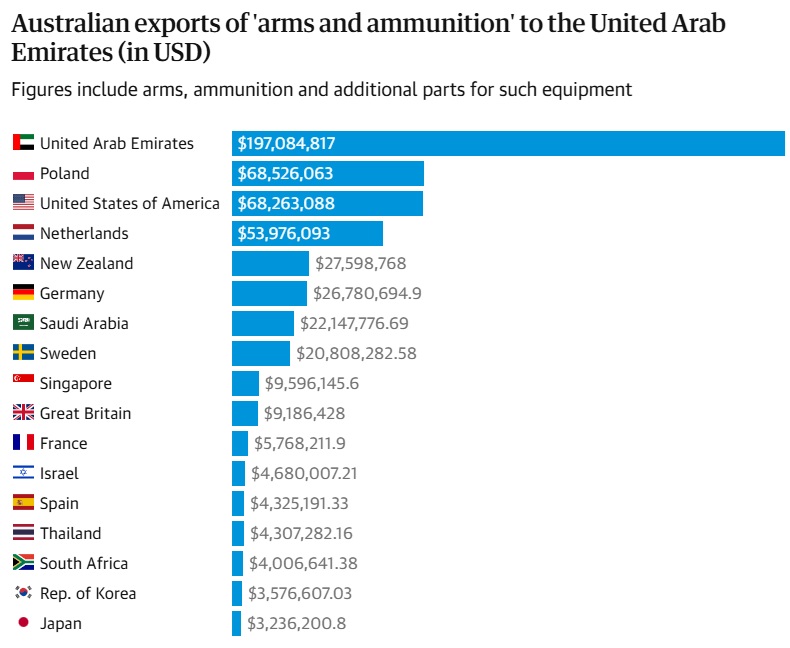
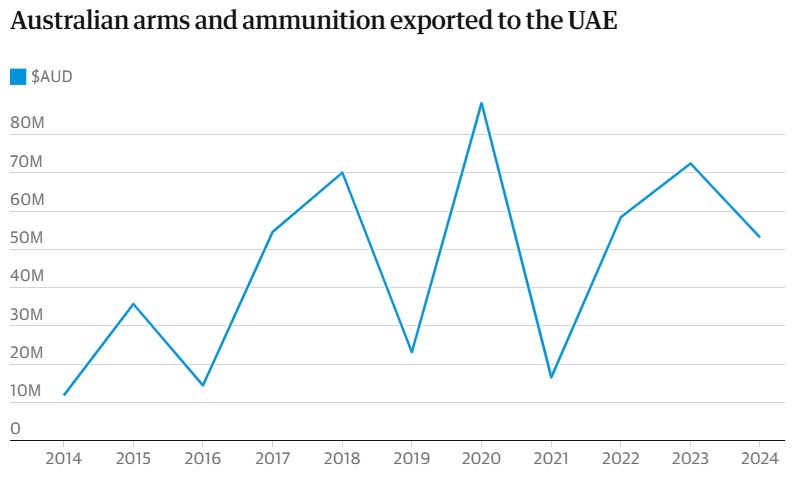
For Canberra, the UAE is now the dominant customer. Government figures show about $288 million (roughly US$197 million in UN trade data) in arms, ammunition, and related components shipped over the last five years, making the Emirates Australia’s biggest defense export market by far.
However, behind the trade-show lighting and export slogans, the strategic question is stark. Critics ask whether Australia’s arms exports to the UAE can truly be ring-fenced from Sudan’s civil war, where the Rapid Support Forces (RSF) stand accused of genocide-level atrocities in Darfur.
UAE supply lines and the RSF war
Since April 2023, Sudan’s conflict has evolved into a brutal struggle between the national army (SAF) and the RSF, the successor to the Janjaweed militias. Amnesty International, Human Rights Watch, and UN investigators document mass killings and systematic rape and torture, particularly around El Fasher and other Darfur cities.
UN panels of experts describe how the RSF suddenly fielded “heavy and sophisticated weapons” it previously lacked, including UCAVs, howitzers, multiple rocket launchers, and MANPADS in Nyala, El Fasher, and El Geneina. They trace new supply lines through eastern Chad, Libya, and South Sudan that shifted the balance of power on the ground.
Within that network, numerous reports say the UAE acted as a logistics hub. The panel’s findings and outside research mention many cargo flights from UAE airports to Amdjarass and other bases in Chad, often run by companies that have previously transported weapons.
Abu Dhabi insists these flights are purely humanitarian, carrying supplies and equipment for field hospitals. Yet satellite imagery, flight-tracking data, and testimony from aid workers and local witnesses leave many analysts unconvinced.
Gold for guns: the RSF–UAE link
The RSF’s combat power rests not only on weapons but also on Sudan’s gold. Investigations suggest that roughly 90% of Sudanese gold exports, worth an estimated US$13.4bn a year, leave the country through illicit channels; most flows end up in the UAE’s trading ecosystem.
In practice, the same networks that move smuggled gold can move cash, fuel, spare parts, and ammunition. This is why export-control specialists are now concerned about Australia’s arms exports to the UAE. Once high-value defense material enters a market deeply entangled with Sudan’s war economy, clean separation between “legitimate” and illicit end users becomes difficult to prove.
What we know about Australian kit
Officially, the Australian government says every arms sale faces a rigorous, transparent export-control review. Officials insist this process aligns with foreign policy, security considerations, and obligations under the Arms Trade Treaty. Recent legislation has also tightened controls on the transfer of controlled goods and sensitive defense technology. In practice, however, the system reveals very little to parliament or the wider public.
Canberra only reports license approvals in aggregate dollar values, without meaningful detail. There is no open breakdown by equipment type, end-user unit, or re-export conditions. Human Rights Watch and Australian civil-society groups call the regime opaque and deeply unsatisfactory. They argue it is effectively impossible to trace where specific shipments ultimately end up.
So far, no public evidence directly links Australia’s arms exports to the UAE with RSF units in Darfur. Even so, legal experts warn that diversion remains entirely plausible under the current disclosure and monitoring rules. They note repeated cases where other countries’ weapons reached Sudan after passing through Emirati hands. By analogy, Australian-made parts might have already surfaced in Sudan’s conflict, unnoticed and unreported.
Lessons from export-control failures
The conflict in Darfur is not the first time Western or allied equipment has fallen into the wrong hands. Defense News Today recently covered a stark example that illustrates this problem clearly. A South African laser rangefinder was designed for civilian drones and driverless vehicles. Investigators later discovered the identical model inside a Russian loitering missile over Ukraine. The case shows how dual-use electronics bypass safeguards and slip into military supply chains despite formal compliance.
A similar pattern appears in Sudan itself. European-made ammunition supplied to the UAE has been documented on Sudanese battlefields. This incident occurred despite end-use assurances, prompting complaints about unauthorized re-export from some Eastern European governments. For analysts and policymakers, these cases underline how challenging post-export risk is to manage. Once equipment enters complex regional networks, tracing or controlling it becomes extremely difficult. Australia’s arms exports to the UAE follow the same troubling logic.
Third-party platforms can integrate imported components or quietly resell them through intermediaries. For a more profound look at Sudan’s wider dynamics, readers can explore Defense News Today’s analysis of intra-Sudanese diplomacy. That article, “Sudan Army chief slams Quad truce proposal—bias row,” examines key external actors and negotiation pressures.
Arms exports and the ‘overriding risk’ test
Under the Arms Trade Treaty and customary international law, exporting states must refuse transfers likely to fuel genocide. They must also assess whether there is an overriding risk that exports could enable serious crimes. In Sudan’s case, UN panels already report credible breaches of the Darfur arms embargo. They also link RSF battlefield gains directly to fresh external resupply. Human Rights Watch has urged renewed and wider embargo measures on weapons flows into the conflict.
The group cautions that ongoing foreign arms imports are fueling the escalation of mass atrocities. Given this record, watchdogs argue Australia’s arms exports to the UAE deserve far tougher scrutiny. Some now say the evidence justifies at least a precautionary halt to these exports. The legal debate is no longer abstract or academic. Sudan has filed an ICJ case accusing the UAE of complicity in genocide. It directly links alleged Emirati support to RSF atrocities against the Masalit community.
Domestic backlash in Australia
Inside Australia, pressure is building from several directions. Human rights organizations, medical associations, churches, and Quaker groups have written to the foreign minister urging a freeze on military sales to the UAE until diversion risks are credibly addressed.
Parliamentarians from the Greens and cross-bench warn that the government is “green-lighting” licenses on a scale far beyond public scrutiny. They argue that every additional approval widens the gap between Australia’s stated support for a humanitarian truce in Sudan and the reality of its booming defense trade with a key external actor in the conflict.
Civil-society coalitions also point out that Australia helped negotiate the Arms Trade Treaty yet still lacks robust post-shipment monitoring. In their view, the credibility of Australia’s arms exports to the UAE now hinges on whether Canberra can demonstrate real-world end-use checks instead of relying on paper assurances.
Policy options on risky arms exports
For defense planners and export-control professionals, several practical levers are available:
- Granular reporting: Canberra could publish anonymized data on licenses by category, platform, and end-user type, allowing independent scrutiny without revealing sensitive details.
- End-use verification: Defense and foreign affairs officials could conduct on-site inspections for high-risk exports or condition new sales by allowing third-party monitors.
- Re-export restrictions: Contracts could include explicit bans on re-export to Sudan or other sanctioned destinations, backed by penalties and suspension clauses.
Risk-based halt: Where data show credible links between recipient states and atrocity crimes, temporary freezes could apply to selected categories such as ammunition, armored-vehicle components, and precision-guided munitions.
For a broader comparative look at how export controls can fail under pressure, readers may consult Defense News Today’s analysis “South African Parts in Russian Drones—Export Controls Tested,” which traces how civilian sensors ended up in Russian attack drones despite formal compliance.
Conclusion
From a narrow industrial perspective, Australia’s arms exports to the UAE promise jobs and scale. They also deepened links with a lucrative Gulf defense market. From a strategic and ethical perspective, that proximity to Sudan’s war is deeply unsettling. UN bodies, NGOs, and states now talk openly about ethnic cleansing and possible genocide. As long as Emirati supply lines to Sudan stay under investigation, Canberra must admit that diversion risk remains significant.
The real challenge for policymakers is balancing industrial ambitions with stringent legal and moral obligations. They must remember how weapons move once they leave the factory gate. More transparency, stricter controls, or even a targeted freeze would all send different signals. Each choice will show how seriously Australia accepts its responsibility to Sudanese civilians. It will also shape the long-term credibility of Australia’s defense-export brand.
References
- https://www.theguardian.com/australia-news/2025/nov/16/australia-dubai-international-airshow-defence-weapons-arms-fair-sudan-uae
- https://www.hrw.org/news/2025/08/25/joint-statement-civil-society-calls-accountability-australias-military-trade
- https://defensenewstoday.info/sudan-army-chief-slams-quad-truce-proposal-bias-row/
- https://defensenewstoday.info/south-african-parts-in-russian-drones-export-controls-tested/
About the Author